
World Zoroastrian Congress
The elusive common voice
The chance of a world body opining on the international community's needs remains elusive
"This is our dream: Coming together in joyful harmony, coming together in hamazori. What happens within these four walls today, will reverberate through history. Let us make it happen!”
It was not to be. This ideal of Rohinton Rivetna, whom the Eighth World Zoroastrian Congress (8WZC) president Dorab Mistry called the "father of the World Body (WB) movement,” was lost in a babble of words and politically generated fears. At the end of a long, voluble day, most people agreed that a WB was needed but the goals and modalities lay in shambles.
Strangely, the discussions began with the implied assumption that everyone in the hall was aware of the latest offering by way of a constitution of the WB. Most had a vague idea. The documents detailing the nitty gritty of the relationships within the WB — designated as the International Zoroastrian Organization (IZO), with its two arms, the World Zoroastrian Organization of Federations (WZOF) dealing with governance and comprising the apex bodies of the main regions of the Zoroastrian world and the World Zoroastrian Organization of Individuals (WZOI) as the 25-year-old World Zoroastrian Organisation (WZO) with its welfare objectives has been designated — have never been published for the benefit of the community at large. Hence it is no wonder that people who have acquired such knowledge third hand have been susceptible to the bias of their informants.
Briefly, it may be noted that the WZOF, based in Bombay, is charged with the function of networking, coordinating and facilitating the Zoroastrian community groups increasingly scattered around the world. The WZOF’s main function however is to represent the interests of Zarathushtis before international forums like governments, the United Nations (UN), environmental and interfaith bodies and contribute to the shaping of the world according to the tenets of Zarathushtra.
The WZOI’s mandate is to continue the socioeconomic welfare work at the individual level as WZO has been doing all these years. It will continue to be based in London.
The IZO governing board with two representatives each from the WZOF and the WZOI has been conceived as an umbrella body to coordinate the functions of these two arms without any policy making authority. It is meant to promote harmony between these arms as well as promote understanding between Zarathushtis of differing cultural, national and ethnic background, to preserve and protect the community’s historical and cultural heritage, publicize and disseminate studies into the faith, etc. The IZO was conceived as being based in Illinois, USA.
It needs to be known that this concept of three bodies working together to represent the global Zoroastrian community has emerged over 45 years of recent history. Though initially mooted at the First World Zoroastrian Congress in Tehran in 1960, differing perceptions of its need colored the opinions of the leaders of those times, so that though the idea was resurrected from time to time, no action was taken.
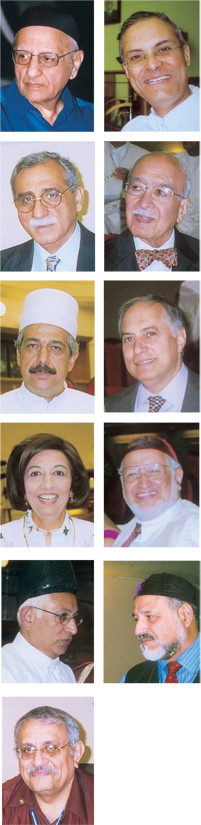
Clockwise from top L: Shroff, Mistry, Mehr, Bhiwandiwalla, F. Mistree, K. Mistree, Collector, H. Gandhi, Jungalwala, Niknam
and Rivetna
It was only when the Islamic Revolution in Iran in 1979 brought fleeing Zoroastrians to the door of the ZTFE (Zoroastrian Trust Funds of Europe) so that its managing committee found itself with the need to represent the interests of these people before the UK immigration authorities and elsewhere in Europe, that the necessity of a WB of Zoroastrians hit them. The WZO was set up, virtually overnight, with almost the same constitution as the ZTFE. Wealthy Iranians registering their gratitude for what had been done for them, donated liberally and after settling the displaced individuals and others in troublesome political straits, the WZO launched out on its many welfare programs especially for rural Zoroastrians in India, supported by donors now settled all over the world.
Though some anjumans and associations also became WZO members, everyone enjoyed the same one vote according to its constitution. This was not acceptable to the BPP (Bombay Parsi Punchayet) and the FPZAI (Federation of Parsi Zoroastrian Anjumans of India) but the WZO which now conceived of itself as a WB, was loath to change its constitution to accommodate their demand that representative organizations needed a different vote pattern and could not be equated with the individual. For long years this stalemate continued while Rivetna organized constitutional conventions and presented a variety of constitutional models. In 1991 it was even proposed to set up a World Council of Zoroastrian Federations, independent of the WZO, with FPZAI and FEZANA (Federation of Zoroastrian Associations of North America) as the founding members. It was rejected by the grassroots membership of FEZANA when put to the vote. They demanded one WB, not two.
Hence, when the current WZO leadership agreed to one WB with two independent arms at a meeting in Bombay in January 2003, everyone involved was elated. The momentum generated continued to the July 2004 meet in London when further breakthrough led to the formation of a group of 10 individuals, between them representing FPZAI, ZTFE, FEZANA and WZO, hereafter designated the G-10, converging, in principle, on the charters of the IZO, WZOI and WZOF.
It was against this background that the traditional lobby in India, led by Khojeste Mistree and supported by the High Priests, began a blitzkrieg that reached a crescendo with the disruption of the FPZAI meet in Ahmedabad in December 2004 and culminated in the formation of the World Alliance of Parsi Irani Zarthoshtis (WAPIZ) in May 2005.
The traditionalists have claimed that the Parsi/Irani identity will be destroyed under the weight of over two million converts to Zoroastrianism who will become members of the WB. It was stated that they will swamp our agiaries, atash behrams, housing colonies, hospitals, etc. The figure of converts was said to have been based on the World Christian Encyclopedia. The Encyclopedia cites no authorities for the figures of Zoroastrians and Zoroastrian converts that it quotes (see "2.5 million Zoroastrians?” Parsiana, May 21, 2005.) How do these converts (assuming they exist and want to) become members of the WB? The WZO membership is open to anyone professing to be a Zoroastrian, without reference to lineage. It was said that the WZO (and therefore, WZOI) allows non-Zoroastrian spouses and their children as members and because the WZOI sends an equal number of members to represent it on the IZO as the WZOF, a non-Parsi/Irani Zoroastrian can conceivably be president of the IZO, which means the WB of Zoroastrians.
It may be noted here that the constitution of the WZOF, which is the governing arm, explicitly states that it will not engage in proselytizing the Zoroastrian religion in any part of the world, nor will it act as a religious body in any part of the world. Its autonomy clause states, "Nothing in this constitution and by-laws shall be construed to impair the autonomy of participating federations, unions of associations… etc.” A "Not-withstanding clause,” said to be based on the one in the federal constitution of Canada, allows that if a member "perceives a decision by a specified majority to be detrimental to its purposes, objectives, values, etc, then the said member can invoke this clause in writing and opt out of the decision taken by the majority…” Section 4 of its constitution preserves and protects Parsi/Irani institutions from any attempts to compromise or undermine them which means that even if some of the more liberal members of FEZANA make demands inimical to traditional Parsi/Irani interests, they cannot succeed.
For reasons unknown all this has not been brought home to the grassroots community in India.
On the day designated for WB discussions, the floor was opened to Khorshed Jungalwala and Farrokh Mistree, two members of a special working group on the WB which had been constituted by former FEZANA president Framroze Patel. Dorab Mistry complimented them for having done an enormous amount of work, praising "the North Americans’ knack for research and study of issues,” cautiously adding, "If we’re not careful, the WB concept may be overtaken by something else.”
Accepting the communications facilities provided by modern technology, harkening to the community’s history "replete with individuals of tremendous courage,” Jungalwala suggested that the community learn from the work of international bodies like the UN, UNESCO, etc "to ensure the wellbeing of generations to come.”
Urging the audience to observe, reflect and articulate, F. Mistree defined truth as what is right for the community in the long run. Perhaps inspired by the British Library’s on-going exhibition on the Danish writer of fairy tales, Hans Christian Andersen, F. Mistree referred to the author’s famous work The Emperor’s New Clothes in conjunction with the WB. In the story the emperor and his cronies are gypped into believing that his near nakedness is clothed in the finest array until a little boy lets the cat out of the bag with the query, "Why is the king naked?” Perhaps F. Mistree was implying that the sponsors of the WB were "economical with the truth,” or perhaps that the constitution under attack was "something without substance.” (These were the two explanations to the story offered at the entrance of the British Library exhibition.) F. Mistree wanted "historians to recognize that the 8WZC left a legacy for future generations to emulate.” He made a special injunction in the course of his presentation to this reporter to the effect that she ensure that she presented a fair and accurate report. (Of course, sometimes what is ‘accurate’ may not be deemed ‘fair,’ but that’s another story.)
According to F. Mistree there are four options open to the community: to keep talking and attacking each other; to declare a moratorium on the issue; to seek a formal, structured concept; to look for new options.
According to Sarosh Collector, another member of the FEZANA special working group on the WB, "the three entities had to be compatible with each other.” The operational independence of the WZOI and the WZOF without the IZO’s "appropriate authority” left the trio resembling a spastic individual. "The head must coordinate the body…the WZOI and the WZOF must function as one WB in core issues, otherwise they are dysfunctional.” He sought a more equitable representation for the regions while maintaining that "representation based on numbers is flawed.” Collector also defined the concept of "emerging regions” to mean places like South Africa where the Zoroastrian presence has been historically known and not places like Tajikistan, Uzbekistan, etc. (This reporter could not find any mention of ‘emerging regions’ in the copy of the constitution available to Parsiana.) He echoed the normal traditionalist criticism that there is no definition of Zoroastrian in its membership clause. (As the IZO’s members are the WZOF and the WZOI and the WZOF’s members are the various federations and associations who have their own membership clauses, the ire of the traditionalists is seemingly directed towards the individual members of the WZOI. These, as noted earlier, are all who profess the Zoroastrian faith without reference to lineage. Hence this is an indirect pressure on the WZO to make more concessions.) In light of WAPIZ he suggested an increase in the G-10.
F. Mistree reverted with what he called "an honorable code of engagement.” At the personal level it meant recognition and acknowledgement of "differences in position;” respect and consideration for the views of others; a focus on issues instead of personalities and motives; to make no personal attacks and stop surrogates from doing so; make an honest response and not merely an agreeable one. At the organizational level he suggested transparency of procedures rather than "sethiagiri;” deals based on principles, not for the benefit of people in power; accurate maintenance of records and keeping the community informed; prompt communication and unemotional responses.
Additionally F. Mistree urged (everyone?) "to ensure that the Parsi Press is even handed in their approach and …stays focused on the issues and not target personalities;” recognize the good in all participants – "we are going to sink or swim together!”
Homi Gandhi, president of ZAGNY (Zoroastrian Association of Greater New York), had a few alternatives to offer: create a formal body of individuals and federations; dump this concept of two individual arms; host a socioeconomic forum with the federations and the World Zarathushti Chamber of Commerce (WZCC). Rivetna’s power point presentation — a mix of idealism and WB history — was followed by a well-deserved tea break.
Calling it a "historical moment because the federations and the WZO are on the same side of the table,” Mistry called forth the presentations from the stakeholders with the words, "Generosity is the first alternative. If we are generous towards each other we will make (progress).”
Referring to the WZO as a "robust” organization, recalling the contribution of the late Iranian philanthropist Mehraban Farangiz and philosopher-professor Kaikhosrov Irani, Prof Farhang Mehr, professor emeritus of international relations at Boston University and elder statesman of the community, declared that the WB’s chief objective is to address political need. "Only an organization can voice against injustice, discrimination.” Quoting former British Prime Minister Winston Churchill’s famous dictum, "democracy is not a great process but it’s the best we’ve got,” Mehr demanded greater respect for the decisions of the community’s elected representatives who have spent so much time and energy drafting the WB constitution, stating matter-of-factly, "nothing can be perfect.” Dismissing the bogey of two million Zoroastrian converts who will "marginalize” Parsi/Irani Zoroastrians as "fiction,” Mehr spoke of the change of law underway in the US where "even an immigrant can be elected president.” In the same spirit he advised the gathering to accept converts and "treat them as first class citizens. It is unfair, not Zoroastrian, to treat them as second class.” Then, remarking that Iran is a very important component of the community, he launched into a Farsi rendition to acquaint the Iranian delegation with the proceedings.
Emphasizing the "philosophy of autonomy” on which the WB constitution has been based, FEZANA president Firdosh Mehta noted with a trace of sarcasm, "It is accepted by the community when applied to themselves…it’s not so great when applied to others!” He pointed out that neither FEZANA, which unites the associations of two countries, nor the WB are "pontificating” bodies – they "do not promote one school of thought, do not decide who can or can’t be Zarathushti. That is left to the member associations on the principle of autonomy…The conversion issue is zero in the WB…It is primarily a community service organization. We elected leaders promise to trust and uphold these documents. Allow us to come up with documents to our satisfaction before we put them up for your ‘yes’ or ‘no.’”
WZO president Rustom Dubash admitted that some of its original concepts had become unworkable in the new context and hence they had agreed to their modification. However, the WZO enjoys a tax free status in the UK as a charitable trust which would continue to apply to the WZOI. "The IZO idea was to keep it simple…We saw the IZO as ‘speaking with one voice’ at the international level (as the community wanted). Now we are asked ‘Why equal voting rights (for the WZOI)?’ Let us put egos on one side and work for the global good. The WZOI constitution has received battering from various quarters. (The proportion of votes) for individuals has to be acceptable to the existing membership of the WZO. Now you are asking that only Parsi/Iranis be members of the IZO board on the basis of a scenario of thousands of converts converging on Bombay and depriving the Zoroastrians of India. Look at it logically. India has its own immigration procedures and legal rights of Zoroastrian bodies. IZO membership does not give any rights. Let everyone look deep into their conscience…To look at every single point to distraction is not the way. Have the courage of conviction and moral fiber. The time for talking is over. The time for doing is now.”
Speaking on behalf of the oldest Zoroastrian association in the western world, ZTFE president Dorab Mistry noted that the definition of its membership was the same as that of the WZO. "But we have succeeded in upholding the interests of Parsi/Irani Zoroastrians here. We recognize the need for a WB for political/economic matters where we need to speak with one voice. (We would) join the IZO in the firm belief that autonomy is strictly enforced. These are difficult choices. We need time, attention and consensus building. At the same time there is not the same enthusiasm for the WB here (as elsewhere). We can survive without it…We are proud to be partners, ready to find the way forward, but not in a hurry. Traditional minded people form a substantial section of our people. Let us take it forward with the necessary safeguards.”
Mistry further spoke of his experience as committee member and president of the ZTFE. Referring to "the huge influx of political asylum seekers in London,” he noted that almost every week there was a request to provide "the Book ( Khordeh Avesta)” by which many Kurds swear to be Zoroastrian and the ZTFE president is often summoned for consultation by the immigration authorities. "Soon, their numbers and ours will be the same. We are positive about the WB but the identity of our forebears must not be lost…”
Zoroastrian representative in the Iranian Majlis Mobed Koorosh Niknam described three types of Iranian Zoroastrians: those who preferred nationality over religion and adopted the new faith – today’s Muslim Iranians; those who preferred religion over nationality – the forebears of the Parsis; and those who had affection for both – the Zarathushtis of Iran today. "They have borne the brunt of trouble.” In the spirit of hamazori he requested that the constitution of the new body be translated into Farsi so that they can study it and make a decision. "Islamic bylaws may need to be considered. There will be certain formalities. It has to go through certain channels. It will take time. There will be delays.” Seeking a measure of social and religious assistance, Niknam noted, "We accept those as Zarathosti who are born Zarathosti. But Zarathushtra preached freedom of choice… At present there is an awakening of Zarathushtrian teaching. Many people would like to accept the Zoroastrian religion. After ascertaining that they are truthful and would truthfully follow the Zarathushti path, we should accept them. In the course of conversation Muslim ayatollahs ask, ‘How many Zoroastrians are there?’ I say two billion. How? If one acts according to the Good Mind and treads the path of truth. If not, even four billion Zoroastrians would not be real Zoroastrians!”
"We favor the formation of a truly representative WB, one that is perceived as a truly global one…Can there be a WB without India?” queried FPZAI president Minoo Shroff. Noting the convergence between the constitutions of the WB and the FPZAI, he stressed that all anjumans can seek advice and guidance without being bound by it. "Autonomy should be truly respected but trust and confidence are necessary. Our duty, reward, destiny is here and now. Let us propel our great community to loftier heights.”
Requested FPZAI honorary secretary Keki Gandhi, "We are all talking about autonomy, respect for other points of view. While our member associations are asserting their right to think for themselves, they are challenging the stand of other bodies. Let us work together on specific objectives. Why are we trying to tell our neighbors how to build their own house?”
"I feel I am in the lions’ den!” jested WAPIZ founder Khojeste Mistree. "You are privileged because you are having the last say,” bantered Dorab Mistry.
"The voice of tradition has not been given due credence. The High Priests feel that Parsi/Irani values are eroded,” complained K. Mistree. Speaking of "overt and covert conversion,” he stressed the importance of the "unity of ideology,” adding, "(That’s why) WAPIZ was created in five months…We represent thousands of members in 31 days… We believe we represent the voice of the community in India and across the world…You may find it comforting to include converts and non-Parsi spouses (but) it is important that the voice of tradition is heard and promoted to reinforce Parsi/Irani identity.” Referring to the 40+ small, hitherto dormant member anjumans who have registered a revolt against the leadership of the FPZAI, K. Mistree noted, "Each anjuman has a vote. Just because they are small doesn’t mean they have no say…Conversion is not permitted in Iran.” He seemed to imply that the Iranian government could review the right of the Zoroastrians’ representation in the Majlis because of the "extremely cosmopolitan nature” of the envisaged WB.
Noting that "the Alliance means friendship between Parsis and Iranis, fosters and increases the safeguards for institutions, gives support and strength to other organizations who believe similarly,” K. Mistree warned that "the converts are bringing in baggage from other religions. We are too small in number to accept such baggage…It is extraordinary that we are trying to create an infrastructure for those who are not even present here.” He also stated that "any WB needs to be headquartered in India.”
WAPIZ provides "the tightest definition of who is a Zarathushti. We have taken into account custom, usage and lineal descent…We have been faithful to the membership clause of the FPZAI,” claimed K. Mistree. Urging the acceptance of the opinion of High Priests and scholars, he added that his organization, Zoroastrian Studies, "has been friends to all…Worked extensively with the BPP. We want the BPP to be the strongest Parsi/Irani body in the world. We write articles for FEZANA Journal; likewise for the WZO when they want something done for the youth…”
Post lunch, for what was billed as the "Elevator Pitch,” the audience was divided into "breakout groups” to answer eight questions provided in the handouts. Specifically:
Should the G-10 be expanded to include other potential constituents?
What should be the principal functions of the WB?
What are the possible structures of the WB?
What key principles should underlie that structure?
The qualifications for membership of the WB.
What steps should be taken to form the WB?
What message should be sent to the framers of the constitution?
What are the elements of a code of honorable engagement for the community in general and people involved in creating the WB in particular?
An expansion of the G-10, at its discretion, to G-20 was mooted — on the basis of elected membership, not religious connection. Discussion of religion was to be kept out of the purview of the WB. It was advised to maintain itself as a socioeconomic entity, to provide information and contacts to the Parsi/Irani community and function on the lines of the World Bank. Emphasizing the spirit of cooperation based on good thought, word and deed it was suggested that the body work on the basis of consensus rather than democratic principles. There was no conclusion on the qualification for membership. The majority seemed to be in favor of incorporating Zoroastrians as well as non-Zoroastrian (spouses) of both sexes. The claim that "the tradition of 3,000 years should not be changed,” that there should be no discussion on conversion, also had its votaries.
It was recognized that currently there is lack of trust and goodwill. But if common social welfare issues are identified and worked on, if people reach out to understand through commitment, consistently using the term Zoroastrian, it would help establish common ground. It was suggested that the constitution of the European Union be explored as a model. People generally seemed to agree that a WB was needed for without it, the Zoroastrian voice will not be heard.
◆ ◆ ◆
From the archive