
Awards
Empowerment through education
Alongside the sixth Nani A. Palkhivala Civil Liberties Award, the eighth Memorial Lecture comprised Union Minister Kapil Sibal’s vision for a total change in India’s educational sector
"Nani Palkhivala was perhaps the most prolific contributor to public debates. His was a staggering contribution and range of subjects but education was closest to his heart and youth his preferred audience,” noted well-known auditor Yezdi Malegam, chairman of the Nani A. Palkhivala Memorial Trust (NAPMT) in his welcome address at the Eighth Nani A. Palkhivala Memorial Lecture titled "The emerging scenario in education” at the Tata Theatre on February 7, 2011. The lecture series in Palkhivala’s memory have been delivered by some of the finest intellects in the country. Malegam recalled how Palkhivala bemoaned the scant attention paid to education in the Indian national budget while in countries such as France the education minister ranked only second to the prime minister.
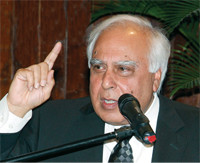
The day’s celebrated lecturer, the union minister of Human Resource Development, Science and Technology and Earth Sciences, Communications and Information Technology, laughed as Malegam introduced him saying, "Ever since Mr Kapil Sibal has taken over the education portfolio, a new wind is blowing which may blow away parts of the system itself!”
Noting that it was "time for the political leadership to put the facts out so we can face the challenges of tomorrow,” Sibal began with a few statistics: Only 220 million children — from a nation of 1.2 billion people — go to school. And only 13 million from among them (12.4 percent) reach college which he stated was a "frightening scenario… For any developed country, the gross enrolment ratio in college between the ages of 18 and 24 years is anywhere between 50 to 70.”
The wealth of a nation does not depend on bank balances, exports or fancy infrastructure but on intellectual capital created by the university system, he noted. Wealth grows through research which leads to improvements in goods and services and thus to national wealth, he maintained. In developed countries, for every million members of the population, there are 4,700 to 7,000 individuals engaged in research. In India, Sibal said, the comparative figure is 176.
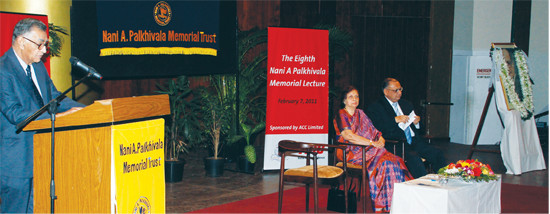
Top: Kapil Sibal; Above (from left): Yezdi Malegam at the mike, Sujata Manohar and Homi Ranina
Noting that the distribution of power is unequal in every society, it was Sibal’s argument that empowerment proceeds from wealth, access to schools or access to resources. For India’s marginalized millions, the only access to power would be through education. Hence, he maintained, the Right To Education (RTE) Act focuses on those at the bottom of the pyramid: to get all the disempowered into the school system, ensure their 100 percent retention through all the years of school, so that 80 percent of them could go to college. Additionally, his concept of empowerment requires schools of excellence to absorb up to 25 percent of their students from among the marginalized.
"It can’t be enforced overnight. We are giving ourselves three years for the implementation of the RTE,” five years for training an adequate number of teachers. "We need the cooperation of the key players (in the system) — state governments, teachers, parents, students, civil society. It is a national priority that needs national effort. Even the political establishment understands the importance of this endeavor.”
For this effort to succeed, "we need to change the way we teach,” said Sibal. He focused on the need to change the relationship between teachers and students: "For the last 60 years we have been foisting textbooks restricted to the four corners of the system. You get educated when you relate to the world outside the classroom.” In the process of seeking "solutions for tomorrow,” the minister noted that the teacher is "no longer the repository of knowledge. The teacher needs to be a collaborator in the journey of the child; it needs a different discourse.”
Emphatic that each child has genius, Sibal was categorical that "the teacher needs to awaken that genius” by comprehensive and continuous evaluation of the child’s interests, be it music, mathematics, literature, arts… "We have democracy in the political sense, but real democracy is freedom in the classroom!... It is about time the educational system is based on what children want, not what the political establishment wants. Access to the best education should be made available to the disadvantaged.”
Sibal spoke of the information revolution in the outside world, how the discovery of the computer "mouse” changed the way the world communicates, trades, rendering the world a truly global village. This global enterprise now needs to be garnered in terms of education. "We will connect every college and every university in India (currently 26,000 colleges and 800 universities) through fiber optics so that students can access lectures elsewhere. The more choice they have, the more empowerment. Give them mathematics and music… physics and literature. Nani was a man of literature. He kept you spellbound by his knowledge of literature!”
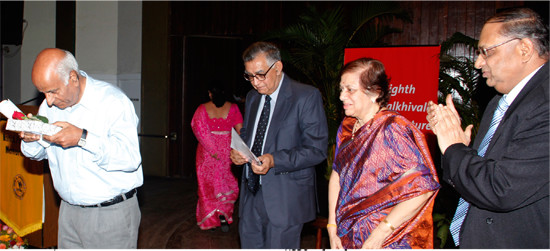
(From left) Chaman Lal acknowledging the Award with Malegam, Manohar and Ranina applauding
Noting that course content has to be created, Sibal spoke of "changing the discourse. Today knowledge is created at the cross-sections of disciplines, in hospitals and medical universities, mathematicians, physicists and biologists are working together.” For such a multidisciplinary approach we need a flexible university system, we need to change the administrative structures. And there, he acknowledged, lay the first hurdle: the fact that a large number of politicians own educational institutions and they are averse to change. "This is standing in the way of reform but it is a national battle we have to fight, to ensure the uniformity of quality.”
Sibal said he was fighting for the semester system to be embraced by everyone "because without it there can be no flexibility, no choice. Administrative systems at the state level need to be (put into a mode) that allows the student to access and discard what s/he wants. We want to increase the 12.4 percent going to college to 30 percent by 2020. We’ll get a critical mass because of the size of our population: the numbers will increase from 13 million to 45 million. But we also need to create the facilities to meet that demand… In the next 10 years we shall need an additional 50,000 colleges and 1,000 more universities.”
With proliferation will also come a large number of disputes, requiring a redressal system. "As a nation we love to run to court, argue endlessly.” According to Sibal the next bill to be cleared by the union cabinet is the Educational Malpractices Bill. Capitation fees hitherto were the result of the demand and restricted supply position that Palkhivala had spoken about a long time ago in terms of the economy at large, Sibal noted. "We couldn’t have imagined the India of today before 1991 (when the Indian economy began to open up). We face the same position in education. Everyone can’t afford the capitation fees which exist because of restricted supply. The sector needs to expand exponentially; but we need to change the licence raj. We have to get in the private sector because no government is capable of doing this.”
Providing a glimpse of the administrative changes required, Sibal referred to the existing system of inspections of educational institutions and the corruption that leads to inspectors approving institutions that do not even exist. "We don’t want rented faculty. We want the educational institutions to disclose their faculty, fees and facilities on their website at the beginning of the academic year… If and when we find any fact is wrong, we shall prosecute,” he outlined the new administrative system envisaged.
Hence, the third bill on education, to ensure the quality of every educational institution, is the forthcoming Accreditation Authority Bill, Sibal told the audience. So far accreditation is voluntary; after the bill is passed it will become mandatory. He wants to ensure that the student will then be able to, electronically, "walk through every institution before joining and choose where he wants to be.”
The Foreign Educational Providers Bill will increase collaboration with foreign universities, help establish superior practices in the field of education.
What happens to the balance of the children after 45,000 or 30 percent go to university? They will need a job and the National Vocational Qualifications Framework is expected to provide them with the necessary skills in industries such as hospitality, paralegal, paramedical, music, tourism, simple mechanics, simple electricals, et al, with the collaboration of the industries concerned. Courses in animation — because Bollywood needs such people — have already begun in 26 institutions across the country after a long discussion with film producer Subhash Ghai, he noted. According to Sibal, a discussion with the automobile industry representatives has revealed that that sector alone will need 150 different courses. So also the telecom sector and construction sector which the Prime Minister has said will see an investment of five trillion dollars in the next five years. "The idea is to ensure that the educational system provides people that the industry wants.” But also on the anvil is the aim to enable interconnectivity between the polytechnics and academe so that there is freedom for the student to change course if s/he so desires, for a university student to also develop a skill if s/he so wishes and get additional credits for it.
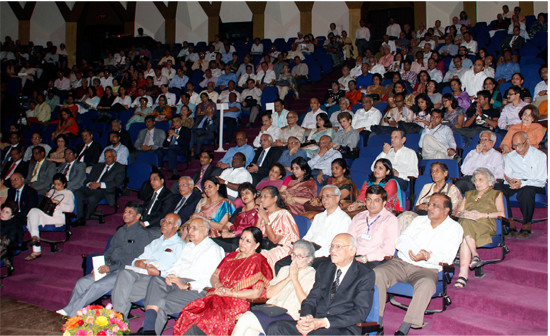
A rapt audience at the Tata Theatre
By 2050, when all the developed countries of Europe, Australia, Canada, Japan will be facing a demographic decline, India will be the most populous country in the world and hence a source of workforce for them. "Foreign investors and universities want to invest here because they will need the workforce,” concluded Sibal, adding, "This is the philosophy of the UPA (United Progressive Alliance) government in education, because you can’t move forward without investing in knowledge. The basic philosophy is that every child is important, " said Sibal referring to an episode when Palkhivala was a child. His father gave him a bowl of almonds , telling him to share it with the orphan next door. "Nani gave it away to his neighbor. Like Nani we, who have the bowl of almonds, need to give it to those who don’t. Education is the way to do it.”
Sibal’s impassioned extempore oratory — the former senior advocate of the Supreme Court referred to no notes — struck a resonant chord with the audience which rose to its feet in loud and spontaneous applause.
In his vote of thanks for "one of the most potent speeches on the subject of education,” well known lawyer and NAPMT trustee Homi Ranina noted, his uncle "Nani Palkhivala would have been delighted. He used to say, education is that which remains after what you have memorized is forgotten!”
NAP Civil Rights Award
"When institutions are crumbling because of corruption, the nation looks to individuals… Mr Chaman Lal belongs to this category,” retired Supreme Court judge Sujata Manohar, one of three former judges of the apex court who constituted the jury that selected the winner of the sixth Nani A. Palkhivala Civil Liberties Award, spoke on behalf of her colleagues Sam Variava and Manepalla Narayan Rao Venkatachaliah.
A professor in a postgraduate institution ere he joined the Indian Police Service, the citation credits Lal with helping K. F. Rustomji to establish the Border Security Force, the largest para-military force in the world. As its deputy commandant he played an important part in the modernization of its systems, further notes the citation read by Ranina.
As Officer on Special Duty in the Shah Commission inquiring into the Emergency excesses in 1977 and also in the investigation of MISA (Maintenance of Internal Security Act) cases which affected both politicians and officials, Lal visited jails and submitted reports on undertrials and convicts and their conditions, as he was concerned for their civil liberties, notes the citation. Deputed to the most challenging tasks such as being actively involved in the fight against terrorism, he emphasized the need to work within the framework of the Rule of Law, ensuring that the rights and civil liberties of citizens are protected and preserved, earning the Padma Shri in 1988.
As Director General of Police for three years in insurgency affected Nagaland (1993-96) Lal’s careful handling of civil rights and liberties earned him the sobriquet ‘honored DGP with a difference.’ After his retirement, the Prime Minister Dr Manmohan Singh presented him with the Friend of the North East Award. Since 1997, for 11 years, Lal served as a special rapporteur for the National Human Rights Commission on a token salary of one rupee, working in the interests of bonded labor, child labor and displaced tribals, promoting human rights and literacy.
Currently involved with the Centre for North Eastern States, which provides health care in 10 districts of Assam, Lal reviews the work being done and assesses its impact to ensure that the benefits reach those intended.
The NAP Award consists of a citation and a purse of one lakh rupees.
"Civil Liberties are a part of constitutional rights but they are also part of life — a life of dignity, not mere survival. Freedom from fear, freedom from want are interrelated and interdependent. People need both, bread and liberty,” responded Lal in his acknowledgement of the award and more specifically being "linked to a great patriot and human being like Nani Palkhivala.” To him, the presence of the NAPMT was a "sign of the health of civil society…when so many in government and business question (the importance of) civil rights.” He said he believed that when there is lifelong condemnation to poverty and hunger, the state should be accused as a killer in famine deaths.
Noting that the concept of eco-political and social rights posed a challenge to a police prone to custodial violence, Lal rued the new mindset in society, the apathy and questioning of civil liberties in the context of left wing extremism. "The founding fathers did not consider national security and human rights as incompatible. But human rights workers and RTI (Right To Information) activists are in great danger as they make the state uncomfortable. There is a mismatch between the fast growing awareness of human rights and the slow realization of human rights in state agencies,” he noted, acknowledging a debt to Supreme Court Judges Venkatachaliah and Jagdish Sharan Verma who had spearheaded judicial activism in the cause of human rights and to mentor and former top cop Julio Ribeiro, the epitome of a "non-partisan, efficient policeman” in the Indian context.
◆ ◆ ◆
From the archive