
Cover Story
Accepting the challenge of change
The Gandhys of Gallery Chemould have been witness to the changing world of Indian art for 44 years
A generational change distinguishes Chemould Prescott Road from its predecessor on the first floor of Bombay’s Jehangir Art Gallery. There is no dearth of space here compared to the cramped 800 square feet of gallery space where it had functioned for 43 years since 1963. Huge picture windows look out over the Fort precinct, as against its totally enclosed, windowless former existence. And a new approach characterizes its presiding deity, Shireen Gandhy.
Though Shireen has been in the van of Chemould’s work for nearly two decades, the old Chemould Art Gallery was part and parcel of her parents’ life. "I really miss that gallery. Here we feel very isolated,” Khorshed Ghandy is unabashedly nostalgic but resigned to changes that life brings. Parsiana spoke to both generations to briefly chronicle the changes in Bombay’s art world.
"For 35 years we had no need for larger space,” notes Shireen. "The low point came when we realized that artists are getting ambitious. (Their canvases) are too large for us to show. Relations with artists take a long time to build. We have a very personal engagement with each artist. When a relationship breaks, there are many repercussions. If an artist in your stable is not showing with you, it makes others in your stable question the gallery,” she notes, emphasizing the "all-encompassing” quality of the relationship between artist and gallery, the mutual pride and satisfaction that characterizes it.
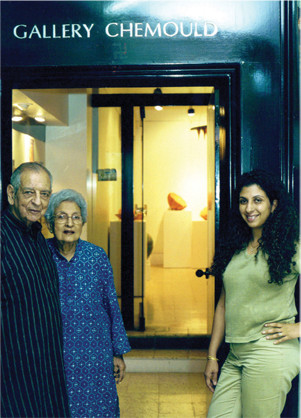
(L to R): Kekoo, Khorshed and Shireen gracing the Gallery’s portals
Recalling the time when they were struggling in "little space” barely a year ago, she speaks of how artists are always in command and the rivalry between Chemould and the Pundole Art Gallery: "(When M. F.) Husain moved from us to Pundole, we decided to meet the challenge. For two-and-a-half years we’ve been looking for a place…It’s very easy to slip when you are on the top of things. There are (now) new people on the block. We have to match up to the challenge. Now I feel we have the place and position and confidence of the artists I show. I know exactly the artists I’d like to show. I am extremely choosy. I have a huge confidence in what I am doing now.”
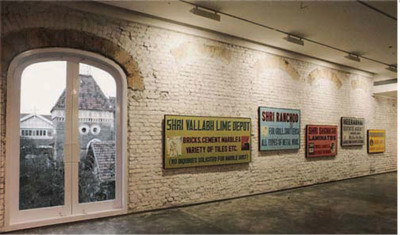
Above: A view of the Fort pre-cinct from the Gallery
Shireen speaks of the multifaceted role of galleries in promoting and sustaining art, showcasing the artists, projecting the work, helping them financially to find good studio spaces, providing the funding for an artist to participate in an international viewing exhibition like a biennale. The work is conceptual: "I can’t say how I am going to benefit. I have to be willing to take risks…If (an artist) is seen in a biennale, for example in Sydney or Venice, (he/she) is on a completely different level. (He/she is) perceived as internationally recognized. Artists are so busy, compulsively working from one project to another.”
That there is a growing market for art — much bigger than ever before — is part of the current data. Bankers have a better understanding than others who buy for the sake of investment, she concedes. But "you have to have some sort of passion. I can’t understand or deal with someone who only buys for investment,” says Shireen, adding that she doesn’t encourage such people because she views it as disrespectful to the artist. She talks to us about ‘art funds’ — like mutual funds — which she doesn’t support though she has been invited on their board to help choose. "I feel it would be something wrong for a ‘galleryist’ to be involved in an art fund.”
Asked about the advent of international auction houses in the field of Indian art, Shireen states, "They have changed the pitch.” She tells us about Saffron Art, an auction house where bidding is online so the "playground is unlimited. A crazy number of people are buying art internationally. It has changed the way pricing is done!” And it would seem that the quality of the painting is not the deciding factor. "Galleries remain the point of exhibition for an artist. Galleries are vital. Auction houses are secondary. Artist and gallery are in constant touch. Auction houses are not. You shouldn’t undervalue the position of the gallery,” she cautions. Having said that Shireen is quick to qualify: "We’d like to have more clients but we can deal only with a limited number — as also artists. We give preferential treatment to certain clients because they support the gallery and (the gallery) supports their collection.”
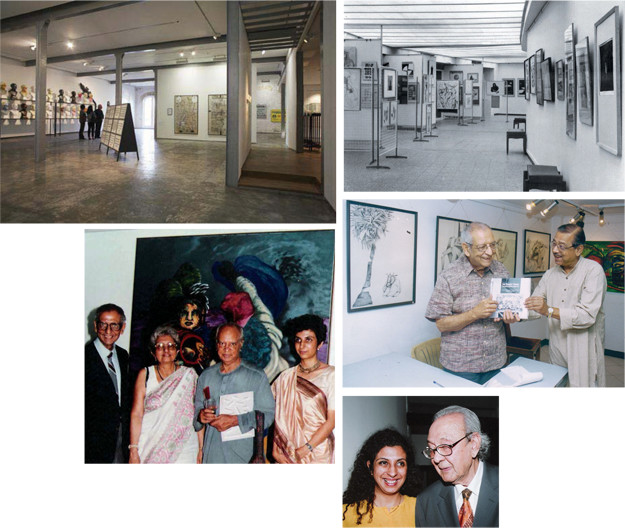
Clockwise from above: Chemould Prescott Road; Kunika Chemould c 1960; Launch of The Perfect Frame at Calcutta Chemould; Shireen with Raza; the Gandhys with Mulkraj Anand
Are there too many art galleries in Bombay now? we wonder. "There are less than 10 good ones in Bombay…Each one has a place and is doing its own thing. There are 20 times as many in London or New York,” she points out, adding that the museum culture abroad makes for a larger viewership. In contrast the Indian scene boasts of no contemporary art museum to buy and back up the emerging artists, nor are there enough publications devoted to art.
Chemould Prescott prides itself in having an international presence in art fairs though their national presence is largely limited to the three metropolises of Bombay, Delhi and Calcutta. "We don’t have the wherewithal to do it on a regional basis,” explains Shireen. But when it comes to mounting an exhibition, there are no holds barred to building new walls, painting them suitably, providing the lighting, publishing a catalog. It takes anywhere up to two years to complete the job. And, starting with Mehlli Gobhai’s very successful exhibition, the paintings were accompanied by music in association with the Mehli Mehta Foundation; an innovation that Chemould would like to repeat again and again. "The art gallery is for people to come to, a cultural addition (to the social life of the city). It is not enough to just build a clientele,” she affirms.
Shireen’s confidence, rooted in her own experience and in that of her family, raises the question whether dealing with artists requires a special skill, whether it is intuitive or can be learnt. "Not just anyone can do it,” she admits with candor, adding, "Today in art you need money, but not money alone.” One needs to understand what makes artists tick, deal with their easily wounded egos. They work in studios; have no concept of presentation. "Each one is so idiosyncratic…Even a joke can be badly misread. You have to be a boxer with kid gloves,” she laughs.
Though she did not mention it to Parsiana, saffronart.com refers to her degree in arts management from an institution in London. "Shireen describes the basic task of the gallery owner as separating the wheat from the chaff. Quality, more than an adherence to a certain school or philosophy of art, determines what is shown at the Chemould,” notes the website. "My special interest lies in projecting works of artists who are working in alternative mediums, who are taking risks and doing work that is outside the framework of the canvas,” it quotes Shireen. "Under her guidance, the gallery has continued to advance Indian art around the world. Shireen has collaborated with major museums to coordinate the participation of Indian artists in international exhibitions in South Africa, Australia and the US,” adds the website.
What she is not so confident about is the current social culture of mob censorship. The artists have no political backing so they have become soft targets, the gallery owner told Parsiana. Describing Husain, who has been targeted by communal philistines for his painting of Hindu female deities and so lives in exile, as "deeply knowledgeable, interested in all religions and completely misread,” Shireen assesses him as "the greatest Muslim artist of our times. (But) he is a sitting duck. It is shameful on the part of every Indian who doesn’t support him.” An equally grave incident had occurred in Baroda recently where the work of some student artists had been reviled on grounds of religion and/or decency. "It aims at the control of young minds. It could spell the death of creativity,” she rues.
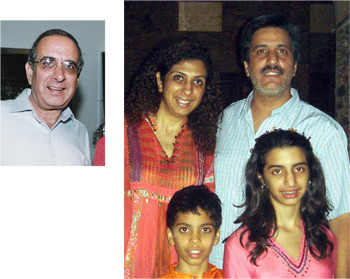
Right: Adil Alongside: Shireen with husband Kurush Jungalwala and kids Aarish and Atiyan
A historical perspective
Khorshed and Kekoo Gandhy tenderly recall the birth of the informal gallery at their frame shop on Princess Street where young and then largely indigent artists like Husain, S. H. Raza, K. H. Ara would leave their paintings in Kekoo’s care for a suitable frame. Kekoo made it a point to put them on display for the benefit of his well-heeled clients who came to find frames for their own pictures and photographs. A regular visitor was nuclear physicist Homi Bhabha, himself a painter of renown.
"At that time Roshan Kalapesi was looking after the shop. She got us more and more in touch with artists. She would show the paintings by the young artists — Husain, K. K. Hebber, Shiavax Chavda — to the clients. Her eventual destination was the crafts of India and with Kamaladevi Chattopadhyaya she formed the Paramparik Karigar (an organization for the promotion of Indian handicrafts),” recalls Kekoo who recently won the Lalit Kala Akademi’s prestigious Kala Ratna Award.
Kekoo himself has a strong commitment to the marketing of Indian handicrafts. Recognizing that "paintings have no relation to the common man but the crafts of India and Pakistan are recognized all over the world,” Kekoo says he has tried to develop its strong points. "Today five to 10 percent of the rural population are craftsmen. We could reverse the (urban) migration and they could continue in the rural areas if we market them better…I am part of the international Rotary movement. I have decided to market the crafts of India and use this international network. It is still in the thinking and planning stage,” notes the octogenarian.
In her book The Perfect Frame: Presenting Modern Indian Art Karin Zitzewitz, a Fulbright scholar and PhD candidate in the department of anthropology at Columbia University in New York, speaks of post Independence concerns that characterized the art world of the1940s and 50s in India and specifically in Bombay: "Independence offered a unique opportunity to recreate all the aspects of a new nation, including its modern art…The giddy energy of the times fills their frames…With his combination of unbridled energy and administrative and diplomatic skills, Kekoo Gandhy came to the center of the Bombay art world in the 1940s. (He) also represented Bombay and Bombay artists in Delhi and Calcutta and, later, in several international exhibitions.” The book was published by Chemould Publications and Arts in celebration of the art gallery’s 40th anniversary.
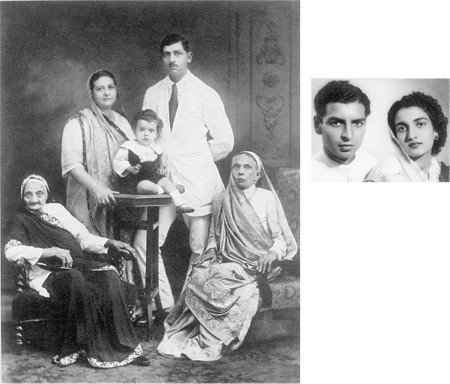
Left: Five generations of Gandhys including baby Kekoo Left: Kekoo and Khorshed when married
There are two types of galleries, Khorshed informs us: "a hiring gallery where you hire a room and the artist does the rest; and a sponsoring gallery where the artist only provides the pictures but everything else is done by the gallery.” Soli Batlivala, then secretary of the Jehangir Art Gallery asked Kekoo to start a gallery in Bombay on the first floor of the Jehangir. "It was then just a dark passage with no ventilation.”
"We got hold of two young architects — the fledgling firm of Desai and Aria — to air condition the place. It took them nine months. Jal Aria is a perfectionist to the last degree. The gallery opened in September1963,” interposes Kekoo. The Gandhys’ third child was 12 years old and Khorshed felt she had nothing to do and though she says she didn’t know much about contemporary art then, Kekoo recalls, "We enlisted her.” "It was quite interesting to discover new artists, travel to Abu, Baroda, Delhi. Raza would come from Paris and have an exhibition with us…” Khorshed remembers the high points. In 1964 Shireen, their fourth child, was born. "She was ready to take over when I was ready to give up,” smiles the mother.
The sponsoring gallery that Kekoo, then very involved as secretary of Bombay Art Society, founded on Park Street in Calcutta in 1952 — a branch of Chemould Frames which continues to serve as shop cum gallery — was inaugurated by the Prince de Ligne, the Belgian ambassador to India. The inaugural exhibition designed by a leading architect of Calcutta comprised a group of Bombay artists and prime Bengal artists like Jamini Roy and Paritosh Sen were present at the show. Kekoo says he had a special attraction for the artists of Calcutta and was very touched when Bikash Bhattacharjee published a book before he died and had it released by Kekoo. "When he exhibited here, he stayed with us. He had a doll that appeared in 30 to 40 of his paintings — the best period of his life,” notes Kekoo. "Today he is a very big name.” Ketayun Saklat in Calcutta had helped him a lot initially; sadly, he made no mention of her contribution in his book, notes Kekoo. Saklat had worked for Chemould in Calcutta for a while. Now she has an art gallery of her own, he adds.
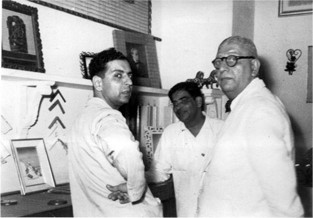
Kekoo, Minocher and an employee at an early exhibition at Chemould Frames
Delhi had its own art gallery, the Kunika, in the Cottage Industries Emporium. The Emporium had been funded by the Ford Foundation initially and its grants continued over a period, Kekoo informs us. At that time Richard Bartholomew, a man who made a mark as an art critic, was in charge, collecting paintings for the Kunika. On his departure the Cottage Industries board invited Kekoo to take on the Kunika as an art personality in whom the public and the artists had confidence and the Kunika-Chemould Art Centre was born.
A query about Parsi painters brings Jehangir Sabavala to Khorshed’s mind. "He always needed more space. We showed him at the Jehangir Art Gallery and at the Museum’s Coomaraswamy Hall. He is in a class by himself — so meticulous even in regard to the (pre-exhibition) publicity. I have not seen anyone so meticulous. It is a pleasure to work with him.”
The Gandhys are to the manor born. Kekee Manzil where Kekoo was born in 1920 has been host to international diplomats, artists of every hue and, during the war years and immediately after, to prisoners of war held in the barracks nearby. Their son Adil now manages the frame shop on Princess Street, a victim of the city’s sinking infrastructure with its choked drains and overflowing gutters. Their daughter Rashna, a psychologist by profession, is married to a Swiss national. The nuptials had evoked opposition from the elders in the family initially, in this case Kekoo’s father Minocher, until he realized that the individual in question was beyond reproach. Kekoo and Khorshed never wanted to lose their daughter in any case, the latter now notes. Behroze, the third born, has become a film producer and lives in London.
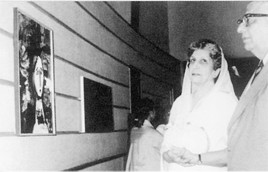
Lady Hirabai Cowasji Jehangir and Minocher Gandhy at the inauguration of Gallery Chemould in 1963
Their extremely cosmopolitan existence has endowed the Gandhys with a liberal frame of reference. Khorshed refers to the community divide on the dakhmas as "foolish.” And yes, they will certainly come to exercise their vote when it is time to elect the new board of trustees of the Bombay Parsi Punchayet. She voices the concern of the majority of the community when she adds, "Who the trustees will be is very important.”
The parting from the Jehangir has been a blot on an otherwise gallant innings for the Gandhys. It was the end result of a case that began in 1980. "The Museum said the Jehangir was built on government land and they put up a fantastic rent with a huge retrospective amount,” says Khorshed. The Gandhys opted to leave as part of a compromise arrangement. The change of venue has underlined the change that has simultaneously affected the art world. "The price of paintings has escalated. Someone sold a Husain for Rs 3,500. I sold it for Rs 5,000. Today it is valued in lakhs, crores, because of auction houses. Young artists become millionaires in no time. It affects their nature. They were previously so simple. Now they are so uppity!”
Usually a gallery charges 33 percent as commission, says Kekoo who has worked the old way and disdains the new materialism. "We really took on the artists. They would stay with us; we’d speak about them from our hearts, because we only took on those we liked. They would come to Matheran, enjoy life with us. Now, if an artist is successful, another gallery would offer more. It becomes unpleasant when money becomes the criterion, when an artist switches over... We would offer shows in other cities …I am glad when our artists are loyal to us. When you become business partners you don’t become disloyal. Good business people are partners for life. "
◆ ◆ ◆
From the archive