
Business
Worldwide connections
The World Zarathushti Chamber of Commerce holds its first ‘virtual’ annual general meeting in its 10th year to overcome difficulties in travel
It was the first AGM (annual general meeting) of the World Zarathushti Chamber of Commerce (WZCC) to be held via video conferencing. Using the 21st century face of technology, the Internet, WZCC brought together the global and the local on April 30, 2011. WZCC office bearers, directors, chapter chairs and members scattered across the world came together in a ‘virtual’ meet, participating in the proceedings or watching seated at different centers — Tehran, Bombay, Poona, Houston, Chicago, New York, London… Due to some technical glitches the video element was missing in some sections but the audio system worked well.
"As decided at the last AGM in Dubai (held on December 29, 2009), many of us were looking forward to meeting in Tehran, the place of our Zoroastrian moorings. However, circumstances willed otherwise. As a result of the dramatic change in the international scenario, almost all the directors expressed their genuine inability to attend the meeting,” WZCC world president Minoo Shroff had stated in his president’s report 2010 circulated earlier to all chapters. As an alternative, Shroff and his colleagues had "willingly offered” to host the AGM in Bombay under the auspices of the Iran chapter of the WZCC. "However it was ordained that the AGM should be held in Tehran and so it will be. However we will all get linked up electronically…” Shroff stated.
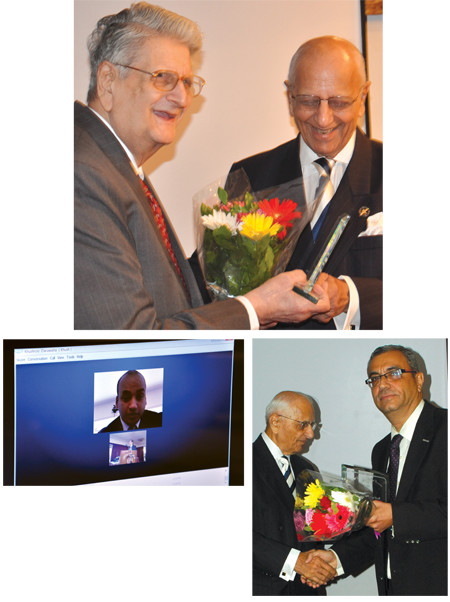
Top: Dr Keki Gharda (left) receiving the Outstanding Entrepreneur award from Minoo Shroff; (left) Khushroo Daruwalla on the video screen from London, Dr Firdos Shroff (extreme right) receiving Outstanding Professional award from Shroff Photo: Noshirwan Mistry
Shroff spoke about the efforts of the Bombay chapter to encourage entrepreneurship. "I have heard cynical comments, that this is not the right time, after recession. But this is the best time to make youth self-reliant, except that entrepreneurship is not an easy ride. But we have gone over the humps and we underline that it can be successful,” he noted. Cyrus Bagwadia, head of the India Chamber, was the prime mover of the Entrepreneur Development Program and other chapters could profit from his expertise, Shroff added. "I often get the impression that our activities are conceived by many chapters as India or Bombay centric. Bombay happens to be the real hub of Zoroastrian enterprise. It has provided the enabling environment for many of our community enterprises to grow, blossom and some of them to be recognized globally… Our object was that Bombay should serve as an incubator and a model for other chapters to emulate,” the president declared. The WZCC is a community endeavor. Members get out of it in proportion to their inputs in terms of time, experience sharing and motivation, he emphasized.
Vice president Rustom Engineer spoke about the economic hardships in the year 2010 and the domino effects of the economy in the US. "Several small business owners saw a marked decline in their revenue and some of our professional members even lost their jobs. The housing market also continued to see record foreclosures and the mood in general was grim,” he described in his report. While some chapters reported little or no activity, "chapters like Houston and New York continued to provide leadership with their strength and momentum to the WZCC organization.” Engineer commended the Bombay and Poona chapters and advocated the strengthening of less active chapters worldwide. "Our admiration goes to the WZCC Iran chapter for having put together a sizable body of Zarathushti business and professional leaders in record time and be prepared for the WZCC AGM. It is regrettable that, due to circumstances beyond our control, many board members could not be physically present. Necessity is the mother of invention and we are proud to hold the first virtual WZCC AGM,” Engineer asserted.
Treasurer Framroze Patel’s financial statements for the year ended December 31, 2010 had been sent earlier to the chapters. "WZCC support comes primarily from individual donors and its affiliated chapters located in North America, the Indian sub-continent, Australia and the Middle East. The individual chapters are self-supporting entities,” Patel noted. The WZCC is a not-for-profit entity.
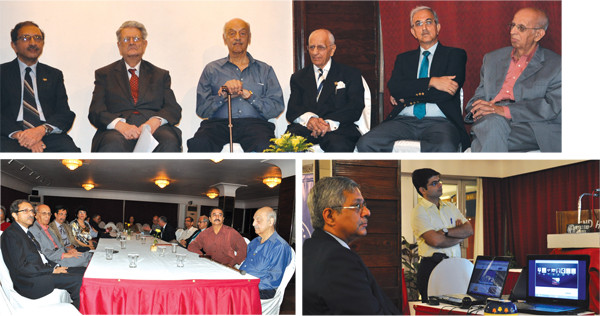
Top row (from left): Farrokh Rustomji, Keki Gharda, Bomi Boyce, Minoo Shroff, Kersi Limathwalla and Minoo Mody; Second row: WZCC members at the West End Hotel, Yazdi Tantra and Maher Dhamodiwala
In her written report, WZCC corporate secretary Behroze Daruwalla stated that last year the worldwide membership numbers dropped to below 1,000 though the figure had been over 1,000 the previous year. "Membership in certain chapters in the USA dropped due to the low economy and recession although their membership fees were deferred as all interested professionals and entrepreneurs were allowed to attend their functions,” she explained. As secretary, Daruwalla went systematically through the agenda, inviting speakers from the various centers to come in with their observations. Iranian members experienced some difficulties in communication, due to occasionally unclear reception and the complexity of the English language. While the WZCC constitution allows resolutions and proposals by e-mail, the holding of board and other meetings by video conferencing might require a change in byelaws, Daruwalla stated. The selection of the location for the next (2011) AGM elicited some discussion, with Singapore, New York and Bombay being suggested as venues. Eventually, it was decided to hold the next AGM in Bombay, the exact date to be decided later.
Priority was also accorded to the selection and subsequent appointment of a paid administrator who could enhance the coordination and working of the WZCC worldwide. Such a person would be a "global supporter and connector” and could be based anywhere in the world, said Zareen Karani Araoz, director for global and external relations, seconding WZCC founding president Rohinton Rivetna’s proposal. It was decided that the Awards process would also be revamped and revisited.
The WZCC is soon to bring out a brochure, delineating the progress and incorporating as much information as possible from the chapters. Technical director Yazdi Tantra has placed all reports on the website www.wzcc.net as also the WZCC magazine SynergyZ, and newsletters. "The Facebook page of WZCC continues to grow, with more than 850 persons actively participating online. It is an open group — just search for WZCC on Facebook and join online,” Tantra reports. "Part of the program (AGM) was also broadcast online although the quality was not so good,” he says. Queried as to why the video conference experienced some problems of audio and video, Tantra replies: "The major difficulty was to get everyone to understand the peculiarities of the medium and ensure discipline in terms of keeping their microphones off, not speaking out of turn, etc. Some locations had technical bandwidth problems which were beyond our control.” Since most of the participants were connecting from their home computer, bandwidth problems came into play. "At our end (seated at the West End Hotel in Bombay from where he was coordinating the conference) we had ensured high speed 3G broadband, which made our transmission and reception seamless. Yes, they could see us, but they could not switch on their videos to conserve bandwidth,” Tantra explains. All this had to be achieved on a minimal budget. "There are other solutions available which are very expensive and unaffordable at this juncture. Hopefully, we will be able to surmount those problems next time,” the technical wizard adds.
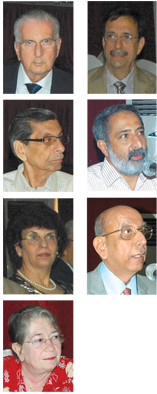
Clockwise from top left: Pheroze Kharas, Cyrus Bagwadia, Shavak Bhumgara, Adi Siganporia, Zarine Khan, Zarine Commissariat and Adi Engineer Photos: Noshirwan Mistry
Visible recognition
The AGM was followed by the presentation at the West End Hotel of the WZCC 2010 Recognition Awards to two of the awardees — Dr Keki H. Gharda as Outstanding Zarathushti Entrepreneur and Dr Firdos T. Shroff as Outstanding Zarathushti Professional. The third recipient, Khushroo Boman Daruwalla of London, would receive his award as Outstanding Young Zarathushti Professional/Entrepreneur at a function in London in May. Speaking to the AGM briefly on Skype, Daruwalla thanked the judges and all members for encouraging the youth of the community and for the inspiration they provided.
"I work because I enjoy what I am doing and I don’t care whether I am successful. I am one of the most unstressed people I have ever come across!” quipped 81-year-old Gharda, chairman and managing director of Gharda Chemicals Limited (GCL). Valued at around Rs 1,000 crore, GCL has about 1,700 employees and four manufacturing plants in Maharashtra and Gujarat. Gharda had set up his business as a small unit way back in 1964 on his return from the US with a Master of Science and PhD in chemical engineering. The company’s strengths have always been the manufacture of innovative products — agrochemicals (insecticides, herbicides and fungicides), intermediates, veterinary drugs, high performance polymers, etc.
Feisty and known to speak his mind, Gharda laced his speech with his own brand of humor: "Lend me your ears because you are not likely to give me your money! I came from a poor to middle class family. We had enough to eat… you can see the residual effects even now (referring to his lean frame). ‘Successful’ is an interesting phrase. Success is minimizing risk by careful and selective action. But a successful entrepreneur can blow all the money he has made! I started Gharda Chemicals in a shed, with a drum as a desk and a carboy as a seat — not an assured way to success.”
Firmly believing in developing technology indigenously right from the stage of ideation, Gharda gave multinationals like Bayer a run for their chemicals! He described his earlier years: "They (Bayer officials who came to see his set-up) came to scorn and remained to praise… I’m slightly crazy; I’m keeping in character (of the Parsis!) Being honest is a personal choice. I think it’s weak to cheat. In these cheating times what’s a 1,000 crore turnover – it’s peanuts. At 10,000 crore it might be respectable, on 100,000 crore enviable! I see people (in the audience) opening and closing their eyes. Keep your eyes closed. I will close before you throw bottles or glasses of wine at me!”
Gharda, the scientist, and his company, have received a slew of awards over the last 40 years — the Chemical Pioneer Award from The American Institute of Chemists, Philadelphia, USA, gold medal from the Society of Dyers and Colourists, UK, for "outstanding contributions to the dyestuff industry in India,” the Sir P. C. Ray Award for development of indigenous technology from the Indian Chemical Manufacturers Association, National Energy Conservation Award from the Ministry of Power, Plasticon Award for innovative plastic materials, etc.
Gharda has also set up the Gharda Institute of Technology in the Ratnagiri district of Maharashtra, which provides four-year degree courses in the chemical, civil, electronics, mechanical and computer engineering fields. The first batch of 360 students will graduate this year. The Gharda Foundation, set up with a two crore rupee donation from GCL, works towards the upliftment of the rural population in the fields of education, health, agriculture, income generation for rural women and microfinance.
"Challenges are like trees seen through a running train. As you approach them, they appear to be bigger. Once you pass them they become smaller,” stated Firdos Shroff, director, Chetana’s R. K. Institute of Management and Research and fellow of the Indian Institute of Banking and Finance, Bombay. Shroff narrated how he joined the Union Bank of India as a stenographer in 1974 at the age of 19, two years after he completed his SSC (Secondary School Certificate) from Boys’ Town, Nasik. Working as assistant to Phiroze F. Gutta, Union Bank’s chairman and managing director, Shroff learnt how to strive for excellence, as Gutta was impatient with work not perfectly executed! Seeking to move up the ladder with a posting in the Economic Intelligence Department, Shroff was told by his superiors that a bachelor’s degree was not enough, a masters degree in Economics was required. Thereafter, he moved on to do his LLB, PhD (in Information Technology in Banking) and an MBA (Master in Business Administration) in banking and finance as recently as 2007, six years after accepting VRS (voluntary retirement scheme) from the Bank.
Shroff has authored a book titled Modern B@nking Technology, which has a foreword by Dr R. B. Barman, executive director of the Reserve Bank of India. "One tree can make one lakh matchsticks, but one matchstick can burn one lakh trees,” Shroff stated, exhorting people to perish negative thoughts and continue to dream a thousand dreams.
◆ ◆ ◆
From the archive