
ART
Heritage, history and hammer
Crowds attended the auction of the personal artifacts of the late Homi and Jamshed Bhabha
The auction "was way beyond our expectation” says Khushroo Suntook, chairman of the National Centre for the Performing Arts (NCPA). Dadiba Pundole from the auction house Pundole’s states "Everybody wants to be a part of history. They want to own something from the estate of late Drs Homi and Jamshed Bhabha… The bidders had no specific profile — they were widespread, individual collectors,” Pundole specifies. The well heeled of Bombay thronged the Jamshed Bhabha Theatre (JBT) that day as did art houses, jewelers and antique dealers aspiring to own a part of history and contribute to a cause as had the benefactor. The auction was thus called out in four sessions at the JBT on October 12 and 13, 2011 with bids for about 400 items that went under the hammer.
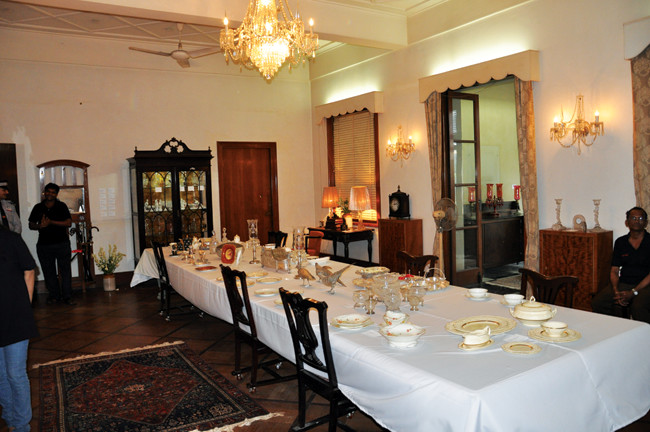
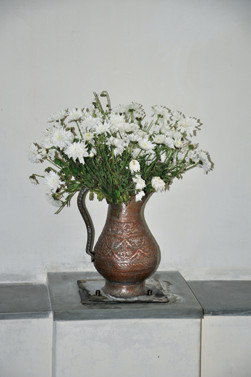
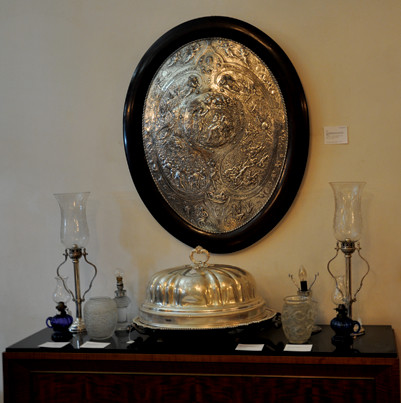
Top: A perspective of the dining room; Below left: A decorative vase as you ascend the stairs ; The Damascened Milton shield.
According to Pundole, "The two sessions on day one were better attended than day two,” while Suntook states that if there is another auction, after the estate has been cleared out, it will surely not be on this scale. The net earnings from the auction were around Rs 17 crores (US$ 34,00,000 millions) — the highest from a three-part necklace made from Colombian emeralds weighing approximately 20 carats and diamonds weighing approximately 35 carats while the third part comprised diamonds with seven suspended pearl drops. The audience in the theater exulted in joyous clapping as this bid closed at Rs 1.20 crores (US$ 250,000).
It all began with silver in the auction’s first session — flatware, tableware, bowls, dressing table accessories, tea services, frames and an intricately chased Victorian Damascened Milton shield designed for the Paris exhibition of 1867 by the renowned French silver designer Leonard Morel-Ladeuil, which fetched nine lakh rupees (US$ 19,000).
The second session was the show stopper when some of the 300 attendees bid for ceramics, glass, writing instruments, coins, clocks and watches, jewelry and gems. Wedgwood, Worcester, New Chelsea, Rosenthal, Limoges and many more branded porcelain tea services, plates, curios, figurines, vases, bowls, decanters, etc went under the hammer. One of the family members must have had a penchant for writing instruments as is evident from several telescopic pencils and also an expandable barrel fountain pen. Medals presented to Homi, gold coins from Monaco, Italy, sovereigns from the UK, gold mohurs and coins from the state of Hyderabad were some of the exhibits in this category. About 15 pocket watches, clocks (mantle, carriage, wall and grand mother) were also up for sale. The repeater changed hands for Rs 2,80,000 (US$ 5,850). All the horological instruments with Roman or Arabic numerals (interestingly none of them had baton indices), were fitted with a second hand.
Pundole specified that as per the Antiquities and Art Treasures Act of 1972, "all antiques shall rest in the country itself. There were no foreign bids from auction houses abroad or from Indians with foreign passports.” Each bought item is accompanied with a note and its brief history. The printed catalog and invoice will be the sole proof of the Bhabha ownership. The 270 page catalog was photographed from early June 2011 and saw its way to Prodon Enterprises for quality printing. Pundole also commended his staff’s hard work in cleaning and polishing the artifacts prior to the display at the Bhabha bungalow for a preview on October 7.
See it as it was
The preview at the Bhabha residential bungalow Mehrangir on Malabar Hill embodied old world solidity juxtaposed with delicate artifacts under one roof with high ceilings, doorways and windows. Rooms flowed into another with ease, at right angles with the simple wood paneled staircase leading one through the house. The ground and first floor house a reception room, galleries, dining room and parlors. The residential space occupies the next two floors with a Stigler elevator lifting one through the house. The driveway is an extension of the property, with the living accommodation on one side and a semi circular patio with a marble bench on the other.
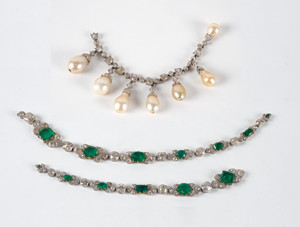
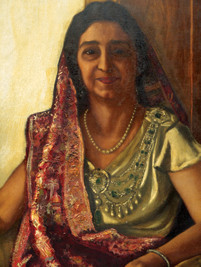
left: Three-part necklace with pearl drops, diamonds and Colombian emeralds.: Meherbai wearing the necklace. Portrait by Homi Bhabha
Day one of the auction came to a close with the sale of some jadau and enamel jewels, precious and semi precious pieces, brooches, sari pins, cigarette boxes, a gold mesh purse, compact cases of crafted gold… and of course the emerald and diamond necklace. Day two saw light fittings, furniture, carpets/rugs and textiles followed by a round of modern art (see "Auctioning art,” Parsiana, May 21, 2011 for the first auction ever, by Pundole’s). There were chandeliers, ceiling lights, pulley lights in art deco and art nouveau styles. Lalique, Bohemian, Baccarat, Daum and Wedgwood were some of the high end brands as were frosted glass, acid etched cut glass and crystal as some of the constituents. The furniture ranged form Jacobean to Sheraton to art deco. The carved Anglo-Indian chair with peacock and foliage, marked at Rs 35,000, went for Rs 90,000. There was also a suraj mukhi cupboard and another customized one with shutter and drawers. Canopied beds, rocking chairs, chaise longues are the last relics of the old world charm that bungalows of yore evoked. The pricing was cleverly managed by placing bids low so that the actual sums realized were well beyond the cataloged amounts, both the auctioneer connoisseurs believe. Consequently, a majority of items went under the hammer for double and some for 10 times the quoted price.
Rugs, carpets and textiles of every hue and texture were exhibited. Parsi kors, jhablas, garas, and other saris were on display for buyers. Embroidery with motifs of birds, flora, figurines and even geometric patterns were embellished with petit point, satin stitch and crewel stitch. The last session saw the sale of modern art collected over decades by the brothers. Their easels were also up for sale; both were keen painters. These items will now adorn several homes instead of remaining under one roof to celebrate history and heritage.
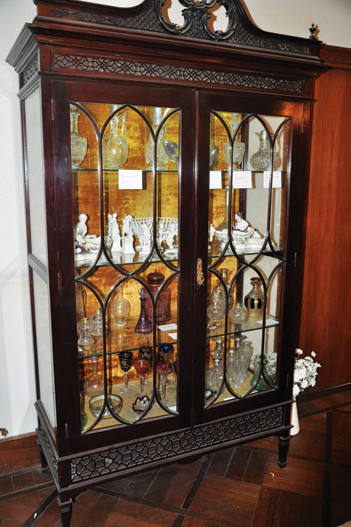
A showcase with decanters, Meissen dishes and Bohemian wine glasses
"Follow the will”
Homi Bhabha, nuclear scientist, connoisseur, art collector, botanist, musician, man of many parts, died in an air crash in 1966. His brother Jamshed inherited all his objets d’art and art works. On Jamshed’s demise in 2007, the NCPA became sole inheritor of his estate. The completing of the auction brought to a close an era — one of history and heritage. Questions and doubts were raised about the sagacity of auctioning a legacy, but Suntook categorically denies having a choice in the matter. As per the dictates of the will of the late Jamshed Bhabha "we had to follow what the will stated.” Suntook applauds Pundole’s role and says "the items sold so well not only because of generous well-wishers (one of the patrons bought two paintings and wants to donate them back to the NCPA for its own collection), but also because of provenance and the surety that there were no fakes. When people bought, they knew it was original.”
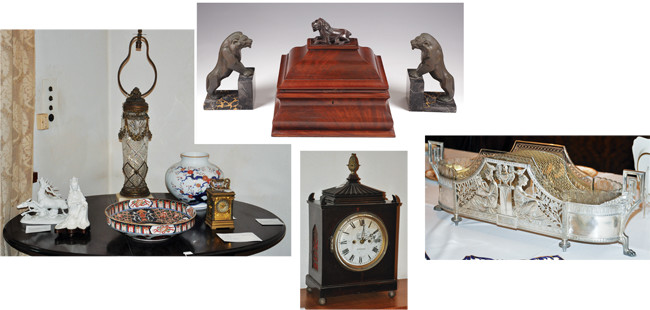
Clockwise, from l: A lion finial and bookends; a rose-bowl centrepiece; a James McCabe mantle clock and a table laden with a French lamp, Imari vase and bowl and white porcelain figures
The Bhabha brothers were reportedly very close and Suntook reveals that letters exchanged by them which were discovered during the clearing bears this out. "He missed Homi terribly, long after his death. In fact, Jamshed was in touch with Homi’s colleagues both at the Bhabha Atomic Research Centre and at the Tata Institute of Fundamental Research till his death.” However, Suntook stresses that Jamshed was an individual in his own right, despite this "great love.” With a smile, he recalls Jamshed’s yelling. "How he bellowed and thumped the table! The staff shook when they went in but he had no malice in his heart. The next minute he would offer tea. He had a wonderful heart and was particularly generous with poor people. He was always full of stories, some of which were risqué.” Suntook affectionately reminisces, "… you knew where you stood with him. He was transparent and made an honest, reliable colleague and friend.”
It seems but natural that all the proceeds from the sale should go to the NCPA, Jamshed’s brainchild and pet project. The preface of the catalog states that Jamshed Bhabha it was who approached the government (with his close friend J. R. D. Tata, Suntook clarifies), for land to maintain India’s millennia old rich culture. It was they who first thought of reclaiming land from the sea in 1965, giving credence to Bhabha’s motto "When the cause is good, the means will follow.” It was this vision that caused the government of Maharashtra to reclaim land on which the NCPA stands today. The JBT is one of the multi functional theaters in the NCPA complex, the only one of its kind for drama, opera and theater. This auction buttresses his philosophy to "think big and start small.” The sale substantiates both his motto and his philosophy.
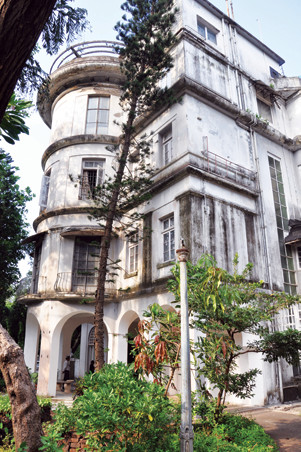
The Bhabha Bungalow — Mehrangir
"There are plans afoot to dedicate to him a memorial wing in the distant future (for which some artifacts have been withheld – editors) after the expansion of the NCPA, have memorial concerts in his name, maybe a Beethoven evening (one of Jamshed Bhabha’s favorite composers). These still remain plans,” the chairman elaborates. Suntook finds comfort in recalling the great pride Bhabha took in listening to at least one concert season of the Symphony Orchestra of India (SOI) before his passing away. After attending to the birth of NCPA, Bhabha put all his fragile energy into the SOI, which struck a major chord in his patriotic heart. Nationalist to the core, but brought up in a western mold, his taste remained such to the end. As a Zoroastrian, for him nation scored over religion. The story was different when it came to dining. Menus at his dinners were strictly Parsi — sas ni machhi, a bake, pulao and always kulfi from his favorite Parsi Dairy Farm! This allegiance to his roots seems to be true of his trust in people as well. "Parsis were always a trusted lot for him,” recalled Suntook.
◆ ◆ ◆
From the archive