
Books
Achievement in exile
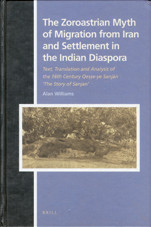
The Zoroastrian Myth of Migration from Iran and Settlement in the Indian Diaspora – Text, Translation and Analysis of the 16th Century Qesse-ye Sanjan: The Story of Sanjan by Alan Williams. Published in 2009 by Koninklijke Brill NV, Leiden, The Netherlands. Pp: xii + 250. Price: Euro 83/US $ 123.
"The QS (Qesse-ye Sanjan) as a text is not just about a journey: the text is itself a journey…the rhythms and registers of the QS follow a characteristically Zoroastrian understanding of progress…of recovery from attack and striving to victory… The dramatization of the events of the journey is such that the migrants from Iran are seen to be transformed into ‘Parsis’…Their status is sanctioned by fate and the forces of nature, and legitimized in their loyalty to ‘India.’”

Alan Williams: listening closely to an old verse
Unlike the earlier examinations of Ervad Bahman Kay Qobad Sanjana’s poetic Persian account of the arrival of the Parsis in India with their emphasis on historiography and attempts to establish the date of the event with all its attendant controversies, author Alan Williams sees it as a piece of literature that helps us understand how the community felt about itself nearly 700 years after they had settled into their new homeland: "Where I depart most from previous approaches to the text (is) in analyzing the poem as a whole which has some kind of literary, and indeed religious, integrity…By comparison with works such as the 18th century Qesse-ye Zartoshtian-Hendustan (which has a weaker poetic structure), or certain Zoroastrian Persian and Pahlavi works in prose, it has a much greater literary and religious coherence…Verse composition gives the content of the text the authority of a higher register than prose.”
Calling it an "idealized story,” Williams argues that the QS records the rites de passage. "Crossing physical boundaries of natural geography or the territorial boundaries of an ethnic or political group is analogous to those metaphorical ‘boundaries’ which are crossed between stages of life,” he explains.
Divided into five main parts, the first two describe the early greatness of the Zoroastrian civilization, with allusions to Zarathushtra’s prediction of three tyrants who would eventually weaken the religion. As it happened there was Alexander, then an evil spirit (perhaps Mani, who founded Manichaeism). In each case the civilization rebounded to life with Sasanian kings Ardeshir and Shapur and priests Arda Viraf and Adarbad. However, after the onslaught of Islam there was no one left to restore the faith.
Williams says the QS relates how the survivors come to terms with the smashing of a whole civilization, the shame of abject defeat, of initially hiding from the victorious Islam in the mountains of Kuhistan for 100 years, of seeking inspiration and guidance from their Zoroastrian religion to move on, first to the port of Hormuzd, then to Diu, acclimatizing there for 19 years before undertaking the onerous trip to Sanjan when, buffeted by a storm, they seek divine intervention and promise to build an atash behram on finding a safe landing.
Arriving on Indian soil as refugees, the next rite of passage they face is the negotiation with the Hindu ruler, the symbol of Indian sovereignty, which is undertaken by the unnamed dastur who represents them. "This is the social and cultural transition…It is no coincidence that the passage of the QS which is best loved by the Parsi community and which has been most elaborated upon in oral tradition, is imagined in Parsi memory as having taken place on a shore — yet no shore, beach or coast is mentioned here in the QS,” states Williams. The raja (king) gives them some land for settlement where they build their refuge which they call Sanjan. After some time they are permitted to create and install the sacred fire in thanksgiving to Bahram Yazad which replaces the king they lost — Iran Shah.
After a period of time, the Parsis find themselves defending their Hindu king in bloody battles when Sanjan is under attack. Described in a style Williams describes as strongly reminiscent of Ferdowsi’s Shahname ("An army was arrayed on either side,/one for Islam, one for the Hindu prince”), a Zoroastrian leader significantly named Ardashir, like the founder of the Sasanian dynasty, initially leads his men to defeat the invading Muslim warriors of Sultan Mahmud, then fights and wins a gallant individual challenge against an unnamed Muslim champion.
This marks a symbolic vengeance against Islam, according to Williams, a counter to the lost battles of Qadisiyyah and Nehavand in the Zoroastrian homeland. Ardashir is however slain in a surprise ambush subsequently launched by the invaders and from then on the tide turns against the Hindus and their Zoroastrian supporters ("Alas for such a valiant commander/whom Fate had scattered to the winds at last!/When inauspicious Fate has turned to anger/ the very hardest stone is turned to wax./ And even though he fought and struggled so,/ to what avail if Fate had turned away?”).
The author terms this the third rite of passage in testing the Iranians’ "warrior prowess to prove their loyalty as Indian-Persians:” Zoroastrian blood has mingled with the soil of India, in its defense ("the earth was tulip-red with soldiers’ blood”); they have fulfilled "a promise of gratitude.”
Thus begins a second, shorter period of dispersal and hiding, this time bearing their enthroned Iran Shah on their shoulders — first to the Bahrot caves, then to Bansdah and finally to Navsari, in a proper abode, at the invitation of Changa Asa. At last they have become "a community both fully Iranian and fully Indian, yet distinctively ‘Parsi,’” notes Williams, as Bahman’s narrative ends.
In the figure of Changa Asa we see the introduction of the laity as the guiding force of the community, replacing the older coalition between priest and royalty, says Williams. "The priesthood retain authority as symbolic custodians of the Iran Shah fire, but the role of Changa bin Asa is new in the QS, as for the first time the community is led by a behdin and he is heralded with a series of epithets which elevate him to the status of a deliverer. Another social change Williams observes is that the fire is moved from Bansdah to Navsari not as a religious necessity but rather for the convenience and happiness of the community — and for the profit of all ("Our livelihood and income would improve:/there would be happiness for all the behdins”).
"In some sense the QS represents a reconciliation with the past, and particularly the emotions of loss, abandonment, nostalgia and shame at having left Iran,” comments Williams. He also asks a question which he knows is impossible to answer: To what extent did Bahman weave together a number of stories and which alternatives did he suppress? Three couplets (64-66) seem to hint at this.
More interested in finding the religious and social meaning of the story "as an enduring myth and charter of Parsi identity” than a chronology which cannot be verified, Williams makes an admittedly exaggerated comparison between the QS and Shakespeare’s Hamlet though the two texts lie far apart on the literary scale: "to read the QS with the sole purpose of finding a historically satisfactory chronology of the Zoroastrians down to 1599 is rather like going to see a performance of Hamlet only for the purpose of learning a lesson in Danish history.”
Eighty-seven pages of the text have been devoted to facing pages of a romanized transcription of Bahman’s Persian verse (also reproduced in the original) with Williams’ own rendition of the couplets in English blank verse, as also the original text in Persian. Of course, there is no reference in this translation (neither was it in the one published in Parsiana July 2001) to the favorite Parsi story of the lead dastur putting a handful of sugar — or a ring – as a promise that the community will sweeten the land of its adoption.
There is also an attempt to integrate the views of socio-anthropologists. The author quotes Paul Axelrod: "The myth provides a charter of the capacity of the contemporary Parsi community to provide its members with a characteristic and separate identity.” He also quotes Susan Stiles Maneck who says, "The importance of the QS lies not so much in the accuracy of its reconstruction of events (where it is not reliable, especially in regard to chronology) as in its depiction of the way Parsis had come to view themselves, their relationship to the dominant culture, and their historic role within the Indian context in the 16th century. Later, the Qissa itself played a significant part in shaping Parsi identity.” Williams has also referred to the work of archeologist Dr Rukshana Nanji whose digs in Sanjan helped to establish that it was once a thriving port with dakhmas in its environs testifying to the Zoroastrian presence, perhaps as a trading community before the fall of Sasanian Iran.
Williams concludes: "The symbolic replacement of the old, fallen Iran which had been left behind, has been achieved in a new land, with its own sovereign in the ateshbahram, ritually enthroned and hidden to all except the Parsi who may behold him, and guarded by his loyal courtiers, the Sanjana priests.”
A reader in Iranian studies and comparative religion at the University of Manchester, Williams earned his doctorate in Iranian studies from the University of London. The Arts and Humanities Research Council and the University of Manchester funded the research which included the study of various manuscripts of the QS in several libraries of the world including the K. R. Cama Oriental Institute in Bombay and the Meherjirana Library in Navsari notes the author, adding, "After working both in Zoroastrian Pahlavi and Avestan texts in the past, and more recently the poetry of Classical Persian, I hope I have been able to look at the QS in a new light.” He has also addressed the controversies regarding the date of Parsi arrival in India. Four pages of bibliography attest to Williams’ research.
Williams has dedicated his book to the memory of Zoroastrian Studies (ZS) stalwart Shehnaz Munshi: "One of the turning points in my appreciation of this poem came during conversations with Shehnaz Munshi who helped me to understand the Parsi reception of the text and some of the Gujarati translations. With her lively knowledge of Parsi traditions and her own embodiment of Zoroastrian teachings, her musical understanding of Parsi Gujarati texts, songs and verses led me to listen more closely to the poetry of this relatively rare phenomenon — an old, Persian, Zoroastrian poem.”
◆ ◆ ◆
From the archive