
Cover Story
A heritage preserved
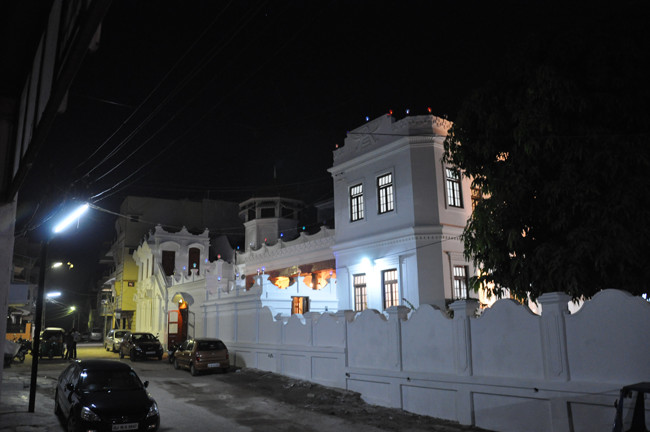
The repaired and restored Homawalla Agiary in Bharuch celebrated its 250th anniversary
The strains of a saxophone
accompanied the singing of Chhaiyé Hamé Zarathoshti in the Homawalla Agiary in Bharuch as the fire temple’s 250th anniversary celebrations drew to a close on December 19, 2010. The night before, the Agiary was filled with the chatter and laughter of volunteers trimming rose stems and arranging the multi-colored buds in silver vases. A young man worked on his laptop as music from a compact disc player wafted through the premises.
The extensive repairs and renovation to the most frequented Agiary in the one-time heartland of the Parsis was both a mammoth effort and a labor of love. The objective was to carry out the restoration "jé pramané aapraa baap daadaaé bandhi né apéloo hatu (the same way our forefathers had built and handed down the building to us),” said the Agiary’s trustee Sarosh Ginwalla addressing a crowd of over 200 who had gathered from as far away as Ahmedabad and Bombay.
A jashan led by Udvada High Priest Dastur Khurshed Dastoor preceded Ginwalla’s speech. In his brief talk, Dastoor, while lauding the trustees’ efforts, termed the sacred fire "a friend, philosopher and guide” to our community. "Rich or poor… all are equal” before the atash.
Despite a daunting estimate of Rs 35,00,000 (US $ 77,777) "We dared to begin. Mathoo oochki né aagal chaalyaa (with head held high we ventured forth),” Sarosh’s wife Pilloo told the assembly. A restoration engineer-cum-contractor from Baroda, Vijay Shah and noted restorer, Prof Rabindra Vasavada, head, master program in conservation studies, faculty of architecture, graduate school, CEPT University, Ahmedabad, were entrusted with the job. The work started in April 2010 and continued till the night before the jashan with finishing touches of paint being applied to the peripheral rear wall of the building and compound.
Citing the adage "charity begins at home,” Sarosh whose family founded and manages the heritage adarian, noted that the family liquidated some of their investments and chipped in the initial sum of Rs 20,00,000 so the work could begin. He noted that donations were received from Delhi, Calcutta, Madras, Hong Kong and other places.
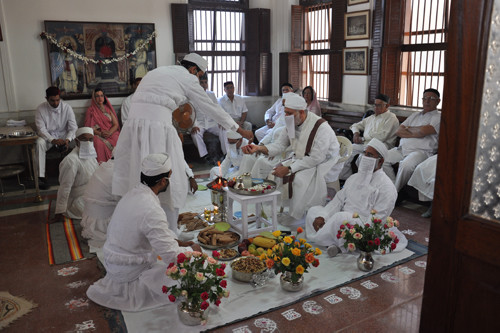
Homawalla Agiary (top) and jashan in progress: "All equal” before the fire
Amongst the major donors were Navaz and Furrokh Guzder, Fali Nariman, Jamshed Desai, Burjor Antia, J. J. Mistry, Dr R. K. Bharucha and Dr Ratan Marshall. Delhi Parsi Anjuman (DPA) president Dadi Mistry and former honorary secretary of the Federation of Parsi Zoroastrian Anjumans of India Keki Gandhi "really promoted our cause,” said Pilloo. Aside from the support outside of Bharuch, members of the local community also "mohta dil thi méhnat karva lagya (generously assisted),” noted Sarosh. Two elderly unmarried sisters, Roshan and Mehra Dalal who use zero watt bulbs at home to save on electricity costs donated Rs 15,000 — Rs 5,000 for kathi and Rs 10,000 towards the repairs, said Pilloo.
A mother and daughter Naju and Phiroza Hamawalla who reside in one of two buildings constructed in Bombay through the philanthropy of Ratanji Furdoonji Ginwalla, Sarosh’s great-grandfather, sent Rs 3,00,000 as a donation in appreciation of the benevolence of the family that provided them a home. Another resident Sam Engineer donated Rs 1,00,000.
Impressed by the dedication of the trustees in restoring the edifice, Vasavada forwent his seven percent consultancy fee and charged only for the actual expenses incurred by his students who traveled to Bharuch, submitted drawings, oversaw the work and so on. Sarosh noted that the wooden beams which support the roof and rest on the walls had rotted at the extremities. A weighty, three-sided brass holder, especially designed and fabricated, was slipped between the beam and the wall with a special adhesive comprising gum from baval trees, sawdust and some chemicals applied for bonding. Using equipment and personnel from his ginning factory, Sarosh undertook the risky operation of raising the beams ever so slightly enabling the brass container to be slipped into place. Pilloo points to the wooden supports below the beam which are recent additions but fit in with the Agiary’s décor.
To replicate the original look, the paint on the beams was removed with a blowtorch as scraping the wood could have resulted in an uneven surface. Fire extinguishers, buckets of sand and water were kept handy in the event any of the beams caught fire, explains Sarosh. The layers of paint accumulated on the walls over the years were also removed by scraping and blowtorches. "Tons of paint had to be scraped off,” remarks Pilloo. Chuna (slaked lime) plaster which has to be soaked for over a month before application was used as was a combination of white cement and sand. Paint from the wooden benches was similarly removed and the wood polished.
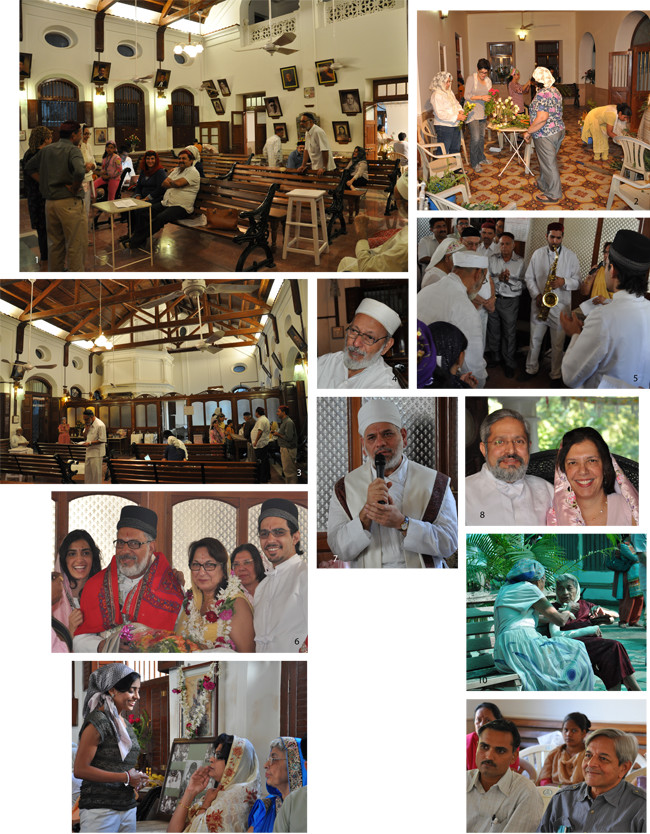
1. Hall of Agiary on night prior to anniversary
2. Arranging the flowers
3. Kebla in background and screen in main hall
4. Ervad Dinshaw Dastoor
5. Ryan Sadri playing the saxophone
6. Dina, Sarosh, Pilloo and Ratan Ginwalla with Sherna Udwadia (rear)
7. Dastur Khurshed Dastoor
8. Hoshang and Sherna Udwadia
9. Chatting after jashan
10. Mehra and Roshan Dalal
11. Site supervisor Manish and Prof Rabindra Vasavada
Even the section where worshipers wash their hands and recite the kusti prayers before entering the sacred precincts maintained the traditional look with Pilloo’s insistence on a specially fabricated copper vessel containing water being used instead of taps. Water is to be scooped out with karasias (circular bottomed receptacles).
Due to the town’s narrow "gully-guchees (bylanes),” Pilloo observed "no truck or tempo” could access the Agiary. Construction material therefore had to be deposited at the nearby Jamshed Baug (dharamshala) and Seth Hormasji Behramji Vakharia Fire Temple (now defunct) where Pilloo is one of the trustees. From there the material was carted to the Agiary.
Cold tar and bitumen were applied on the roof planks over which Mangalore tiles were placed. The trustees eschewed marble or tiles on the walls except for those existing in the kebla. Removing those tiles might have weakened the walls. While tiles save on recurring expense of painting and lessen damage from smoke and moisture, they give the image of "a big bathing chamber,” quipped Pilloo. "Maintaining the heritage look was the most important aspect for us,” she added.
There is no exhaust fan in the kebla chimney, note the Ginwallas as this results in excessive burning of kathi, thus increasing the consumption and expense of procuring the wood. The Homawalla Agiary trust spends around Rs 53,000 per annum on kathi, says Sarosh. With an exhaust fan the cost of kathi would increase by one-and-a-half times. Solar lights, brought from Canada by Sarosh’s sister Sherna Udwadia, illuminate the top of the fire temple’s peripheral walls and save on electricity costs.
All the labor, including people from Ginwalla’s office and factory toiled ceaselessly. "The result is what you see today,” stated Sarosh. "They treated the Agiary as a mandir or holy place. Khub dil thi (wholeheartedly) they made it like new.” Family friends, Archana and Tanuj Patel who run an anti-friction ABC Bearings factory assisted with Archana arranging the flowers in the vases the night before in the adjoining hall. Swati and Mukesh Choksi who own CPL Electric provided the switches and switchboards. When the local florist asked for a fancy price, Pilloo who describes herself as a "value seeker” sourced the flowers from Bombay’s Dadar wholesale market and her sister Jeroo Vazifdar brought them with her to Bharuch. Another sister Zarine Sadri along with others did the flower decorations while singing khushali na (happy) Parsi songs.
Locally purchased clocks that had their hands removed, a photo of the Agiary pasted on the dial and the hands put on again were presented as gifts to all who had assisted. Amongst the many who helped, the Ginwallas name Eric Sethna, a neighbor and prosperous businessman, Rashna Vispi Ginwalla, a former teacher and Kaiyomard Kerawalla, an agriculturist.
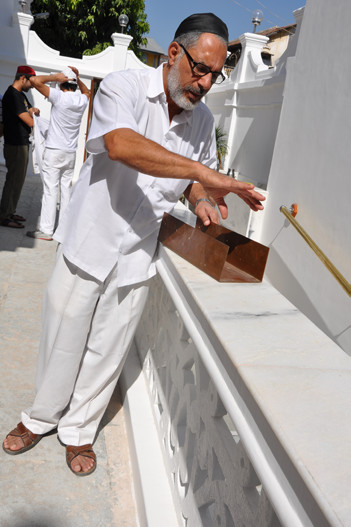
Sarosh Ginwalla demonstrating use of brass holder
Greater returns
The Agiary had celebrated its 200th and 225th anniversaries "so we thought 250 would be a nice landmark to celebrate,” recalls Pilloo. Sarosh was insistent that major repairs and renovation should be done. "We thought our (personal) money is lying in fixed deposits, shares and other investments,” explained Pilloo. If they liquidated those and invested the money in the fire temple, the returns would be greater, the family reasoned. A monument would be restored to Bharuch.
The Homawalla Dar-e-Meher, as it was originally referred to, was built by Homaji Darabji on February 18, 1760, notes the marble plaque on the Agiary wall. The structure was further renovated and reconstructed by Dinshaw Furdoonji and his brothers in 1896 and subsequent changes were made by Ratanji Furdoonji in 1940.
When the Ginwallas approached other trusts for donations the first question often asked was, "How many Parsis are there in Bharuch?” On hearing the figure of 140 many questioned the justification for repairs and spending such a large amount. "Did they want the roof to collapse on our heads?” queried Pilloo.
Bharuch has four fire temples at present, the other three being the Sir Shapur Burjorji Bharucha Dar-e-Meher, the Pastonji Aslaji Doongaji Agiary and the Shapurji Narielwala Agiary. The Bharucha agiary, whose fire is reputed to date back to 1255 AD, is a few minutes’ walk from the Homawalla fire temple but the panthaky there Ervad Marzban Gonda says there are hardly any visitors. The Doongaji Agiary stands desolate adjacent to the Bharuch Parsi Panchayet office. The agiary is overseen by an elderly man and woman, with Ervad Cyrus Bhada from the Narielwala Agiary tending to the fire periodically. The high rafter ceiling and dank interior presents a somber atmosphere though the exterior of the structure is architecturally appealing. Sethna who has an ice factory and runs the Hotel Sethna Plaza in Bharuch, makes it a point to visit the various fire temples on a regular basis to see that things are in order and the fires tended to, says Pilloo. "The Homawalla Agiary is the most popular,” says Sarosh, attributing a part of its success to the panthanky, Ervad Dinshaw Dastoor and his son Navroze, both of them members of the local community. They serve the agiary "with laagni (feelings) and prém (love),” says Sarosh. Dinshaw’s birthday coincided with the fire temple’s. Prior to the Dastoors, the late Ervad Burjorji Vimadalal and his father Hoshang tended the fire.
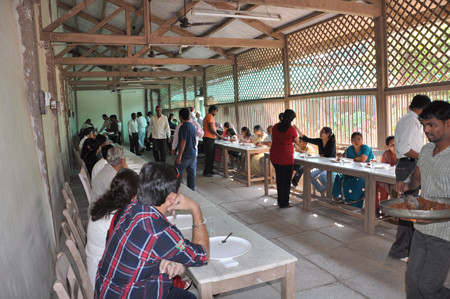
Lunching at Meherwan Baug
The gin in Ginwalla
Sarosh says Bharuch is one of the oldest living cities in the world tracing its origins to over 3,000 years ago. Once just a small village on the banks of the Narmada river, the town grew and prospered as a trading and shipbuilding port, states Wikipedia. Bharuch’s population was 1,48,391, according to the 2001 government of India census report while Bharuch district which comprises Ankleshwar and six other boroughs has a population of 13,70,656.
Sarosh can trace his ancestry back eight generations. The family surname was originally Homawalla but in the 1800s was changed to Ginwalla as the clan entered the ginning process. Gin mills separate the lint from the cotton seed, the lint being then compressed into bales. The family built and moved into a palatial home on the banks of the Narmada river in 1925. Pilloo’s family, the Vakharias, were also in the ginning business and at one time one of the uncles owned more than 50 ginning mills. Sarosh and Pilloo are second cousins. The Vakharia family home in Begumwadi is another stately heritage structure with an underground tanka (small underground tank) to store rain water. The late Lt Gen Adi Sethna, president of the DPA, had especially visited the home along with a group of environmentalists to study the workings of the tanka. As Pilloo’s brother Jamshed notes the water is lukewarm in winter and cold in summer. Brother Hormuzd observes the water is free of any impurities.
With rising costs and cut-throat competition the families wound down their ginning business and today Sarosh says he does mainly job work as procuring cotton seeds and storing bales is an expensive and working-capital intensive business. Their son Ratan who is the second trustee of the Homawalla Agiary runs an advertising agency in partnership in Juhu while daughter Dina teaches ballroom dancing. They enjoy spending time in Bharuch along with their two Great Danes, a bullmastiff and a flock of noisy geese.
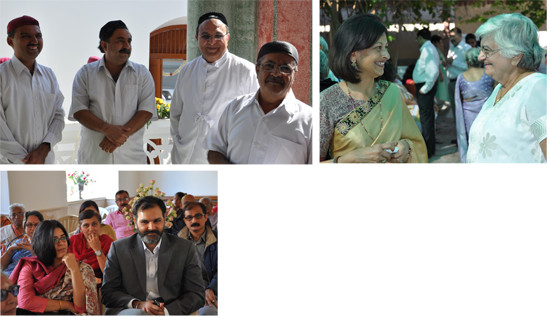
Clockwise from top left: Kaiyomard Kerawalla, Eric Sethna, Dara Mahu-dawalla, Bharuch Parsi Panchayet trustee Homi Hama-walla; Archana Patel, Homai Engineer of Vapi; Bharuch district magistrate (collector) Roopwant Singh and wife Avantika, district development officer of Anand
Ratan who worked for Rediffusion advertising left the agency and tried his hand at real estate in Bharuch. Though the pickings were lucrative he preferred the adrenaline-rush, high-pressure world of advertising. Dina would not mind residing in Bharuch and notes many of the local Gujarati ladies say "mané salsa seekhvooch (I want to learn salsa).”
Pilloo stayed in Bombay while the children were schooling in the city but she now looks forward to spending more time in Bharuch. She has set up a Bal Mandir, an evening school cum recreation center for disadvantaged children with the assistance of the Jeejeebhoy Dadabhoy Trust on its premises formerly used for the Jeejeebhoy Dadabhoy Parsee Charitable School. The garden at the Agiary still needs to be done, observes Pilloo who plans to plant some gulabs (roses). She believes the restoration work brought the Bharuch community together to "bond… the fun of doing it together. We were fortunate to get an opportunity to do this,” to restore what would otherwise have been a lost heritage.
◆ ◆ ◆
From the archive