
Cover Story
Blessings for Bardoli
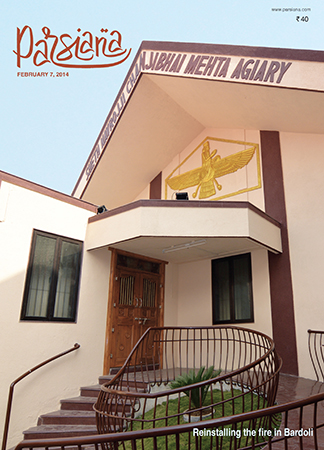
The Sheth Navrojji Chanjibhai Mehta Agiary fire in Bardoli was reinstalled in a new agiary structure this January
With the hall illuminated by the flickering flames of several divas and filled with chants of the Yatha Ahu Vairyo prayer, the consecrated fire of the Sheth Navrojji Chanjibhai Mehta Agiary was shifted from the adjoining mobed quarters to the newly rebuilt fire temple premises in Bardoli on the chilly morning of January 18 between 4 and 4.30 a.m.
A path for the fire’s route was made by creating a réti ni pavi (liturgical dematcation) from its one-year temporary home to the new kebla. The electric supply was turned off, mobile phones ordered to be switched off, photography forbidden and silence observed. The embers of the dadgah fire were then carried stealthily to the sanctum sanctorum by three priests bearing a metal container with a cover, the implements loaned from a Surat atash behram. After placing the atash on the afarganiu, a humbandagi or congregational prayer was recited. The gathering of around 40 devotees then thronged around the kebla containing the re-enthroned atash to offer sandalwood, apply ash on their foreheads, pray and seek the fire’s blessings. The Agiary’s panthaky Ervad Roomi Aspi Sanjana accompanied by two priests from Surat, Ervads Zubin Rabadi and Burjor Aibara performed the liturgical ceremonies which included a maachi prior to the shifting. Around 5 a.m. tea was served.
At 9 a.m. that morning in the presence of Navsari High Priest Dastur Kaikhushro Dastoor Meherjirana eight priests performed a jashan while a large congregation of worshippers streamed past the praying priests to offer sandalwood and prayers to the reinstalled fire and then to light divas.
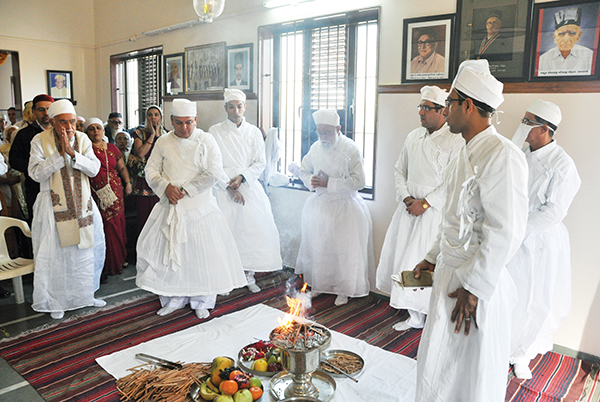
Conclusion of jashan
Thereafter a public function was held under a large, multi-colored mandap on Parsi Street which borders the Agiary. Those responsible for the shifting of the fire as well as the guests who had travelled from adjoining areas and also as far away as New Delhi and Bombay were felicitated. Bardoli is about an hour’s drive from Surat. Author Rusi Besania from Surat was the master of ceremonies, introducing the guests in flowery Gujarati and regaling the gathering with his witticisms.
On the dais were Meherjirana, Ervad Asphandiar Dadachanji, chief guest Keki Daruwalla, Zoroastrian representative on the National Commission for Minorities, Bombay Parsi Punchayet chairman Dinshaw Mehta, World Zoroastrian Organisation Trust Funds managing trustee Dinshaw Tamboly, Marzban Baria, president of the Bilimora Parsi Anjuman and the office bearers of the Bardoli Jarthosti Anjuman (BJA), Homi Pithawala, president, Daulat Mohta, vice president, and trustees Maharukh Sanjana, Kersi Sanjana, Gustasp Pastakia and Godrej Batliwala. Pervez Mehta, the conscientious and efficient honorary secretary and trustee of the BJA, came later for the function on account of ill-health.
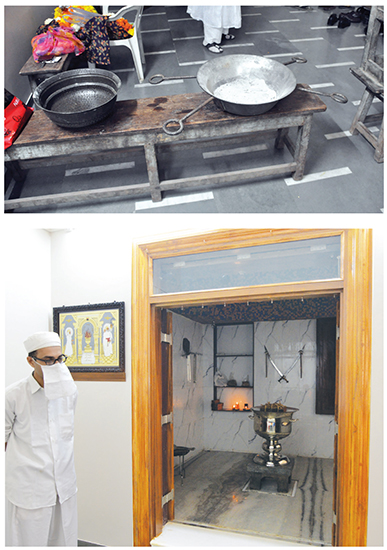
Photos of the kebla, afarganiu and implements used in shifting of the fire
Meherjirana sang some couplets from a monajat (religious song) while Dinshaw Mehta termed the occasion an "itihas divas” (historic day). He marvelled at the "way they have built” the fire temple. "Congratulations to all the trustees.” Noting that the community’s "main issue was the declining population,” he urged the young to marry early and have three to four children. "Don’t get tired after two.”
Daruwalla said it was "a great day in our lives (to) witness the fire in a new fire temple.” He spoke about the Cyrus Cylinder on loan from the British Museum to the Prince of Wales Museum in Bombay. The etching on the tablet referred to human rights and turning slaves into free men. He spoke of the Parsis who initially fled Iran as being "boat people, defeated…without a country, exiled.” India had given them a home.
He said he did not "see the youth” in the gathering and voiced his apprehension about the community becoming extinct. "Buckle down and get married,” he counselled. There were too many spinsters and bachelors. Recalling a friend of his who fell in love four times but never married, Daruwalla advised the young, "the first time you fall in love, get married.”
While an audio recording explained how a boi/maachi is performed, Dadachanji on the makeshift stage demonstrated with implements the intricacies of the ceremonies.
Besania announced lunch was served but regretted that though a Daruwalla (liquor merchant) and a Pithawala (place where liquor is sold) were on the stage, no liquor would be served! There is prohibition in Gujarat.
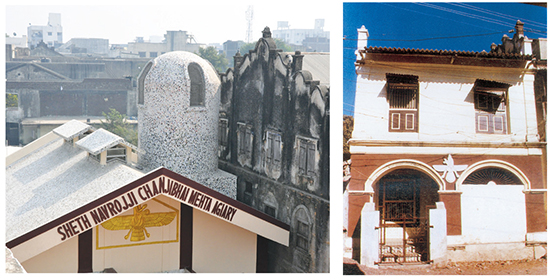
Chimney of new agiary and (right) old structure.
Wooden structure
The old agiary structure was made of wood, noted Pithawala in a telephonic interview with Parsiana on January 28 explaining why a new building was erected. (Due to some confusion, Pithawala was not called upon to give his speech at the public function.) The timber not being of a high grade, the huge expense of termite treatment and leakage during the monsoons meant repairing the existing structure would prove to be prohibitively high. Only one old beam was of good quality and was repurchased from the contractor Anil Pankhania who was responsible for demolishing the structure and erecting a new one. The wood from that beam was used by architect Jehanbux Bilimoria for the frames of the wooden door and window in the kebla. Had more such wood been available it would also have been used, narrated the president.
With an estimated cost of around one crore rupees (US $ 1,58,730), a corpus of only Rs 4,00,000 and a contentious opposition, the BJA trustees trod cautiously, Pithawala stated. All legal requirements were observed, permissions taken, tenders called and donations sought. Ervad Khurshed Desai of Navsari, a builder, was of great assistance in guiding the BJA trustees, said Pithawala.
The old agiary structure was made of wood, noted Pithawala in a telephonic interview with Parsiana on January 28 explaining why a new building was erected. (Due to some confusion, Pithawala was not called upon to give his speech at the public function.) The timber not being of a high grade, the huge expense of termite treatment and leakage during the monsoons meant repairing the existing structure would prove to be prohibitively high. Only one old beam was of good quality and was repurchased from the contractor Anil Pankhania who was responsible for demolishing the structure and erecting a new one. The wood from that beam was used by architect Jehanbux Bilimoria for the frames of the wooden door and window in the kebla. Had more such wood been available it would also have been used, narrated the president.
With an estimated cost of around one crore rupees (US $ 1,58,730), a corpus of only Rs 4,00,000 and a contentious opposition, the BJA trustees trod cautiously, Pithawala stated. All legal requirements were observed, permissions taken, tenders called and donations sought. Ervad Khurshed Desai of Navsari, a builder, was of great assistance in guiding the BJA trustees, said Pithawala.
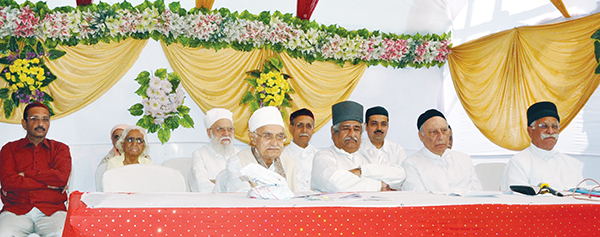
(Above): Guests and trustees on the dais including from (left) Marzban Baria, Daulat Mohta, Ervad Asphandiar Dadachanji,
Dastur Kaikhushro Dastoor Meherjirana, Kersi Sanjana, Dinshaw Mehta, Godrej Batliwala, Keki Daruwalla and Homi Pithawala.
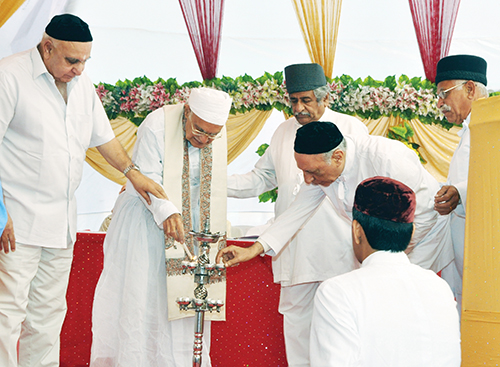
Lighting of the lamp, Dinshaw Tamboly (ext left)
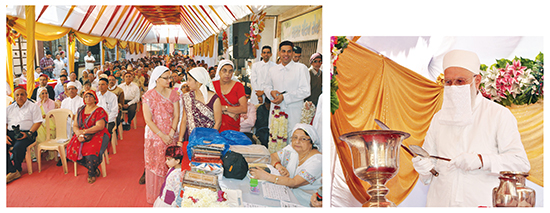
Section of audience; Dadachanji demonstrating performance of maachi/boi ceremony
An initial donation of Rs 12,00,000 from the Bai Maneckbai Jeejeebhoy Deed of Settlement Fund courtesy Scylla Vatcha made possible the construction of the two bedroom, hall plus kitchen mobed quarters. The kitchen area was made akin to a kebla to house the sacred fire temporarily, noted Pithawala. Due to Bilimoria’s eye for detail and exactitude the cost of constructing the Agiary escalated. Pithawala described the bearded architect as a "Kaam no keero (a workaholic)… Apré parishan thayaa (We became hassled).” But money came and Bilimoria also arranged donations for the building.
Former Surat Parsi Panchayat president Darayas Master provided the electrical fittings, wires, etc while painting was done gratis by Jehanbux Daruwala of Bombay. Shapoor Mistry of Shapoorji Pallonji and Company provided the tiles while agriculturist Dr Rohinton Avari of Navsari landscaped the front garden free of cost. Dr Cyrus Poonawalla of Poona donated Rs 12,00,000 in memory of his wife Villoo while Tamboly arranged for a donation of Rs 10,00,000.
The brass rods for the kebla were salvaged by a Parsi who spotted them lying with a scrap dealer outside a Bombay atash behram. He purchased the lot and donated them to Bomi Sachinwalla for his agiary in Vasai. The extra rods were in turn gifted by Sachinwalla to the BJA. Iron rods were inserted into the hollow brass rods to give them strength, explained Bilimoria. Also the chimney above the kebla is three layered and permits daylight to enter indirectly, states the architect.
"I did more running around for the Agiary than I did for my own house,” joked Pithawala. Referring to the emails that were circulating criticizing the BJA for spending so much on a fire temple when Bardoli only had 100 Parsi residents, Pithawala recalled a Zoroastrian residing abroad who wanted to know what amounts the critics had contributed. He offered to donate double of whatever they had given. That silenced the dissenters, claimed Pithawala. He referred to the message sent for the function by SPP trustee Yazdi Karanjia advising that instead of "Parsio Parsi maaté vaat karé, Parsio Parsi saathé vaat karvi joié (instead of talking about each other we should talk to each other).”
Faith and the fire
A background note on the Mehta Agiary prepared by Pervez Mehta mentioned that the fire temple originally opened on December 25, 1885, roj Adar mah Tir, and was built at a total cost of Rs 5,000. Edulji N. Mehta of Navsari built the Agiary in memory of his late father Navrojji Chanjibhai Mehta and handed it over to the Anjuman of Bardoli.
"As all the agiaries to the east of Surat district were either closed and the fire shifted or else there were no mobeds to look after these agiaries, Parsis had to go either to Surat or Navsari for the performance of the religious ceremonies especially of the dead. They requested Bardoli to perform all the necessary ceremonies,” stated Pervez Mehta.
A background note on the Mehta Agiary prepared by Pervez Mehta mentioned that the fire temple originally opened on December 25, 1885, roj Adar mah Tir, and was built at a total cost of Rs 5,000. Edulji N. Mehta of Navsari built the Agiary in memory of his late father Navrojji Chanjibhai Mehta and handed it over to the Anjuman of Bardoli.
"As all the agiaries to the east of Surat district were either closed and the fire shifted or else there were no mobeds to look after these agiaries, Parsis had to go either to Surat or Navsari for the performance of the religious ceremonies especially of the dead. They requested Bardoli to perform all the necessary ceremonies,” stated Pervez Mehta.
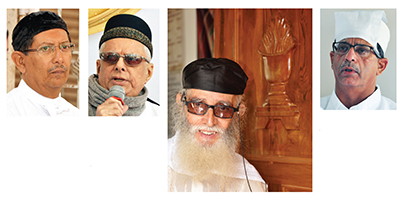
From left: Pervez Mehta, Rusi Besania, Jehanbux Bilimoria and Khurshed Desai
The grandfather of the current mobed, Ervad Minocher Rustamji Sanjana first joined as a panthaky in 1945. After his sudden death in 1987 and by the time his son Aspi could take over the responsibility of tending the fire, the adarian fire had become a dadgah. Aspi’s son Roomi took over in 2001. In 2011 the trustees decided to reconstruct the Agiary as it was in a dilapidated state. "We contacted Bilimoria, who after many inspections came to the conclusion that the building will have to be demolished and rebuilt,” wrote Pervez. They were told they would require a minimum sum of Rs 1,00,00,000. "We were put off by this daunting figure (but) ultimately having faith in our Atash Padshah Saheb we decided to go ahead.”
The area of the old Agiary was about 1,800 sq ft whereas the new one is around 2,500 sq ft with the mobed quarters being 1,000 sq ft. The expansion was made possible by demolishing seven rooms built around 1955 adjoining the Agiary building and rented out as shops/godowns. The rents varied from Rs 5 to Rs 10 per month. During the last 15 years these rooms had been kept locked by the tenants anticipating money in lieu of their surrendering the possession. The present trustees were able to persuade these tenants to vacate the premises only because of help received from Aspi Sanjana. "At no time was the work stopped or slowed down due to want of funds,” noted Pervez.
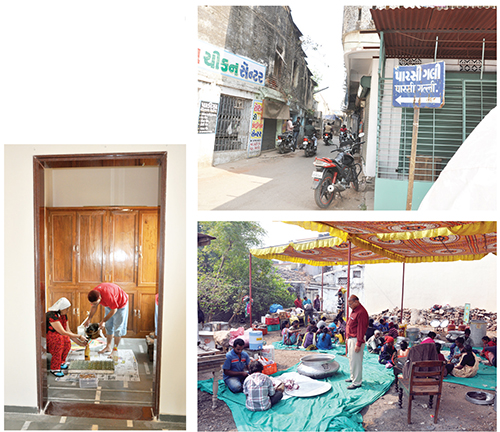
Signage indicating Parsi Gully; caterer Khushru Kasad supervising preparation of meals;
pouring oil for making divas at agiary
"Bilimoria did not charge a single penny and visited Bardoli at his own expense almost every week. Desai travelled almost every day from Navsari to Bardoli and supervised the work, guiding and helping us without any monetary gains. The structural engineer Phiroze Ghadiali of Ghadiali and Rawal, Bombay too gave his services free of cost. Mehernoz Daruwala and many others who had never heard of Bardoli were drawn to this project” and assisted, stated Pervez. "Although initially the magical figure of Rs 1,00,00,000 seemed far beyond our reach, with Ahura’s blessings and help from our Atash Padshah Saheb we were able to collect around Rs 80,00,000 and complete the project.”
◆ ◆ ◆
From the archive