
Faithfully fixing fire temples
In nearly two decades members of the Yazdaan group have voluntarily repaired 44 shrines in India
The following Sunday was earmarked to clean the kebla. That is when the priests of the atash behram would scrub the insides of the sanctum sanctorum while the members of the Yazdaan group would be on top of the gumbaz to clear layers of soot. "Aakhaa kaaraa thainé nikalsu (we will come out totally black),” revealed Nozer Sutaria, distinguishable by his elf-like blue and orange cap. With members of the group ranging in age from 30 to 70 years, they have rendered honorary service during the last nearly 20 years to restore/renovate/repair/paint/clean 44 agiaries and atash behrams in different parts of India. Besides Bombay and Gujarat, members have cleared cobwebs and buckets of soot from fire temples in Indore and Mhow in Madhya Pradesh to Hubli and Belgaum in Karnataka. Their most enduring ties though have been with the Dadysett Atash Behram in Bombay which was the first fire temple they renovated in 1994 and which they dutifully clean every year before its salgirah.
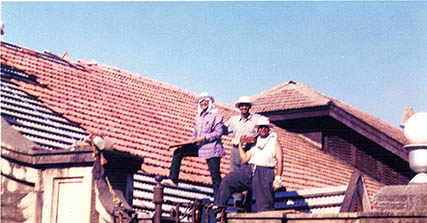
Once they undertake an assignment, Mistry does the planning after which Sutaria does the technical drawings. They may not be professionals, but they believe in perfection. When doing the roof of the Navsari Atash Behram, after laying the tiles they realized it was sagging because the wooden framework had bent. Instead of taking a short cut, they made repeated trips in the next year to redo the roof, insisting "karo tau barabar karo (if you do work, do it well).” Do they get time to rest? "Rest lèvaani kai aay oomaré (Is there any need for rest at this age)?” retorts 55-year-old Sutaria who works as design engineer with Mazagaon Docks, is active on the Nowroz Baug residents committee and trains youngsters for the Bombay Parsi Punchayet’s athletics program.
In addition to their privilege and casual leave, weekly offs, bank holidays, compensation for overtime, are all utilized to serve the abodes of the atash. Throughout the year, regular repair and painting jobs are done and additionally each year two major projects are undertaken. As per their chart (see list), already in 2013 they were involved with the renovation of the Modi Atash Behram in Surat, and had spent four days replacing the roof at the Wadiaji Dadgah in Davier. Their truckload of tools and equipment is currently stationed in Surat to facilitate assignments in Gujarat. They are in constant need of good quality (not made in China, as one of them joked), preferably German made, sturdy electric and battery operated drills. The cost of harness, special rigging ropes, tall stepladders, variety of tools, is all borne through donations and their personal funds. Recently compressors, pumps, blowers and a generator were purchased, the cost running into lakhs.
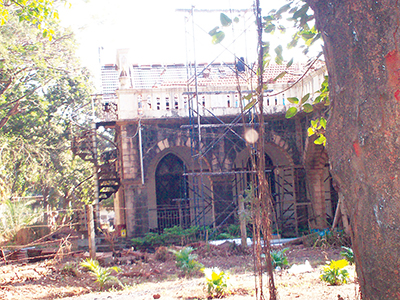
Belgaum fire temple renovated by the Yazdaan group
After the monsoons they will work on the Navsari Adarian that is housed in the Modi Atash Behram although initially they had decided to undertake the total renovation of the Iranshah Atash Behram as they had last done in 2005. Work in Udvada, however, will not be possible this year because although the chimneys at the Iranshah are choked with soot making it difficult to pray in the kebla, to arrange for priests of the necessary rank and ritual purity to temporarily transfer the sacred fire may not be immediately feasible, explains Sutaria.
Sometimes enthusiastic friends show an eagerness to volunteer but when given the date for the next assignment convey their regrets due to some preoccupation. The regular workers though are used to such excuses knowing that only those who are sincere make an effort to create time. Their dedication is commendable even though they may have faced hazards in the form of fractures, cuts with the electric saw, dehydration (when repairing a roof in the middle of summer with soaring temperatures). They are fortunate though to have the support of understanding families (see "Active members”) who encourage them to serve the sacred fire. Many a social outing is foregone, personal funds utilized, days away from the family accepted with a smile.
Whilst Yazdaan members may not have expectations from general community members, they observe that even when they are cleaning and repairing fire temples that lie within baugs and colonies, rarely do residents come forward to volunteer their services. Considering that most colonies have their own residents’ associations, they should prevail upon their youngsters to join in the cleaning operation of the fire temple, believes Sutaria who feels they can be lured with a promise of fun and enjoyment whilst working.
When polishing the tiles in the kebla at the Surat Atash Behram, Sutaria recalls two youngsters observing them. To lift the heavy machine into the kebla he requested them for help which they willingly offered. After some time they obliged by bringing in water from outside. Thereafter they stayed back to assist the Yazdaan team during the entire duration of the work schedule, although one of them was studying to be a chartered accountant.
Subsequent to that trip the Yazdaan group must have visited Surat many times but those two youngsters have not joined them again. They are happy though to have the support of others like the chasniwallas in Bombay and Gujarat who willingly help out knowing that they can be assured of decent meals sponsored by community well-wishers on those days. Expecting the priest in attendance to help out is unrealistic. Knowing that they are overworked, Sutaria asks rhetorically, "ék maanas kétlu karé (How much can one person do)?” He knows of a priest in a Bombay agiary who at the end of a hard day, maakar bharélu shetranji paathri né sui jaai (sleeps on a mat infested with bedbugs).”
Would he recommend the merger of fire temples? Preferring not to comment on this issue, Sutaria maintains, "I am totally orthodox.” He is aware that agiaries like Ashburner at Grant Road which once used to get an overload during muktad times, has now no takers despite the priest offering to recite prayers at half the prevailing rates.
Seeing the religious fervor among the youngsters today who are motivated by youth bodies like ZYNG (Zoroastrian Youth for the Next Generation), Sutaria is convinced that the future augurs well for the community although they may not be interested in the upkeep of the fire temples. For members of Yazdaan though, the maintenance of fire temples is crucial. If the temples are neglected by the current members they fear "the next generation bahaar thee joie né chaali jasé (give it a passing glance and walk away).”
(With inputs from Geeta Choksi)
Bomi’s boys
Geeta Choksi
Today the Nanabhai Choksi Dar-e-Meher in Panchgani looks tranquil and pretty attracting visiting devotees and the few sincere local residents. It is largely the efforts of "Bomi’s boys,” undoubtedly the unsung heroes of the Parsi community.
Some of us trustees had heard of this team that travels around India as volunteers, restoring agiaries and atash behrams. The team leader, Bomi Mistry refuses to carry a mobile and works long hours, and thus can only be contacted after 10 p.m. we were advised. After many months of doggedly trying to track him down and pin him to a schedule which required a lot of coordination with all the team members, it was decided that work would start in December 2011 and last around six weeks as both the interior and exterior of the fire temple had to be restored.
On Mistry’s advice and assistance, the trustees were guided where to purchase quality material at competitive rates — gallons of paint, brushes, sheets of sandpaper, cement/plaster, a host of electrical material as well as the Tata GI (galvanized) sheets for a new roof. The team of 14 arrived accompanied by a large tempo carrying all their tools, equipment, stepladders, tall pre-fabricated metal stands/scaffolding, all of which could be dismantled.
The team worked relentlessly with a fervor inspired by Mistry who always led from the front. He has been known to work 48 hours with just catnaps to refresh him. A fine, unassuming gentleman, his quiet personality exudes his depth of sincerity and commitment. His team members came and went as per their schedule but some were constant throughout.
The kebla or the inner sanctum required intense cleaning and painting as this area had not been touched for decades. The fearless climbed high into the gumbaz above the sacred fire and removed over 40 buckets of soot. Ervad Veerzad Khambatta of Mount View Hotel volunteered to clear the wooden false ceiling of years of smoke and soot. The team then scraped off layers of the old oil paint, creating a smooth surface and repainting the walls and the high ceilings. The slightest streaks were unacceptable to the eyes of the perfectionist Bomi. Huge cracks were fortified and held together with C hooks and then plastered over. Open seams in the floors were closed. Since this intensive work involved shifting of the fire, Ervad Asphandiar Dadachanji of the Vatchaghandhy Agiary in Bombay offered his services gratis to guide the performance of relevant prayers and rituals.
Neatly executed too was the electrical work that involved complete rewiring, planning of adequate light, fans and extra points with illumination even on the exterior of the fire temple. Old metal cupboards were cranked open revealing a treasure of old alat (ritual) implements. Some of these have been polished and displayed for use in the agiary.
We trustees were responsible for the boarding of the team. Thanks to the generosity of Mani Boman and her daughter they were all accommodated at the former’s heritage bungalow Dhun Heta at the foot of Tableland. Meals were generously provided by the local Parsi hotels, Il Palazzo, Mount View and Dina Hotel. The local community was in awe of the quality work that was undertaken which evoked respect and a deep sense of pride and gratefulness.
An email sent out almost three years ago traversed the five continents and donations were received from so many unexpected sources especially the ex students who have fond memories of studying in Panchgani. We thank them for their generous support.
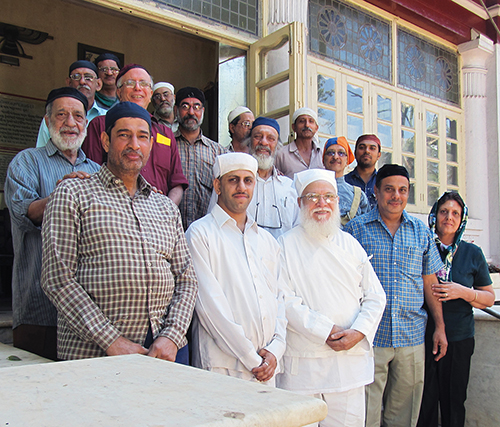
Members of the Yazdaan group with priests outside the N. Choksi Dar-e-Meher in Panchgani
Bomi Mistry has been ardently serving the cause of fire temple renovations for the past 19 years. He is one of Tata Electric’s most loyal and long standing employees. A large part of Mistry’s salary is spent on this volunteer work while wife Veera is most supportive in taking care of the day-to-day expenses from her salary. Their daughter Delzeen is studying commerce.
Nozer Sutaria, a design engineer with the Mazagaon Docks, has been part of the team since 1998. He is very active on the Nowroz Baug residents committee and trains the community youth at Rustom Baug for sports meets. He is married to Jasmin who works for Kansai Nerolac and their sons Parastaar and Arish study graphic design and commerce respectively.
Keki Denugara who has retired from Bombay Dyeing is a full-time, dedicated social worker involved in fund-raising for these projects.
Neville Bhopti, the youngest team member, has been associated with the team for over 12 years. It was under his guidance that the old tiles at the Dadysett Atash Behram were polished to a gleam. He works with an air-conditioning firm, and with his wife Tanaz is looking forward to the birth of their twins.
Noshir Vazifdar, one of Mistry’s stalwarts, most dedicated to the ethos of the team, worked in the office at Mazagaon Docks. He is a confirmed Parsi bachelor!
Phirozshaw Shroff who retired from the Taj Group of hotels as a project engineer is the ideal person to head the purchase team. He is married to Katy.
Jimmy Siganporia, a retired banker is married to Siloo. They have three sons are working in the merchant navy, with Jet airways and in a business.
Homiyar Mehta works as a foreman for the Bombay Port Trust. His wife Jasmine is a homemaker, son Kaizad is working for Tata Consultancy Service and daughter Simin is studying.
Soli Kodia serves as an estate supervisor at Behram Baug. His wife Yasmine is a homemaker and son Ramin is studying for a degree in mechanical engineering.
Gev Bhathena works for the Gujarat Electric Board. His wife Jaklin is a homemaker, son Khoremand is doing his MPharm and daughter Kainaz, BHMS.
Supportive members are Vistasp Damania, Nozer Meherji, Rumi Sidhwa, Rohinton Patel, Cyrus Irani, Aspandiar Irani, Tanaz Kerawala, Khurshed and Jeroo Desai, Yasmine Dumasia and Dara Mistry.
Occasional volunteers are Kaizad Mehta, Ardeshir Khushroshahi, Aspi, Burzin and Behzad Mandviwalla, Eruchshaw Billimoria, Khushru Petiawala, Khoremand Bhathena, Khushru Malesaria, Jimmy Italia, Parvez Gandhi, Firdosh and Parvez Zaiwalla, Hosi Madon, Fram Hakamaneshi, Jamshed Irani, Zarir Debara, Zubin Jasoomani, Rushad Mehta, Hoshdar Pochara, Pourus Nekoo, Kaiwan Amrolia, Parastaar Sutaria, Pervez Mehta, Meherji Dordi, Sohrab Irani and Nariman Mogrelia.