
Cover Story
Mahuva’s Mogal mohalla
As a salute to Lt Cdr Firdaus Mogal of the Indian Navy, a road is named after the braveheart who perished at sea after saving six of his teammates
In commemoration of Shaurya Chakra awardee Lt Cdr Firdaus Mogal’s last act of bravery, the erstwhile Parsi Mohalla (road) in Mahuva village, 28 kms from Navsari, was named after the gallant naval officer on September 11, 2016. The function was attended by gram panchayat (village administration) members, office bearers of the Shree Mahuva Parsi Anjuman and other nearby anjumans, members of the family of the late naval officer, district officials from Surat, politicians from the legislative assembly, and a minister of the Gujarat cabinet. Thirty-six-year-old Mogal died amidst choppy seas, after saving the lives of his team members who were at risk of drowning while repairing their submarine INS Shankush (see "Submariner’s supreme sacrifice,” In Memoriam, Parsiana, September 21, 2010). The peacetime equivalent of the Vir Chakra, and third in order of precedence after the Ashok and Kirti Chakras, the Shaurya Chakra is awarded for courageous action or self-sacrifice while not engaged in enemy warfare.
Under a shamiana outside the daremeher building that marks the beginning of the street that once had several Parsi homes, guest of honor Cmde Aspi Marker (Retd) unveiled the plaque revealing the new name, amid applause from the gathering. Mogal’s parents Armin and Darabshah maintained solemn faces. The audience later walked past the Mogal family home, abode to Firdaus’extended family to this day, to the end of the newly-named street where chief guest Ganpatsinh Vasava, minister for tribal welfare, tourism, and forests and environment in the Gujarat government, who has also served as speaker of the assembly till August 2016, unveiled another plaque marking the end of the road.
Under a shamiana outside the daremeher building that marks the beginning of the street that once had several Parsi homes, guest of honor Cmde Aspi Marker (Retd) unveiled the plaque revealing the new name, amid applause from the gathering. Mogal’s parents Armin and Darabshah maintained solemn faces. The audience later walked past the Mogal family home, abode to Firdaus’extended family to this day, to the end of the newly-named street where chief guest Ganpatsinh Vasava, minister for tribal welfare, tourism, and forests and environment in the Gujarat government, who has also served as speaker of the assembly till August 2016, unveiled another plaque marking the end of the road.
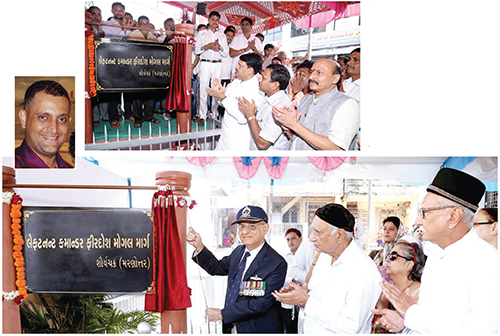
Firdaus Mogal; Unveiling the plaques: top, by Ganpatsinh Vasava,
(in white kurta); above: by Cmde Aspi Marker (Retd)
Between the two unveilings, Darabshah walked Parsiana’s representative through the daremeher structure that is being renovated by a scion of the Mogals, who have lived in Mahuva for several decades. The dadgah-grade fire is currently housed in an adjacent hall. Darabshah proudly points to a portrait of his son, installed there in January 2013, pursuant to a resolution passed by the Mahuva Anjuman, two years after Firdaus’ brave act in August 2010. What would be his reaction if his grandson Yashaan wanted to join the Navy? "I would not stop him. I did not stop Firdaus. I won’t interfere,” Darabshah stated simply.
"Aa prasang dukhno chhè, pan vishésh chhè (this is a sad but important occasion),” said Hosi Bajina, president of the Mahuva Anjuman, setting the tone for the various speeches that followed in chaste Gujarati in the nearly packed 700-seater air conditioned auditorium of G. H. Bhakta Sarvajanik High School. The first ever function to be jointly hosted by the gram panchayat and the Anjuman, several speakers referred to the milk-in-sugar story, while the minister referred to the harmonious relations between Parsis and Gujaratis over the centuries and commented that the Parsis were ahead of other communities ("bijao né paachhal raakhé”) in patriotism. Cmde Marker ("speaking in my Parsi-Gujarati”) reiterated the events leading up to the braveheart’s death on that fateful day in August 2010, explaining how Mogal had saved six lives. He summarized details of the solemn ceremony with full military honors that preceded the funeral.
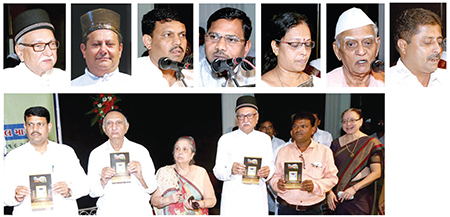
(L to R): Dr Hoshang Mogal, Hosi Bajina, G. Vasava, Parbu Vasasva, Nila Patel,
Nalin Vyas, Nikhil Vyas; releasing Bhar baporé suryast
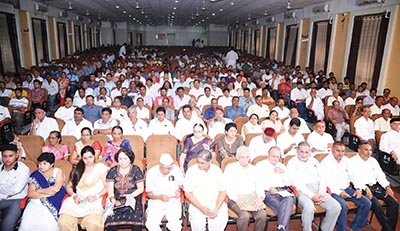
Audience
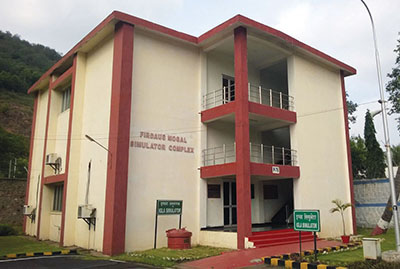
The Firdaus Mogal Simulator Complex building, Vizag
Dr Hoshang Mogal, uncle of Firdaus, and trustee of the Anjuman, quoting from the Atash Nyaish informed the predominantly Gujarati audience that in that prayer the supplicant prays to Ahura Mazda that "éva santan paida karrav jé gher, gaam, khaandaan, dharam ané desh né aabad karé (give birth to those sons who bring glory to the house, village, family, religion and country they are born in),” a subtle reference to Firdaus’ gallantry. In a voice that was only slightly a-quaver, he recalled that at Bombay’s Doongerwadi, when the late naval officer was consigned, a press reporter had asked his brother Darabshah what his feelings were on that occasion. The grieving father had then retorted that every family should have one member in the armed forces, narrated Dr Mogal.
A second edition of Bhar baporé suryast (Sunset at noon), a commemorative volume, first published by Dr Mogal in January 2013, was released by the dignitaries present. Writing in the second edition, trustee of the Surat Parsi Panchayat, Yazdi Karanjia who was also present in the audience stated that Firdaus’ story of bravery ("sahaskatha”) would continue to inspire the youth of the region.
After Dr Mogal’s vote of thanks on behalf of his family, the assemblage partook of a community lunch.
Memories of Firdaus
At the sidelines of the function, while walking through the school compound, Dr Mogal revealed that there was no history of service in the armed forces in their family. "Probably he was inspired by his maternal grandfather, Lt Col Jal Daruwala of Ahmedabad,” said the professor.
Marker mentioned that it was he who had enthused Firdaus to be a speaker at the Holiday Programme for Youth (HPY) of the Bombay Parsi Panchayet (BPP) for the participating children. He was all praise for the speed with which the then trustees of the BPP provided permissions for the naval honors at Doongerwadi prior to Firdaus’ funeral. Previously, such an honor had been accorded at the funeral of others like Vice Adm Jal Cursetji.
Diana Marfatia, architect of the HPY program, informed Parsiana on September 13, 2016 that when Firdaus first participated as a student back in 1990, he was "an astute and disciplined young lad even when he was only 16 years old.” Stating that "he knew his mind and had the determination and grit to chase his dreams,” she is appreciative that "his high moral values and hard work made him scale the ranks in the services quite fast.” Adding that Firdaus "came back to HPY as faculty with a string of decorated officers from all the three services to convince the young Parsi boys to join the services,” she rues that "this career did not seem to catch the fancy of our youngsters.”
At the sidelines of the function, while walking through the school compound, Dr Mogal revealed that there was no history of service in the armed forces in their family. "Probably he was inspired by his maternal grandfather, Lt Col Jal Daruwala of Ahmedabad,” said the professor.
Marker mentioned that it was he who had enthused Firdaus to be a speaker at the Holiday Programme for Youth (HPY) of the Bombay Parsi Panchayet (BPP) for the participating children. He was all praise for the speed with which the then trustees of the BPP provided permissions for the naval honors at Doongerwadi prior to Firdaus’ funeral. Previously, such an honor had been accorded at the funeral of others like Vice Adm Jal Cursetji.
Diana Marfatia, architect of the HPY program, informed Parsiana on September 13, 2016 that when Firdaus first participated as a student back in 1990, he was "an astute and disciplined young lad even when he was only 16 years old.” Stating that "he knew his mind and had the determination and grit to chase his dreams,” she is appreciative that "his high moral values and hard work made him scale the ranks in the services quite fast.” Adding that Firdaus "came back to HPY as faculty with a string of decorated officers from all the three services to convince the young Parsi boys to join the services,” she rues that "this career did not seem to catch the fancy of our youngsters.”
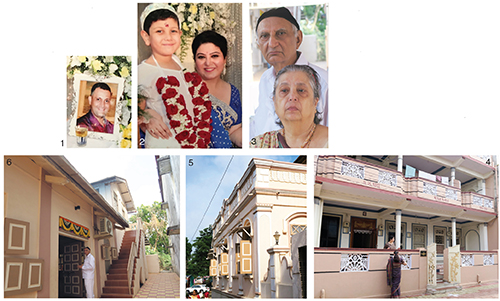
Clockwise from right: 1) Late Firdaus; 2) Yashaan and Kerzin Mogal; 3) Darabshah and Armin;
4) Manek Wadi; 5) Daremeher building; 6) Mogal family home Photos 3, 4, 5 & 6 by Farrokh Jijina
Firdaus’ wife Kerzin, who received the naval officer’s posthumous Shaurya Chakra from President Pratibha Patil in April 2012, informed Parsiana on the phone on September 14, 2016, that their nearly eight-year-old son Yashaan "is an avid swimmer … he talks, walks and argues like his father,” who she referred to as "my lion-heart Mogal.” A senior fashion designer with celebrity Masaba Gupta’s ready-to-wear label, she lives with her mother Shiraz Sarbhanwala in Bombay. Kerzin states that a building for training submariners within INS Satavahana, a naval facility in Visakhapatnam, has been renamed after the late Firdaus in 2012. A note from Marker and Cmde Medioma Bhada mentions that INS Satavahana was Firdaus’ alma mater and that he had worked towards setting up the ‘simulator complex.’ Yashaan remembers Firdaus "more with pride than with sorrow,” states the mother. At school assemblies on national days, he is very happy to speak about his father, she shares. Firdaus would be very proud of him too,” Kerzin says, before connecting us on phone to the lad.
"Do you know, when my father was my age, he would go to Ahmedabad (to meet his grandparents) on his own?” the boy asks us. "It is because of him, that I am so brave,” he continues. A winner of interschool and district level competitions in swimming, his favorite subject at school is history. Stating that he wants to be a biologist when he grows up ("to study life and living organisms and cells and stuff”) and to play kabaddi at the competitive level, he fires this volley: "please write about me when I win medals” in that sport!
Mahuva sidelights
Dr Mogal reveals that he and his co-trustees look after the maintenance of the daremeher structure, three defunct dakhmas, and the community hall, Manek Wadi. The other trustees are Hosi Bajina, Rohinton Mogal, Parvez Bacha and Manek Mogal. Another trust, Mahuva Vibhag Garib Parsi Jarthosti Madad Fund assists needy Zoroastrian students with roots in and around Mahuva to complete their education, disbursing upto Rs 1,00,000 each year.
"There is only one Parsi family home that is occupied round the year in Mahuva, ours,” stresses the academician who taught chemistry in a Navsari college till he retired a decade ago. The Anjuman has about 60 registered members, he explains, including those who live in the nearby villages of Bartad, Kokerbeda and Dholikur and those who have settled in Navsari or other cities. A dadgah fire was established by the locals of Mahuva in 1859 and the daremeher building came up in 1910, with funds provided largely by the Patel family of Bombay who also funded the Seth Pirojsha Ardesher Patel Daremeher in Andheri. "We sent our young men who were then studying in Bombay to that trust, and on hearing our appeal, they gave some funds,” says the proud professor, pointing to an image of an effusive hand-written thank-you letter addressed to Ardesher Patel, the benefactor, signed by the Parsis of Mahuva, printed in the centenary souvenir of the daremeher. A mobed was attached to the place of worship till the late 1970s.
"None of the dakhma property is encroached upon,” says the professor. He could not say who endowed the first tower of silence or when it was built, but dates it to the period between 1740 and 1750. The second was endowed by the Poonjiaji family in 1833. The third, endowed by Sir Dinshaw Petit, was erected in 1885. Reporting on the laying of the foundation of the third dakhma, the Jam-e-Jamshed of December 29, 1885 (reproduced in the centenary souvenir) stated that "Sir Dinshaw was welcomed to Mahuva by Parsis, Hindus and Muslims and others with shouts of joy ("khushali no pukar”) making their enthusiasm apparent.”
◆ ◆ ◆
From the archive