
Politics and Policy
Reining in the radicals - V
Maintaining community assets in the face of declining numbers continues to pose a challenge
Anjumans that are dwindling in numbers should accept the custodian trusteeship of the Federation of the Parsi Zoroastrian Anjumans of India and safeguard their properties against land mafias and unscrupulous developers, recommended Tehmton Anklesaria, vice president of the north zone of the Federation. At the executive council meeting of the Federation on October 9-10, 2010 he brought to light the instance of Mhow anjuman which despite being the first to accept the custodian trusteeship of the Federation has not been able to hold elections even though its bylaws were altered to reduce the strength of the managing committee. With the approval of the Federation and on the orders of the Registrar of Public Trusts, Mhow, the anjuman has filed a new scheme awaiting the sanction of the Mhow court.
While the strength of the Mhow anjuman is less than 50, it has an agiary, dharamshala, doongerwadi and more than a dozen residential buildings to accommodate its members. In other areas of Madhya Pradesh like Harda and Itarsi, where no Zoroastrians now reside but aramgah property remains, the Federation is making concerted efforts to save the encroached lands. On the land revenue records of the 20-acre plot in Harda, usurpers have wrongfully entered their title by adverse possession. Itarsi has a graveyard with two bighas of land in the heart of the city that is encroached upon.
Should the Federation involve itself in the matter of the Kashmir Parsi Aramgah Trust? deliberated the house when Jennai Banaji conveyed that the remaining trustees due to reasons of age cannot take on the responsibility. Whilst their corpus of seven lakh rupees is in the safekeeping of the Bombay Parsi Punchayet (BPP), another lakh of rupees is in the Jammu and Kashmir Bank in Poona. "If more funds are needed, we will raise,” she assured. The one-and-a-half-acre aramgah plot where stands the walled graveyard, a prayer hall, gardener’s room and orchard is on military land where "we have every right… free access.”
Questioned Federation president and BPP chairman Dinshaw Mehta, "If the military has control of ownership, do we have any other title papers? Can it be used for any other purpose? We don’t want to take on the Army.” Farokh Rustomji, being the erstwhile secretary of the Delhi Parsi Anjuman which under the presidentship of the late Lt Gen Adi Sethna had been asked to assist in this matter briefed the delegates that civilian access to the land is limited and we should use the good offices of senior military personnel like retired Air Chief Marshal Fali Major. When Mancher Mubaraki of Dahanu commented, "How will it help us to hold on to the land?” Feroza Punthakey Mistree responded, "History is in the graveyards…”
Normally Sorab Katpitia who handles the defunct anjumans portfolio would have given a detailed report of the struggle he encounters in trying to secure community lands that have been wrongfully usurped by the last Zoroastrians residing in the area or non-Zoroastrians taking advantage of their naivete. Due to paucity of time Mehta had to repeatedly request Katpitia to make the rest of his presentation in the boardroom of the Punchayet. But the octogenarian who faces intermittent spells of hearing difficulty could not contain himself and would keep interjecting even as members of other anjumans sought to give a brief overview of their activities.
He was happy to report that in Beena the officials have agreed to include the Federation name on the five-acre cemetery after which the land can be disposed of at fair price. After the protracted discussion on Dharwar which was the first defunct anjuman property to yield an income to the Federation (see "Reining in the radicals,” Parsiana, October 21, 2010) he referred to Bhu-sawal where reside the last seven-eight Parsis. While efforts are ongoing for the last five years he has not been able to make any progress there. At Gadag in Karnataka, Katpitia reported that negotiations are near completion. He further questioned the creation of a Zoroastrian Blood Bank in Nanded where only the last trustee is surviving. Due to the indifference of such community members "Federation naa maathé toplu vadhtu jaay (the load on the Federation keeps increasing),” he lamented.
When introducing himself on the first day Maj (retd) Noshir Marfatia of Ajmer had referred to only six Zoroastrian families remaining in the area. They have an agiary that is 114 years old and a dakhma that is 120 years old. "No BPP or Punchayet has tried to help us with a single rupee... One day our agiary will come to an end like the Bhuj agiary,” he forewarned. (Though there are no Parsis in Bhuj, the dadgah is maintained by non-Parsis and has a Parsi board of trustees that sees to its welfare — editors.)
When Adil Vania of Badnera-Amravati reported that they have a population of 10 since the last 45 years, realizing the pitfalls of such a dismal scenario Katpitia declared, "Aag laagé taré kuvo khodé tau soo kaamnu (what is the sense of digging a well after a fire has broken out)?”
This same Gujarati idiom was earlier used by Areez Khambatta, vice president of west zone B, in the context of priests being unwilling to look after the fires in the smaller anjumans. Residents of such areas who are retired and with a religious bent of mind should be encouraged to train as paramobeds if they are not from athornan families so that they can perform some, if not all religious ceremonies, he advocated. Jam-e-Jamshed correspondent Marzban Giara informed the gathering that The M. F. Cama Athornan Institute Ex-Students’ Association conducts refresher courses every year in May where anjumans can send their members for training.
"Jimmy Mistry (BPP trustee and founder of the Parsi Resource Group) has 750 mobeds on his roll,” announced Khambatta but by then Mistry had excused himself from the meeting. Actually discussions on the Agiary Adoption Scheme were deferred to the second day so that Mistry could participate in them. But with the Sunday sessions having started late after 11 a.m. and the guest speakers making their presentations in the pre-lunch session, Mistry had to leave as "Sunday lunch is with the family,” explained Mehta.
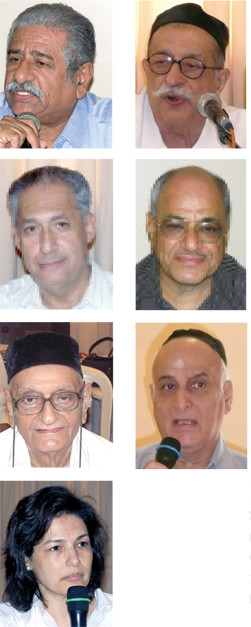
Clockwise from top left: Dinshaw Mehta, Areez Khambatta, Kerfegar Antia, Maj Noshir Marfatia, Jennai Banaji, Sorab Katpitia and Tehmton Anklesaria
The Agiary Adoption Scheme as envisaged by Khambatta is meant to support those needy anjumans which are not able to maintain their agiaries or offer adequate remuneration to their priests. But while financial commitments have come forward in the form of donors like Kerfegar Antia, vice president of the south zone, there have been no appeals from agiaries. Khambatta’s plan is to make a list of deserving agiaries so that they can be made functional, if possible, or their atash padshah shifted to associations like Borivli or the Nirlon Complex at Goregaon, the residential colony being developed by the BPP. Another plan is to build a hospice for holy fires so that they are well taken care of at a predetermined place until a better location is found for them.
But even donors like Antia sought details: "What is the scheme? Is it compulsory for a donor to make a lifelong commitment?” The cost of adopting an agiary could range from Rs 5,000-15,000 a month, stated Khambatta, adding, "The man on the street knows about WZO (World Zoroastrian Organisation) but no one knows about the BPP because they have no PRO (public relations officer).” Contrary to what Khambatta stated, the BPP has a PRO, Godrej Dotivala.
Mehta admitted that the details of this scheme were "vague and not clearly worked out; let us do our homework first before approaching the anju-mans.” Khambatta though was persistent: "If you don’t want to make a start, nothing will come out of it. Give one lakh to the Federation on full trust. We are very flexible. I don’t like working with the accelerator on one side and brake on the other. Too much petrol then goes waste. Count me out. Let someone else do it.” He was disappointed that most of the anjumans had not taken the trouble to fill out the questionnaire circulated by the Federation secretariat seeking information on the anjuman with details of the religious and community institutions managed by it. "Once we collect the forms and compile the data we will be in a better position to assess the needs,” summed up Mehta.
With agiary repairs costing between five to 10 lakh rupees, "We will only consider those that can’t last the next monsoon,” stated Khambatta. In Gandevi, Phiroze Gandevia reported that three lakh rupees were needed to repair their agiary roof. "Where there is no patronage of an agiary, why spend on its repairs?” enquired Noshir Paghdiwalla of the Borivli and Suburban Zoroastrian Association adding, "Shift the agiary fire to a place like ours.” Assured Federation joint honorary secretary Khojeste Mistree, "Before the next meeting of the Federation in Bombay, we will be able to give you an atash padshah, one of your choice.”
Those attending the Federation meeting were: Maj (retd) Noshir Marfatia from Ajmer; Noshir Captain and Adil Vania from Badnera-Amravati; Homi Pitha-walla from Bardoli; Maki Kapadia from Belgaum; Marazban Baria from Billi-mora; Dinshaw Mehta, Jimmy Mistry, Khojeste Mistree, Yazdi Desai, Armaity Tirandaz, Godrej Dotivala, Mehli Colah, Cawas Panthaki and Ronny Patel from Bombay; Noshir Paghdiwalla, Minoo Khan and Khurshed Pastakia from Borivli; Darius Marshall from Calicut; Rohintan Italia and Parvez Italia from Chikhli; Marzban Magol and Mancher Mubaraki from Dahanu; Marazban Wadia from Davier; Dadi Mistry from Delhi; Parhad Postwala from Dumas; Mabrin Nanavatti and Ariz Bokdawalla from FOZYA (Federation of Zoroastrian Youth Associations); Phiroze Gan-devia from Gandevi; Kerfegar Antia and Keki Colah from Hyderabad-Secun-derabad; Pervin Jehangir and Mehroo Panthaki from Ilav; Bomi Heerjee from Indore; Pervez Irani, Mehrwan Irani and Gaiv Irani from the Iranian Zoroastrian Anjuman; Kerman Batliwalla from Jabalpur; Ronny Dick and Firoz Pestonji from Jhansi; Jennai Banaji from Kashmir Parsi Aramgah Trust; Pervez Khergamwalla and Tannaz Parakh from Khergam; Mani Clubwala and Kersi Shahuna from Madras; Yasmin Sanjana from Mahuva; P. G. Mandviwala and Godrej Hansotia from Mandvi-Mangrol; Kersi Daruwala from Mt Abu; Rayomand Madan from Nagpur; Hoshang Wania and Farroakh Govadia from Nargol; Farokh Kavina and Jimmy Bacha from Navsari; Noshir Jal from Neemuch; Homi Pardiwala from Pardi; Noshir Nanavatti and Porusasp Mehta from Poona; Khushman Tambulli from Rajkot; Tehmton Anklesaria from Rat-lam; Dinshaw Patel, Sarosh Poonawala, Jehangir Mandviwala and Yezdi Pan-thaky from Saronda; Jamsheed Kanga from Satara; Dr Firdos Shroff and Anahita Desai from Sholapur; Dara Gandhi from Tavdi; Zarsis Udhnawala, Zarsis Sachchinwala, Pervez Bhesania and Kaizad Billimoria from Thana; Sam Chothia and M. F. Dhanbhoora from Valsad; Keki Lakdavala from Vesu; Cmmdr Jal Postwalla and Dinyar Nakra from Vizag; Persi Buhariwala, Dr Bahadur Jokhi and Sarosh Buhariwala from Vyara; Adi Mehta from Zai Bordi. The Press was represented by The Times of India, Jam-e-Jamshed and Parsiana.
The office bearers who were not representing their Punchayet were west zone B vice president Areez Khambatta, joint honorary secretary Pervez Mehta and executive secretary Arnavaz Mistry. The guest speakers were Burjor Antia, Sorab Katpitia, Nozer Meherji, Pareecheher Daviervala, Kaizeen Jehangir, Tashan Mistree and Darayus Tirandaz.
◆ ◆ ◆
From the archive