
Politics and Policy
Reining in the radicals-IV
Youth affairs and problems facing outstation anjumans were hastily discussed at the Federation meeting
"What have you done for the youth of your anjuman? How many have taken an interest in sending your youth to the youth meets?” questioned Mabrin Nanavatti, president of the Federation of Zoroastrian Youth Associations of India (FOZYA) at the post-lunch session on the second day of the meeting of the Federation of the Parsi Zoroastrian Anjumans of India (FPZAI) on October 10, 2010 in Bombay. At the last youth meet in Poona in May 2010 among visiting contingents, there was maximum representation from Ahmedabad, fol- lowed by Navsari although it has no youth body, he specified. For the youth meet in Poona, each participant was only expected to contribute Rs 500 although FOZYA expended Rs 3,500 per participant. This was possible thanks to the sponsor- ship support of Dr Cyrus Poonawalla, acknowledged Nana- vatti.
Surat has about 25-30 youth who are ac- tive in sports. Banga- lore has a floating population of 35-40 youth. His reference to Nagpur having no youth group and the Hyderabad youth body being inactive made Federation south zone vice presi- dent Kerfegar Antia comment, "With great difficulty we could collect eight people to participate in Dance Bawa Dance [orga- nized by the Zoroas- trian Youth for the Next Generation (ZYNG)] even though all expenses were assured…What more can the Anjuman do? What a sorry figure the Anjuman has cut (when the team selected for the finals chose not to participate due to examinations and other pressures).”
Welcoming youngsters, particularly from the smaller anjumans of Saronda, Ankleshwar, Bharuch, Umbergaon, to the next youth meet in Baroda from November 6-8, 2010 Nanavatti stated, "Don’t consider it as just a matrimonial (opportunity). They are more interactive meets.”
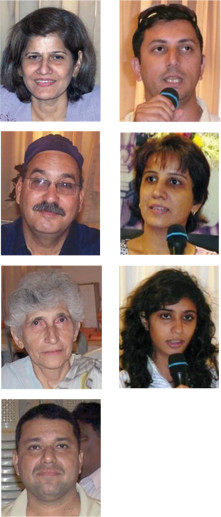
Clockwise from top left: Arnavaz Mistry, Mabrin Nanavatti, Pareecheher Daviewvala, Kaizeen Jehangir, Pervez Mandiwala, Maki Kapadia and Mancher Mubaraki
The matrimonial bureau of the Bombay Parsi Punchayet (BPP) has been reactivated since February 2010 under trustee Arnavaz Mistry. With 69 girls and 172 boys registered, they have held eight meets, on the second Saturday of each month. While some of them have found suitable part- ners and have started dating one couple has decided to marry, re- ported Mistry urging those from out of Bombay "to use this initiative to find their soul mate.”
Describing this ef- fort as being "done half-heartedly,” Areez Khambatta, vice president of west zone B declared, "You can’t do any- thing in two hours.” He suggested Bom- bay replicate the "fantastic” working of Ahmedabad where he had planned full day and overnight trips for matrimo- nial hopefuls to know each other. When Federation president and BPP chairman Dinshaw Mehta referred to the upcom- ing matrimonial meet on November 20-
21 organized in Bardoli, Khambatta shot back, "Sorry sir, this is an excuse for not doing anything.” He further expressed his "surprise” that Bardoli had orga- nized such a meeting without having the courtesy to inform their zonal vice presi- dent.
When it was suggested that the BPP website could be used to publicize mat- rimonial information, Mehta pointed out that ZYNG already has such informa- tion on their site. Further the assembly was informed that shaadi.com has a sepa- rate listing for Parsi Zoroastrians but according to Khambatta, "dotcoms are not popular in south Gujarat.”
Mancher Mubaraki of Dahanu re- gretted that "no girls from Bombay wanted to come to Dahanu” and with the prevailing real estate prices in the me- tropolis wondered how the Dahanu boys could hope to relocate to Bombay. Re- sponded Federation joint honorary sec- retary and BPP trustee Khojeste Mistree on behalf of the "present board that is keen to work on the housing front…I hope in five years we will be able to say that there are flats vacant in Bombay.” There are 1,100 on the waiting list at present of whom "perhaps 700-800 must be deserving,” he guesstimated. Lament- ing that legal battles are impeding their progress, Mistree mentioned that the current board is working with "a lot of vision, not building 200-300 sq ft kholi (shanties)” but flats with medical, prayer and parking facilities.
Counseling and careers
"There is no fairy wand to wish away any problem. You have to recognize the problem,” stressed Pareecheher Davier- vala who working as the BPP’s school counselor was in favor of "a realistic way forward.” With eight years of expe- rience she has learnt that for some "coun- seling is not just critical but mandatory.” Her advice to students is to set goals that are "achievable and practicable.” The young counselor was wary of parents who question her saying, "Do you have a kid that you’re telling us what to do?” Whilst she was sympathetic to the "tremendous burden on students,” she was critical of the new policy whereby all students are to be compulsorily pro- moted each year until they reach the ninth grade. "In this false sense of com- fort zone where passing becomes auto- matic why then would a child study? Instead of inculcating the need for hard work and a fiercely competitive spirit,” they feel "why work/study or research? Why listen to teachers?... How can they suddenly change in Std IX?” she won- ders, advocating the need for "amending the syllabus whilst retaining a competitive atmosphere.”
The BPP’s Holiday Programme for Youth (HPY) which has entered its 25th year registered 193 participants last May who had appeared for their school leav- ing examinations from 80 schools, men- tioned Kaizeen Jehangir giving the high-
lights of the 2010 program and announc- ing their future events.
Pass the mike
"Discussion by individual anjumans and punchayets on the status of community properties in their anjumans and their plans for their future maintenance” was a scheduled item on the agenda of the annual gen- eral meeting but having deferred it till the end when they were running short of time, Mehta had to request the representa- tives who had come from different parts of India to speak "if you have a problem, otherwise pass the mike to the per- son next to you.”
The problem of preserving lands used for burial/dakhmenashini was an issue with three anjumans: The trustees of the Sholapur anjuman were summoned by the collector to permit Muslims access to their burial land, stated Dr Firdos Shroff. Adil Vania from the Badnera-Amravati anjuman sought to know whether their dakhma land can be put to other use when they were informed by Mistree that ac- cording to the Ven- didad if the dakhma is not used for 50 years, the land is no longer considered im- pure because there is no naso in the form of a dead body. In Indore they are unable to find volunteers to carry the dead into the dakhma and are contemplat- ing starting an aramgah. The trauma suffered by some who have carried the bod- ies into the dakhma has made them swear never to offer their services again. Pervin Jehangir shared the advice they had re- ceived for the Mhow dakhma land: leave an area of 50 feet around the circumference of the dakhma.
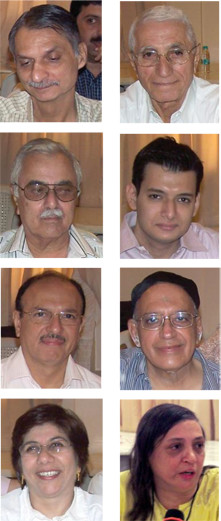
Clockwise from top left: Keki Lakdavala, Farroakh Govadia, Khushman Tambulli, Dinyar Nakra, Pervin Jehangir, Yasmin Sanjana, Zarsis Udhnawala and Noshir Nanavatti
"Because the living are finding it horrific to carry the body doesn’t mean we can make the soul suffer,” declared Mistree. "The mode of disposal is for the benefit of the person dying. A dakhma doesn’t exist on the sen-
timents of the living,” h added citing the Persian Rivayats according to which the soul of a cre- mated person goes to hell. When Indore presi- dent Bomi Heerjee said they would keep open both the options of dakhmenashini and aramgah, Mistree averred, "This mode of disposal is not one of choice.” In Bombay, 95.27 percent of those who die are con- signed to the dakhmas, noted Mistree, adding, in Bangalore when a contro- versy arose regarding the use of a dakhma and aramgah, the Mysore High Court ruled that a dakhma has to be used and be given precedence when both exist (the court ruling stated both could co-exist — editors). "You can’t chop and change traditions to aid the living,” reiterated Mistree. "If the inten- tion and will is strong then we can find prac- tical solutions. We can send volunteers from Bombay. We have flown priests from Bombay to the Nilgiris.”
The Bardoli anju- man needs funds to rebuild its 125-year- old agiary as also to host the matrimonial meet, the costs work- ing out to Rs 3,000 per participant for which they are charg- ing only Rs 500. The Vyara-Songadh anjuman is planning to build a bungli for which they have been promised a dona- tion. Recently, at a cost of four lakh rupees, their young trustee repaired the agiary that serves the religious needs of 150 Zoroastrians.
Belgaum has lost 20 feet of its land in road widening work. It is badly in need of funds to rebuild its bungli, conveyed Maki Kapadia. "Under law you have a right to seek compensation,” advised Mehta. "They think Parsis are timid and won’t fight back so they take advan- tage.”
The farmers in Mandvi-Mangrol are living in a pathetic condition, mentioned Pervez Mandviwala. There are more than
100 families living there but most of the children have left for Navsari and Bombay. There are 30 Zoroastrians re
siding in Vesu (now considered a part of Surat) of whom 10 are very poor, reported Keki Lakdavala. The agiary there is managed by a separate trust. The Nargol anjuman has an annual income of three lakh rupees but expenditure of five lakhs, the shortfall being met by "donations from sethias,” reported Farroakh Govadia. Having planted 1,200 bawal saplings, mangoes, grass cultivated by drip irrigation they hope their anjuman will be self sufficient in 10 years. After rebuilding the quarters of the manager, gardener, nassessalars, the godown area, their next priority is to build a tarred approach road at a cost of 10 lakh rupees since the dirt track is difficult to use during the monsoons.
"We are thriving,” reported Noshir Nanavatti, chairman of the Poona Parsee Panchayat referring to the community strength that is supposed to be upward of 10,000 (the Government of India census figures placed it around 4,000 — edi- tors). "We do not have much finances but we have lots of land,” he declared, issuing an "open invitation to build on our lands for Zarathoshtis.” Their 69 acres of land in the heart of the city is reportedly worth thousands of crores.
The Rajkot anjuman too is rich with property worth 70 crore rupees. "My personal aim is to ensure that not only 16 people but 69,000 benefit from our as- sets,” announced Khushman Tambulli before an appreciative audience. Jabal- pur’s endeavors are to safeguard its prop- erty for the few Zoroastrians remaining in the area, said Kerman Batliwalla.
The fire in Saronda is "burning bright,” stated Ervad Yezdi Panthaki. Secunderabad-Hyderabad has three agiaries to serve its Zoroastrian popula- tion of 1,200, noted Keki Colah. The dar-e-meher in Madras celebrated its centenary in July this year, mentioned Mani Clubwala, while the agiary in Mahuva was to observe its centenary on October 30, 2010, as noted Yasmin Sanjana.
There are nearly 700 Zoroastrian resi- dents in Thana of whom around 500 are members of the anjuman, stated Zarsis Udhnawala. With a corpus of about 45 lakh rupees, they expend five lakh ru- pees on different religious, medical, edu- cational and social objects with an active service force of youngsters who are will- ing to help in any emergency 24x7. While litigation is still ongoing on their land encroached by the Shiv Sena, the anju- man is hopeful of gaining possession and would welcome any assistance in the matter.
The Iranian Zoroastrian Anjuman in Bombay gave nearly Rs 40 lakhs in charity helping 385 individuals with educational help, 615 for medical, and 192 for relief of poverty.
In Visakhapatnam there reside only five Zoroastrians now, the youngest be- ing 50 years of age, reported Dinyar Nakra. They have a small aramgah ad- measuring 65x45 feet within the mu- nicipal burial/cremation ground with about 11 graves. Their corpus funds are in the vicinity of Rs 20,000.
(The final report of the Federation proceed- ings will appear in the December 21 issue of parsiana.)
◆ ◆ ◆
From the archive