
In Memoriam
The untiring urologist
Died: Dr Dara Kaikhushroo Karanjavala, 88, father of Indian urology, on May 9, 2010 at Bombay’s Breach Candy Hospital following advanced carcinoma of the right kidney resulting in multi-organ failure.
"He has been the father of urology in India having been held in high esteem and has helped a large number of students prosper in life in India and abroad,” noted a condolence letter from eminent urologist Dr Fardoon Soonawalla who considered it "a great privilege to have Dara as a friend and senior colleague who helped me in my career... Dara was a unique and much loved person and exuded happiness wherever he went.”
Four months before his demise, the president of the Urological Society of India (USI) came from Madras to Karanjavala’s residence in Bombay to invite him to be the chief guest at a USI meeting in Agra in February 2010. Despite a fracture in the right wrist, the senior acceded to the request and proceeded to Agra where he was presented an appreciation award for being the first national delegate (in 1958) to the Societe Internationale d’Urology (SIU). Karanjavala reinforced the need for the fraternity of urologists to progress with unity. It was in the same town of Agra that Karanjavala had presented his first paper on "Micturating Cysto-Urethrography as a Diagnostic Aid in Paediatric Urology” under the aegis of the Association of Paediatricians of India in 1957, as conveyed by his secretary K. P. S. Narayanan.
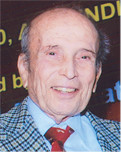
Dr Dara Karanjavala: sincere and modest
Despite his advancing age, he made it a point to attend as many medical meetings/conferences as possible to keep abreast with the recent advances in medicine, and urology in particular. His participation in the World Congress on Endourology (WCE) and Shock Wave Lithotripsy in Bombay in 2004 earned a mention in the WCE newsletter which gave the octogenarian Karanjavala credit for being present "at 7.15 a.m. to watch the Robotic Radical Prostatectomy relayed live from Detroit... Karanjavala was amazed and thrilled to see the progress achieved in modern urological treatments but expressed concern about the potential for a possible abuse of modern technology. One must not forget, he emphasized, that the need for establishing a clinical diagnosis by history and physical examination are as important today as in the past.”
The pioneer in urology was "a wizard with the cystoscope which he handled with great dexterity and skill,” summed up Dr Hirji Adenwalla, head of the Charles Pinto Centre for Cleft Lip and Palate, Jubilee Mission Medical College and Research Institute, Trichur, Kerala, who had served under him for a short time at the Jerbai Wadia Hospital. "When I entered medical college, Dara was already a house surgeon at the K. E. M. Hospital (KEM). I remember him dropping in at the dissection hall one morning to see Farokh Udwadia and me (we were partners is anatomy) dissecting our first part — the superior extremity.”
Karanjavala had a long association with the KEM from 1955 to 1980 and retired as the head of the Department of Urology and also the Kidney Transplant Department. He also headed the Department of Urology at the Bombay Hospital and was on the panel of urologists at the Breach Candy Hospital, the B. D. Petit Parsee General Hospital, Tata Memorial Hospital, INS ASWINI Armed Forces and other hospitals. At the Sher-e-Kashmir Institute of Medical Sciences in Srinagar he served as advisor for several years, mentions Narayanan impressed that the sincere surgeon had resumed his active life after the coronary artery bypass graft.
Bombay born, Dara was the youngest of three children born to Kaikhushroo who served in the postal department and Minnie who was a home maker. After his schooling in Panchgani he graduated in medicine and postgraduated in surgery from KEM. Subsequently he gained experience in Lambeth/Dulwich Hospitals in London for some years interacting with eminent urologists like Drs Terrence Millins and Alec Badenoch. During this time he also qualified as a Fellow of the Royal College of Surgeons. On his return to Bombay he chose to specialize in genito-urinary problems.
Conferred the Padma Shri Award by the Government of India in 1983, three years later he was presented the Dhanvantari Award. He was the first Asian to receive the St Paul’s Gold Medal from the British Association of Urological Surgeons, England in recognition of his notable contribution to urology outside the UK. In addition to his membership/fellowship of professional bodies like USI and SIU, Karanjavala was affiliated to the British Association of Urological Surgeons, American College of Surgeons, Royal Society of Medicine, National Academy of Medical Sciences... In 1969 he was offered the prestigious Huntarian Professorship by the Royal College of Surgeons in England.
His professional expertise brought him in contact with eminent personalities in the world of business, politics, rulers of erstwhile princely states of India like Dr Karan Singh, Farooq Abdullah, B. K. Nehru, L. K. Jha. But that did not make him forget the underprivileged. The poor Kashmiris held a special place in his heart and on his annual trips there he would offer free medical advice as also certain medicines. Many anecdotes concerning Kashmiris feature in his Memoirs, published in 2003. When reviewing the book Adenwalla had commented ("Karanjavala reminisces,” Books, Parsiana, November 2004), "Simple and modest in style, typical of the man...”
An ardent traveler Karanjavala had visited numerous countries with his family. Kashmir though was a favorite destination for both Dara and his wife Khorshed who would spend a couple of months there each year. As per Khorshed and Dara’s wishes their ashes were scattered around the base of the magnolia tree at the Parsi graveyard in Srinagar, five years apart.
Whilst proud of his Parsi lineage and the community’s excellence in different specializations, he was concerned about the dwindling numbers. As Parsis progress and prosper, integrating with the changing national and international scene, religious rules and regulations should also keep pace, believed the surgeon. Besides being a trustee of the R. M. Mehta Parsi Charitable Dispensary Unit, Karanjavala was also a trustee of the H. D. Saher Agiary Trust and the N. S. Saher Charity Trust. Reading being a passion with him he enjoyed his copies of Parsiana. "The moment Parsiana arrived he used to keep aside whatever other magazine he was reading and switch over to Parsiana,” conveyed Narayanan. He enjoyed watching games of tennis and cricket as also programs on nature, science and animals on television. During their college days Adenwalla recalled "long sessions of exhausting table tennis with him on Sunday afternoons. I remember he played an aggressive attacking game and had me with my back to the wall most of the time.”
As senior surgeon, 94-year-old Dr C. G. Saraiya who had known Karanjavala for over five decades noted in his condolence letter, "Apart from his reputation as a urologist, he was a very fine man — kind, gentle, mild and honest to the core.”
The sensitive surgeon is survived by his urologist son Dr Jehangir and daughters Minnie Alexander Badenoch and Shireen Karanjavala Bisol.
◆ ◆ ◆
From the archive