
In Memoriam
The spirited surgeon
Died: Dr Tehemton Erach Udwadia, 88, considered the father of laparoscopic surgery in India, founder president of the Indian Association of Gastrointestinal Endo-Surgeons and founder chairman of the Center of Excellence for Minimal Access Surgery Training (CEMAST); of cancer at the Breach Candy Hospital in Bombay on January 7, 2023.
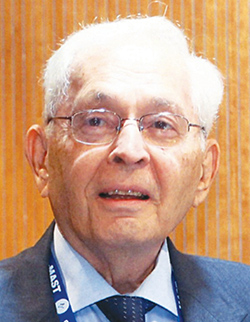 "The motto of my alma mater G. S. Medical College is something I have always lived by: ‘You are here not to worship what is taught but to question it.’ Questioning things rather than blindly accepting them has been an integral part of my journey, be it for advancing the cause of laparoscopy or using ghee and honey dressings or promoting the use of mosquito net meshes for hernia repair,” related the avant garde surgeon in his memoir More than Just surgery: Life lessons beyond the O.T. (operating theater) published in 2021.
"Dr Udwadia leaves behind an indelible mark in the field of medicine. He is widely respected for his innovative zeal and desire to remain ahead of the times when it comes to treatment methods,” Tweeted Prime Minister Narendra Modi. "Father of keyhole surgery dies at 88,” reported the front page of Sunday Times of January 8.
The reputed gastrointestinal surgeon is credited with introducing laparoscopic surgery in the country in 1972 and being the first to perform laparoscopic cholecystectomy (removal of the gallbladder) in the developing world in 1990. For his contributions to medical advancement, the pioneering surgeon was conferred the Padma Shri in 2006 and Padma Bhushan in 2017. He was also the recipient of the Dr B. C. Roy National Award, the highest Indian award in the field of medicine, from the Medical Council of India (MCI) and the Officer of the Most Excellent Order of the British Empire (OBE) from Queen Elizabeth II.
"Udwadia has perhaps done more for the surgical health of Indian patients than any other surgeon on this vast subcontinent... by demonstrating that laparoscopic surgery is not just for the wealthy, but can be used in a cost-effective fashion to relieve suffering for all,” read the citation when he was conferred the honorary fellowship of the American College of Surgeons in 2010.
"I cannot passively accept that in one country or in one world there must forever and ever be perpetuated a class system with a second tier of humans fit only for second rate surgery. The poorest of the poor have as much right as anyone else to less pain after operations, reduced medications, less morbidity, shorter hospitalization and early return to home, family and work,” believed the considerate surgeon (see "Salute for surgeon,” Parsiana, January 21, 2011).
"The motto of my alma mater G. S. Medical College is something I have always lived by: ‘You are here not to worship what is taught but to question it.’ Questioning things rather than blindly accepting them has been an integral part of my journey, be it for advancing the cause of laparoscopy or using ghee and honey dressings or promoting the use of mosquito net meshes for hernia repair,” related the avant garde surgeon in his memoir More than Just surgery: Life lessons beyond the O.T. (operating theater) published in 2021."Dr Udwadia leaves behind an indelible mark in the field of medicine. He is widely respected for his innovative zeal and desire to remain ahead of the times when it comes to treatment methods,” Tweeted Prime Minister Narendra Modi. "Father of keyhole surgery dies at 88,” reported the front page of Sunday Times of January 8.
The reputed gastrointestinal surgeon is credited with introducing laparoscopic surgery in the country in 1972 and being the first to perform laparoscopic cholecystectomy (removal of the gallbladder) in the developing world in 1990. For his contributions to medical advancement, the pioneering surgeon was conferred the Padma Shri in 2006 and Padma Bhushan in 2017. He was also the recipient of the Dr B. C. Roy National Award, the highest Indian award in the field of medicine, from the Medical Council of India (MCI) and the Officer of the Most Excellent Order of the British Empire (OBE) from Queen Elizabeth II.
"Udwadia has perhaps done more for the surgical health of Indian patients than any other surgeon on this vast subcontinent... by demonstrating that laparoscopic surgery is not just for the wealthy, but can be used in a cost-effective fashion to relieve suffering for all,” read the citation when he was conferred the honorary fellowship of the American College of Surgeons in 2010.
"I cannot passively accept that in one country or in one world there must forever and ever be perpetuated a class system with a second tier of humans fit only for second rate surgery. The poorest of the poor have as much right as anyone else to less pain after operations, reduced medications, less morbidity, shorter hospitalization and early return to home, family and work,” believed the considerate surgeon (see "Salute for surgeon,” Parsiana, January 21, 2011).
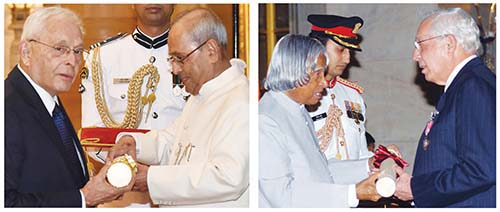
Top and above: Dr Tehemton Udwadia receiving the Padma Bhushan from
Pranab Mukherjee (l) and Padma Shri from Dr A. P. J. Abdul Kalam
Keen to impart lessons in diagnostic laparoscopy to surgeons who had no investigative facilities, he traveled throughout the country. "I went ostensibly to teach, but after coming back from every place I visited — be it a small town, a rural area or a tribal region — I returned humbled and educated and inspired to do even more because I saw what could be achieved in the face of a total lack of facilities,” wrote Udwadia in his book. "After 60 years of surgery and over 40 years of teaching surgery, I have never been more excited than at CEMAST,” Udwadia had conveyed at the inauguration of the new premises of the Center in early 2017.
"His genuine concern and care for his patients be they rich or poor drew people to him,” remarked ear, nose and throat surgeon Dr Pilloo Hakim, Professor Emeritus, Grant Medical College and Sir J. J. Group of Hospitals. "He devoted a large proportion of his time to research and academia. Documentation of cases, active participation at conferences, articles in journals led to wide recognition of his work both in India and abroad. He rose to become president not only of The Association of the Surgeons of India but also of the International College of Surgeons. He was invited to give the Hunterian Oration in UK at the Royal College of Surgeons — a rare honor indeed… His zeal and love for his profession made him continue to work almost till the end of his life,” added Hakim.
"A titan in the field of minimal access surgery (MAS), a compassionate clinician, a pioneer surgeon-scientist, a dedicated teacher and one with a passion to reach out to rural India to develop the art and science of surgery,” is the impression he left on Dr Sultan Pradhan, former president and chief surgical oncologist at the erstwhile Prince Aly Khan Hospital. "Warmth, humility and grace, combined with exceptional skill in surgery make Dr Udwadia a rare commodity,” commented Harsh Goenka, chairman RPG Enterprises and trustee, Breach Candy Hospital Trust. Both of them were quoted in Udwadia’s book.
Past president of several surgical societies including the International Federation of Societies of Endoscopic Surgeons, Udwadia was also honorary member of the Nepalese, Japanese and Brazilian Colleges of Surgeons as well as the Association of Rural Surgeons of India. It was by dint of hard work and persistence that he had earlier earned his Fellowship of the Royal College of Surgeons, Edinburgh and London before he returned to India to start his practice.
The mid-day of January 9 quoted Goa based oncology surgeon Dr Shekhar Salkar who recalled Udwadia’s words, "To be a good surgeon, you must know when not to operate.” Cartoonist Dr Hemant Morparia, consulting radiologist with Breach Candy Hospital, referred to Udwadia’s "superb sense of humor.” "Patients should be reassured, listened to and, most importantly, cheered up,” Udwadia would constantly remind his juniors. "A sense of humor goes a long way…”
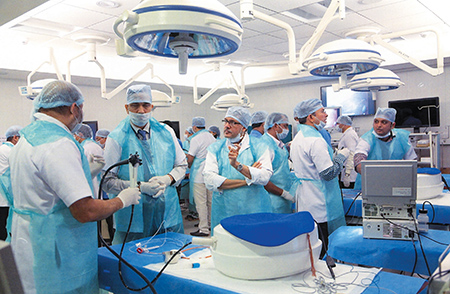
Laboratory at the Center of Excellence for Minimal Access Surgery Training
where Udwadia was founder chairman
In his book he recounted his early days of struggle when he was "busy from morning till evening at three charity hospitals — King Edward Memorial, J. J. and Wadia Children’s Hospital — but I had no private practice to call my own... I refused to budge; I’d vowed never to split fees.” In addition, his father Dr Erach, a general physician known to treat poor patients, would also refer surgical cases to him at J. J. for free treatment. In later life, the senior surgeon was Emeritus Professor of Surgery at the Grant Medical College and J. J. Hospital, and consultant surgeon at the Hinduja, Breach Candy and The B. D. Petit Parsee General Hospitals in Bombay plus had a thriving private practice.
Besides compassion and care, from his father he had learnt "that mere skin contact with the patient creates a bond… That relationship and the bond should continue with post-operative care,” reiterated Udwadia. "Having gone through eight operations myself, the most important event the patient looks forward to, for the next 24 hours, is the surgeon’s visit,” he confirmed. "No matter how committed and experienced I may hope to be, I have never taken credit for saving a patient’s life because I truly believe that lives are not saved by us; lives are saved by a higher power… I am not overtly religious, and 10 minutes of prayer after my bath are sufficient for me. But when I am scrubbing for surgery, the whole team knows that I am to be left to myself. While scrubbing, I recite the simplest of all Zoroastrian prayers, and often a request to St Jude (Patron Saint of Hope and impossible causes),” stated Udwadia in his book.
He recounted his experiences with two 18-year-old patients: Unable to save the life of jockey Karl Umrigar (when thrown off his horse while racing in 1979) despite the best efforts of the team of senior doctors, Udwadia admitted, "In such situations, there is always a second victim. The first, obviously, is the patient. The second is the surgeon.” The other youngster who recovered taught him that "medicine and doctors can only do so much. The patients’ real recovery comes from their determination, courage and spiritual strength.”
Candid in his assessment, he observed, "It’s not the nature of the medical degree that makes a doctor but the quality of the person. Some of my best residents have not been MBBS doctors.” Inclusive and open to all forms of medicine he confirmed, "I have also learnt to be holistic — whatever helps healing is acceptable and good… God grants miracles to those who deserve them.”
In an earlier email to Parsiana when the magazine had written on him being awarded the Padma Bhushan (see "By surgeons, for surgeons,” Events and Personalities, January 7, 2017), Udwadia had credited his success to "My wife Khorshed, who has been my support system, my mother Perin who instilled discipline and my father Erach who was and is my hero and role model, my teachers (at St Mary’s) who were far the best any indifferent, troublesome student could ever hope to have.” While in college (at Wilson and Grant Medical), Udwadia participated in athletics, cricket, boxing and debates. Later, he was a member of the Bombay Flying Club and on the golf team of the Willingdon Sports Club. "He was a great fire who burned bright, and we lived in his light and warmth for so very long. We know that his flame lives on in each of us,” noted a public statement from Udwadia’s elder son Dr Rushad, a surgeon based in Vancouver, on behalf of his mother, sister Dinaz Shroff, a Cordon Bleu chef settled in Los Angeles, and brother Dr Ashad, an orthopedic surgeon in Manchester, UK.
"In life, as in practice, Dr Udwadia was a reticent man, quietly going about his work, always in whites, an energetic spring in his step even in his late 80s, a twinkle in the eye… But carrying his fame lightly…” noted a tribute by journalist Mark Manuel. During his last month in hospital, "when doctors attending on (him) tiptoed around him feeling he was sinking, he was demanding a Bacardi and tonic… asking for an indoor golf set to be brought so that he might practice a few putts… wanting to be taken to Willingdon Gymkhana where Christmas was being celebrated,” added Manuel.
The dedicated surgeon is survived by his wife Khorshed, sons Drs Rushad and Ashad, daughter Dinaz Shroff and brothers Farokh, Darius and Firdaus.
◆ ◆ ◆
From the archive