
Books
Karanjavala reminisces
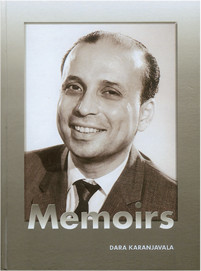
Memoirs by Dara Karanjavala. Published in 2003 by the author, Mayfair Gardens, Little Gibbs Road, Bombay 400006. Pp: v+187. Price: Rs 300.
Memoirs by Dara Kaikhushroo Karanjavala — the remarkable story of a man who blazed a trail as a pioneer in his field. It is also the story of a caring man who was ever willing to lend a helping hand to friends and people in distress. Trained in the best traditions of the Parsi surgeons of old, Karanjavala pioneered surgical urology in this country. Inspired by Alec Badenoch with whom he worked in England, Karanjavala faced an uphill task to establish himself in Bombay as a specialist. He impressed his colleagues and his peers by his uncanny skills in diagnostic cystoscopy, his appreciation of tissue planes and the depth of knowledge that he possessed in his chosen specialty.
Never forgetting the difficulties he had in his early professional life Karanjavala helped a host of young surgeons to find their feet and reveled in their success. Honors came to him in due time, to mention a few — the President’s Gold Medal and the Sarkar Memorial Oration of the Urological Society of India, the Padma Shri, the Dhanwantri Award and the much coveted St Paul’s Gold Medal awarded by the British Association of Urological Surgeons. He was the first Asian to receive this honor.
As neurophysician Dr Eddie Bharucha points out in his Foreword to the book, the Karanjavalas "went regularly to Kashmir and met the members of the ruling elite, including Sheikh Abdullah and his son, Farrukh. Dara became acquainted with a large number of Kashmiris and operated on some of them in Kashmir, while others came to Bombay for their surgery.” In the book Karanjavala joyfully recalls the eight years he spent in Kashmir: "The high points of my otherwise routine medical practice were the times I spent in Kashmir with my family. We used to stay at the lovely Highlands Park Hotel in Gulmarg, where the children learnt their skiing. I hold very dear memories of Kashmir and even till this day, whenever I can avail of an opportunity, I visit the valley. Even through the turbulent times I have never felt wary. I guess that must be due to the close bond I share with Kashmir and her people.
"When we were there the Pestonjis were the only remaining Parsi family in the valley. Behram (the patriarch) was called ‘Uncle’ by everybody, including the chief minister. He owned a liquor shop on Residency Road. This was later closed down and converted into an insurance agency. Khorshed Pestonji was a most gracious and charming lady...
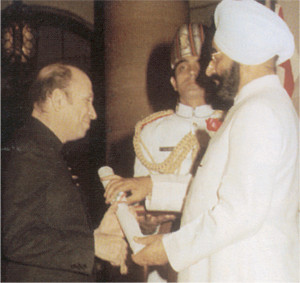
Karanjavala (left) receiving the Padma Shri from then President Giani Zail Singh in 1983
"It so happened that some friends of Sheikh Abdullah had collected funds to build a hospital with modern facilities in his home town. Sheikh Sahib invited me over for tea one day to ask me to start the Department of Urology with the latest facilities and techniques and make it a place of excellence. Dr Ali Jan was the chairman of the advisory board and he was very good to me and my family... ‘Greenfields’ gave us a lot of pleasure and in the mornings its garden became my consultation office! In this way, I came in contact with the other luminaries of Srinagar like Dr Karan Singh, Dr Farrukh Abdullah and also B. K. Nehru and L. K. Jha, who were governors of Kashmir in those days. When Dr Karan Singh developed a stone in his kidney, which had descended into the ureter and caused him pain, I operated on him at the Breach Candy Hospital...”
Not all patients were celebrities. Cooks, bearers and craftsmen got their share of the doctor’s attention. Nor were all of Karanjavala’s pronouncements confirmed by time. Cases written off by specialists mended on their own. Speaking of the case of a lady where the prognosis was "hopeless,” Karanjavala admits candidly, "Here again, I had opened my big mouth to tell the parents that she would not last long, as she was in advanced renal failure and we had little hope of her survival. Years later it did my heart a lot of good to see her looking fit and well!”
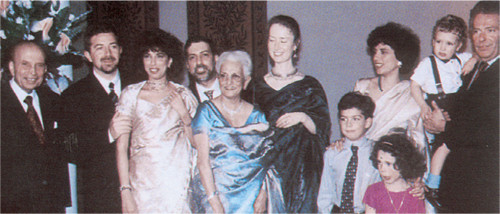
The Karanja-valas at daughter Shireen’s wedding in 1998
The book has neither literary nor scientific pretensions. It is divided into two parts — memoirs and reminiscences of a life well and usefully spent, and a collection of interesting and instructive case studies and a mention of achievements and laurels received.
Simple and modest in style, typical of the man, both sections keep the reader’s interest alive. The case studies make one nostalgic about the phenomenal advances that surgery made in India in the mid-20th century and the dedicated men in Bombay that made this possible. It certainly is a book worth reading and deserves a place in every Indian surgeon’s library.
Dr Hirji S. Adenwalla
◆ ◆ ◆
From the archive