
Cover Story
The farsighted surgeon
Padma Bhushan winner Dr Noshir Shroff looks forward to the award assisting the work of Dr Shroff’s Charity Eye Hospital
"A patient always comes first.” Having been in the medical field for close to three decades what matters to the respected ophthalmic surgeon Dr Noshir Shroff is not the count of over 30,000 surgeries he must have performed over the years, or the lectures he has delivered or the honors he has earned. Among the two Zoroastrians (the other being Anu Aga) to be conferred the Padma awards at the hands of the President of India Pratibha Patil in March this year, to the reticent ophthalmologist quality care will always remain a priority.
In fact, his preoccupation with his patients has become legendary and Shroff well remembers his elder son Daraius, when still a child, innocently announcing that he wanted to grow up and be a patient! That the lad finally became a doctor, the fourth generation of ophthalmic surgeons in the family, is testimony of the father’s inspirational life.
The Padma winners are announced each year on India’s Republic Day. In 2008 it was Bombay eye surgeon Dr Keiki Mehta who won the Padma Shri. Fortunately, Shroff earned a double bonanza this January 26 when besides earning the Padma Bhushan (the nation’s third highest civilian honor) he also became a grandfather. The birth of Daraius’ daughter, Zara, the first girl child in the Shroff household in three generations, gave the family another reason to jubilate.
"I am very honored, happy and humbled” to receive this award, remarked Delhi based Shroff. Describing himself as "a very shy kind of person” he realizes that the national honor has "not changed my life” for he neither plans to hang a framed copy of his certificate in his consulting rooms nor does he intend to announce the award on his visiting cards. The 58-year-old specialist only hopes the new recognition will "carry some weight to help expand the charitable work” undertaken by the family at Dr Shroff’s Charity Eye Hospital (SCEH) founded by his grandfather Dr Sorabji Shroff in New Delhi in 1926.
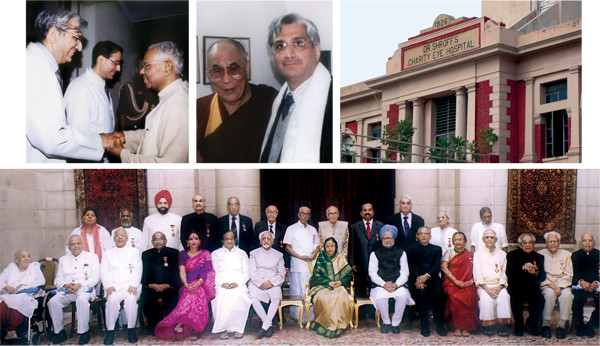
Top row(from left): Drs Noshir and Cyrus Shroff with K. R. Narayanan; with the Dalai Lama; Dr Shroff’s Charity Eye Hospital; (bottom) Noshir Shroff (standing third from right) at Rashtrapati Bhavan
One of the first charitable eye hospitals in northern India, the vision of SCEH is "to have a major impact on blindness eradication in India, especially among the poor, by building an accessible, self-sufficient model institution which has internationally approved performance standards and is focused on quality, excellence and patient-care.” Besides being honorary consultant and advisor (anterior segment), Noshir is one of the four trustees at this Hospital along with his mother Mehru, younger brother Cyrus and sister-in-law Rukshana. The Hospital has a Vision Enhancement Centre which provides devices and advice to those who are severely visually impaired; a School Screening Programme where teachers are taught to identify students with visual problems who can be given the necessary treatment; an Outreach Programme for the financially needy in distant locations in Rajasthan, Haryana and Uttar Pradesh.
In collaboration with ORBIS International, SCEH aims to screen and treat three lakh children for uncorrected refracted error. With MIT (Massachusetts Institute of Technology) USA it is implementing Project Prakash to study and rehabilitate children with certain disorders like congenital cataracts.
Further, the Shroff Eye Centre where Noshir is medical director and partner runs free eye clinics in charitable dispensaries run by the Delhi Commonwealth Women’s Association and Savera Association. In the last four years over 14,000 patients have benefited from the Centre’s charity work with around 1,900 free surgeries being performed at the Centre, states Noshir’s bio data.
Respected as a pioneer in the field of intraocular lens implantation surgery, Noshir remembers the time in 1982 when patients were "skeptical, apprehensive whether the new device would work in the eye…or whether it was like a time bomb that would explode one day.” While Noshir specializes in phacoemul-sification (sutureless cataract surgery) and refractive surgery (as a keratore-fractive surgeon he uses procedures like PRK, LASIK, LASEK, Epi-LASIK and Intralase), Cyrus has the necessary patience to tackle lengthy retinal operations, acknowledges the elder brother considering himself blessed for having "supportive parents (his father Minoo too was an ophthalmic surgeon), wife Niloufer who is a pillar of strength and a loving brother Cyrus who has stood by me.”
Determined to keep pace with the latest technological advances in the world the Shroff Eye Centre is equipped with the most modern diagnostic and therapeutic facilities using state of the art equipment with high speed sterilization instruments in place. As a student surgeon in 1977 Noshir remembers the strategic planning that had to be undertaken to import a gadget worth Rs 25,000 into India. The machinery was brought as components by five different friends and assembled here. Presently there is a "sea change in ophthalmic care,” sums up Noshir, appreciating that sophisticated gadgets can now be easily imported from Japan, Europe or America thanks to a "sight saving duty free” policy. Known for his meticulous approach and relentless attention to detail, Noshir confesses that he is a "stickler who ensures that there are no short cuts in any procedures.” Noshir has treated a cross-section of patients. He was honorary ophthalmic surgeon to the President of India for five years and had even attended on the Dalai Lama, as mentioned in his curriculum vitae.
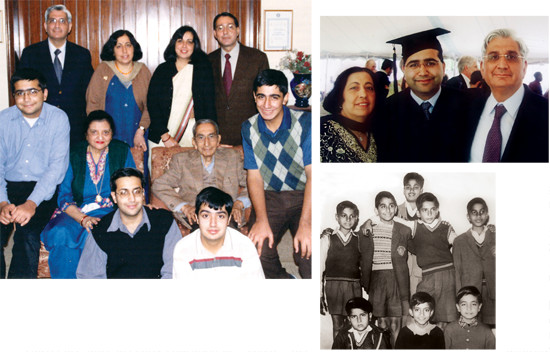
(Far left) Three generations of the Shroff family; (alongside) Niloufer and Dr Noshir at Kersi’s graduation from Yale; (below) Noshir (standing 2nd from left) with friends during school days
Having done his graduation and postgraduation in ophthalmology from the Maulana Azad Medical College, Delhi University, after his early education at Delhi’s Modern School, Noshir ensures that continuing medical education is an integral component of the various subspecialties at the Shroff Eye Centre. Recently recognized by the National Board of Examinations, the Centre offers postgraduate training leading to the degrees of Diplomate National Board.
Besides organizing regular meetings, lectures and seminars the Centre also hosts bi-annual workshops and conferences attended by doctors from India and overseas. "Today our Indian ophthalmic surgeons are second to none in the world. Now our papers are accepted at conferences, we are invited to make video presentations,” stresses Noshir. Over the years Noshir has been requested to deliver the prestigious Dr P. N. Sinha Oration, the Dr C. Shekhar Grover Oration besides numerous addresses and presentations at national and international conferences. His papers have been published in medical journals and he has contributed chapters in ophthalmic texts, according to his curriculum vitae.
Unlike a few years ago where the medical profession was mired in controversy and frivolous litigation introduced under the guise of medical negligence, today the profession is viewed as "an up and coming field with hospitals and private medical centers offering top end care and treatment,” observes Noshir.
His search for improved technology has led to innovations in ophthalmic instrumentation with indigenous manufacturers willingly incorporating his suggestions in the production of better instruments. "Although these are not patented,” his name is associated with some devices and thus within the fraternity the Noshir-Kabra Round-bodied handle, Pierce-Noshir Co-axial Irrigation Aspiration Cannula and a special drip controlling device to aid in immersion A-scan biometry are some of the devices attributed to his ingenuity. Being a consultant to Alcon, the ophthalmic company welcomes the feedback and inputs made by Shroff towards improved quality control of products.
Although dining table conversations frequently revolved around ophthalmic subjects, nobody in the family was forced into the profession, maintains Noshir. Thus while Daraius pursues retinal surgery and relieves the workload on Cyrus, Noshir’s younger son Kersi graduated in computers and economics from Yale University and is now working in a consultancy firm, happy to keep doctors and hospitals at a distance since he is in awe of surgical instruments and "not temperamentally meant” to follow the medical profession, explains the father. With Cyrus’ son Rushad now planning to join the league of ophthalmic specialists, Noshir hopes he will specialize in corneal and refractive surgery and thus assist him. Regardless of the "maska maaréch (flattery)” insinuations from the family, Noshir favors his nephew with guidance to gear him towards his specialization.
Noshir and Cyrus’ spouses provide the necessary balance in the predominantly medical family. While Niloufer works as director in the Department of Information Technology, she has not been assigned a vehicle with a prominently displayed light on the roof signifying the important status of the car occupant, jests Noshir. She is also a trustee of the Delhi Parsi Anjuman (DPA). Rukshana conducts The Farohar class for children run by the DPA. In fact the family has long been associated with the Anjuman, points out Noshir. His grandfather was a president of this Anjuman as was his father-in-law Lt Gen Adi Sethna. Observing the Parsi community in Delhi, numbering around 700-800, Shroff says he is happy to belong to this "well knit, liberal anjuman, with no acrimony and controversies.”
Although warned by his wife to be more circumspect when responding to queries concerning sensitive religious issues, Noshir believes he has to speak out: "Unless we are more liberal as a community we will disappear from the surface of this earth.” Admitting that he is "not deeply religious,” he does however clarify that daily kusti prayers are a must with him as also an unwavering belief in good thoughts, words and deeds. Regarding disposal of the dead, he tends to favor cremation on the rationale that it occupies the least amount of space.
When he attends anjuman functions, Noshir realizes that nearly all Zoroastrian families in Delhi must have consulted the Shroffs for their eye problems. As compared to other communities he finds Parsi patients come to him with "implicit trust, not with a host of doubts… and besides they follow instructions more diligently.” He does not associate the community with any specific eye ailments but more with age-related problems arising from longevity and diabetes.
◆ ◆ ◆
From the archive