
Politics and Policy
The leader of the opposition
Over the past decade Kersi Randeria has tackled the Bombay Parsi Punchayet’s housing policy
When Kersi Randeria overpowered a gang of pickpockets who attempted to steal his wallet at Vikhroli station and then dragged them to the local police station to have them arrested, he became quite a legend at the Godrej and Boyce Manufacturing Company where he was employed.
A few years later that reputation for daring stood the young science and law graduate in good stead when he decided to leave the safety of his secure job in 1986 and take on contract assignments for the company. "An opportunity came… the managers backed me up and it happened,” he explained to Parsiana on May 19, 2010. "Every bawaji (in Godrej) called to say ‘Gaado chhè (you’re mad)! Su karéch (what are you doing)? Akkal chhè (do you have sense)?’” But the budding entrepreneur recalled, "I was never satisfied in service.”
From providing labor, maintenance services, civil construction including constructing buildings at Godrej Baug, providing transport to even cleaning toilets, "it was very hard work,” recalls Randeria. "We worked 12 to 16 hours a day.” He rented a factory shed in Vapi in the mid-1990s (which he later bought) and by 1999 he had earned enough money to put up his own factory in Sarigam in Gujarat close to the Maharashtra border.
With no guaranteed jobs in hand, Randeria said, "I took a chance.” He approached Godrej saying, "I have this factory. These are the things I can do.” He was given orders to manufacture cupboards. "Godrej has very strict guidelines for vendors. There is a certifying process from the smallest to the largest component.” He studied the processes at Godrej and "duplicated them on a small scale” at his factory. "If you are honest, hardwork-ing and quality conscious you can survive and grow with Godrej,” he advises. "Always work for the good of the principals. It has paid us dividends.” His other clients include Bluestar, CPS Color and Areva.
"Manufacturing is hardcore mehnat (effort). Don’t look at high margins of profit. It’s a high volume, low margin business,” he notes. Their website ahuramazdagroup.com states the companies convert 40,000 tons of steel per annum. "Manufacturing always finds a customer. If you have the right equipment and right infrastructure you can’t go wrong,” he notes.
With the constant pressure to reduce costs, Randeria emphasizes the need to automate, keep pace with technology and improve the manufacturing process. "The market is always going to put pressure on you” to reduce prices, he notes.
What about the competition from China? Conceding that China is the manufacturing hub of the world and that the "Chinese government has a more progressive attitude than India,” the businessman believes "India is more quality conscious.” Plus the "infrastructure is developing very fast” in India thereby "supporting industry.” Being conversant with English also gives India an edge though the Chinese are making efforts to popularize the language. "Five to 10 years from now India will be in good shape vis-à-vis the Chinese.”
He cites the example of the automobile industry with companies such as Tatas, Mahindras, Bajaj and Maruti "taking on foreign companies head-on. They learned how to handle new models and produce world class products. They are giving Toyota and Honda a run for their money.” Even in furniture, China "is not even close to Godrej’s quality workmanship and value for money,” he opines. "Godrej innovated sufficiently.”
The company’s former managing director Naoroji Godrej’s "simplicity of lifestyle” remains Randeria’s model of what a businessperson should be. He recalls the late industrialist walking daily from plant to plant dressed in a cotton shirt, cotton trousers and carrying an umbrella. "He acknowledged everybody” and knew the old-timers by their names. He drove around in a Fiat car.
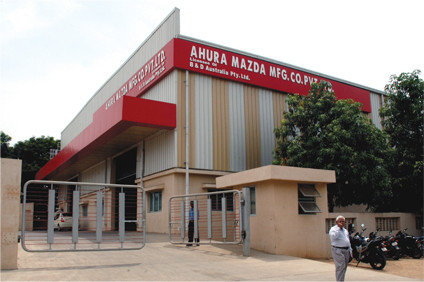
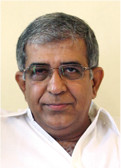
(Top) Kersi Randeria (Photo Cyrus Dastur) and (above) in front of one of his manufacturing units
Similarly Randeria believes money "should not be blown up on clothes and cars (he says he was "tricked” into driving a Honda as his family bought the vehicle and refused to use it forcing him to either utilize the automobile or leave it standing in the garage)… there is only one use for what one earns: to put it back into machinery and production.” Investment is needed to service the 40 percent annual growth he envisions for his companies named after Mazda or Ahura Mazda. As a result he now owns around half a dozen factories in southern Gujarat and Gauhati in Assam and gives employment to around 900 people.
Randeria’s interest in community affairs which propelled him to the center stage of Bombay Parsi politics coincided with his colleague at Godrej, Maneck Engineer standing for the Bombay Parsi Punchayet (BPP) trusteeship election in 2001 against veteran sitting BPP trustee and present chairman Dinshaw Mehta. "I did not know who the trustees were. I only knew Dinshaw Mehta by name because of my Godrej Baug work.”
At one of the election meets a woman complained to Randeria that flats in B. S. Panthaky Baug in the western suburb of Andheri were being sold and the BPP was "not helping the poor.” During the 15 days of campaigning Randeria "saw Mehta’s electoral machinery at work. The Jam-e-Jamshed refused to carry Maneck’s (printed) matter,” he alleged. Soon thereafter Randeria along with Percy Patel and Zeree Jehangirji formed the Alert Zoroastrians Association (AZA). The word alert was incorporated because the trio believed the community was asleep on many crucial matters. Membership was "dil sé” (from the heart) for all who were interested in housing. In the next election against sitting trustee Rustom Tirandaz, Engineer won.
Drawn into the vortex of community politics and especially a contentious issue of housing, Randeria sent off a letter from his laptop while commuting to and from his factories inquiring as to the housing policy of the BPP.
BPP trustee Dadi Engineer "invited us to Willingdon Club” for discussion and a Chinese meal. Randeria avoided eating as he was unsure if the food was being paid for by the trustees or the trust. Even at BPP trustee meetings the snacks served should be paid for by the trustees and not the BPP, he believes.
Randeria says he was "aghast” at the "brazen” manner in which the BPP dealt with property matters. He claimed there was gross "manipulation” and an "unconcern for the poor.” There was "zero level of opposition to the BPP.” The AZA "picked up issues. We made an impact — some amount of transparency, accountability...They decided to take me on the Housing Advisory Committee (HAC) despite Dinshaw Mehta’s objections. Aapré éné sudhari kaarsoo (we’ll reform him),” they said.
Randeria pointed out how the merit rating scheme devised by the BPP could be influenced. One could "manipulate the ratings so as to give or not give” a flat, he alleges. "One plus one can be two or 11. Mehta studied the files and was conversant with the facts which the other trustees were not. I did my homework and took him on.” Social worker Phiroze Amroliwalla who was close to the AZA before falling out with them commented that if Mehta was a housing encyclopedia then Randeria was a Pentium Four computer on the subject, recalls Randeria. The HAC meetings became "comprehensive.” But around 2006 to 2007 the BPP "stopped calling the HAC meetings. At that time the controversy over the four trustees’ resignation had begun and the shift towards adult franchise.” Universal adult franchise was "more Berjis’ (community activist Berjis Desai) baby,” notes Randeria.
"I genuinely do not have a (personal) agenda,” avers Randeria. "I have no interest in becoming a trustee. I increasingly became concerned about housing for the poor… that is why the 104 became such a major issue.” The 104 are the number of allottees the earlier board had agreed to assign houses to after much bickering and the intervention of the Joint Charity Commissioner. When the new board of trustees was elected in October 2008 they challenged the allotment in the Bombay High Court setting off a chain of events due to which all 104 are still without the promised accommodation. Retired Supreme Court Justice Sri Krishna who was to scrutinize the allotments was tied up with more pressing engagements and has reportedly withdrawn from the post as the prescribed time limit is over. The BPP and the AZA may now have to approach the Bombay High Court for directions.
Randeria is skeptical of the trustees rationale of selling flats earmarked for the poor to raise funds to create housing for the low income groups. He points out that despite proceeds from several ownership buildings such as Aderbad, Spenta, Shanazeen filling the BPP coffers, no homes were built for the poor. Even assuming flats in the existing colonies were to be sold, he is adamant there should be a public auction. Except for one advertisement for a Cusrow Baug flat for sale, all other deals have been done by calling only a few known parties. This results in the flats being sold at less than par. "To my mind it is not an auction, it’s a farce.”
He also asserts that under the consent terms filed in the 104 case, the BPP had to provide a list of flats available for allotment and hence should not be disposing of flats prior to judicial preview. "They are guilty of disobeying the court,” he contends. Randeria further postulates that some leave and license agreements entered into by the BPP are just a subterfuge to avoid taxation as the transaction is in fact a change of tenancy and not a license agreement. His attempts to arrive at a peaceful resolution of the disputes between the AZA and the BPP have come to naught.
Aside from housing, Randeria, like Mehta, has little interest in other community issues. He became involved in the disposal of the dead controversy only when feisty Dhun Baria was reportedly threatened. His intervention on her behalf earned him the nomenclature of being her "palélo dikro (adopted son).” Born to Amy and Jamshed Randeria, Kersi has two sons, Astad, a lawyer and Zubeen who is studying law. His wife Hutokshi assists with purchases for the companies.
To prove that he is not just bent on a obstructionist course (he helped to get the pickpockets a lawyer and arranged bail for them), Randeria along with Engineer, BPP trustee Noshir Dadrawala, Patel and Jehangirji formed the Zoroastrian Trust Funds of India (ZTFI). Among its objectives are offering monthly financial assistence to the needy, holding medical/dental camps, feeding those who are unable to cook for themselves or cannot afford to buy sufficient food, granting scholarships, etc.
Randeria envisions the ZTFI as a body that will liaise with other trusts to work together towards the common weal. "There are many trusts which have funds but refuse to cooperate with the BPP because of the kind of trustees that are on board.” In five or 10 years ZTFI’s efforts may "thoru ghanu unite karé (bring about some unity),” he opines.
But the road will prove to be bumpy. ZTFI’s attempt to develop the Bharucha Baug playground met a roadblock with the BPP trustees deciding to undertake the venture themselves. While terming Bharucha Baug "the most neglected of the BPP colonies,” Randeria noted that while the trustees cry hoarse about not having enough funds, when someone was willing to spend money on their behalf, the BPP insisted on utilizing their monies. Even efforts at charity and philanthropy have become deeply mired in community politics.
◆ ◆ ◆
From the archive