
Events & Personalities
Visibly concerned
Since its inception in 1927 Dr Shroff’s Charity Eye Hospital (SCEH) in New Delhi has attended to over 4.4 million patients and performed more than 2,50,000 surgeries making it one of the foremost eye institutions in North India, notes a write-up on the Hospital. To mark the 75th anniversary of the SCEH, an eight-foot-high white marble bust of the founder Dr Sorabji Shroff was unveiled at the hands of the former President of India, K. R. Narayanan.
A Fellow of the Royal College of Surgeons of Edinburgh, Shroff started his practice as an ophthalmic surgeon in Delhi. The increasing number of poor patients who came to him for free treatment compelled him to start a charity eye hospital which had its genesis in a single room in the Dharamshala of Lala Laxmi Narain in 1914. Philanthropist Haji Mohammad Ishaq later put one storey of his newly constructed building on Burn Bastion Road at Shroff’s disposal. When this space too proved inadequate Shroff felt the need to create a trust, collect funds, secure a plot of land on lease from the government and construct the present building in Daryaganj. With his openly expressed nationalistic views it was no easy task for Shroff to secure a lease from the British government but when he could convince them that he was "not interested in politics, and social service of the poor” was his main aim, he was granted the lease.
The same British who were initially wary of granting him the lease, once convinced of his sincerity, helped him by donating large sums of money to build and equip the Hospital. He was even granted the Kaiser-e-Hind gold medal by the British Government in 1933 and the Padma Shri by the President of India in 1963. For 12 years, from 1944-56, he served as president of the Delhi Parsi Anjuman during which time he succeeded in obtaining a plot of land from the local government for the use of the Anjuman and raised donations for the construction of an agiary, a dharamshala, a hall for social and religious functions and residential quarters for the priests, mentions the literature on the founder and the Hospital.
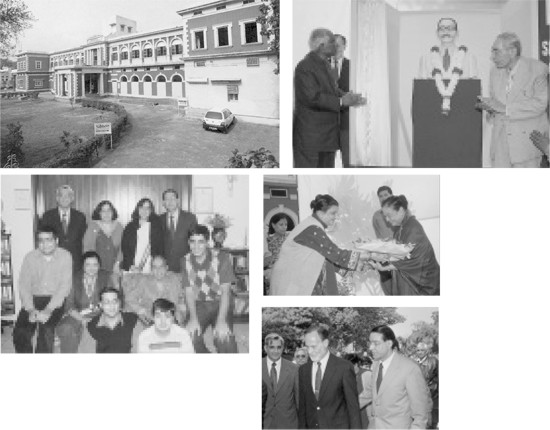
From left: (top row) Shroff Hospital, bust of S. Shroff being unveiled by Narayanan as Minoo Shroff applauds; (Middle): Shroff family (standing) Noshir, Niloufer, Rukshana and Cyrus, (sitting center) Kersi, Mehru, Minoo and Rushad, (Sitting, front) Daraius and Zubin; Mehro Shroff (left) and Usha Narayanan; (below) Noshir Shroff, Steven Roy and Cyrus Shroff
When Shroff retired due to advanced age, his son Minoo was appointed as the chief medical officer cum managing trustee. Minoo was instrumental in the modernization of the Hospital with better instruments and appliances. His wife Mehru was appointed honorary welfare advisor. Later the couple was joined by their two sons — Dr Noshir, an intraocular lens implant surgeon and Dr Cyrus, a vitreo-retinal surgeon — who both serve as honorary senior visiting consultants and advisors of the Hospital and retain their association as trustees of the Hospital too.
With the funding of Eicher Goodearth Limited, a well-known corporate body, since 1996 the Hospital has improved and modernized much further, helping to fulfil the dreams of the founder. And although Minoo has retired as managing trustee, he remains chairman of the board of trustees. Their Outreach program has brought nearly 2,000 patients from the poorer areas and villages outside Delhi to the Hospital for sight restoration. In 2001 SCEH was chosen by Orbis International as a partner to establish a pediatric ophthalmology department. The same year the Hospital started a private patient wing to help fund its operations.
As stated in the vision statement, they would like to create a Hospital which is an international standard institution for eye and ENT care treating at least 50 percent patients free of cost and treating all socioeconomic classes with the same quality of care. Being self sufficient for running costs is also their endeavor whereby they accept fees from those who can afford to pay for their treatment so that those with limited means can benefit.
◆ ◆ ◆
From the archive