
Medicine/Health
Surgical insight
Emerging from the shadows of his father’s repute, Dr Cyres Mehta is now viewed as a skilled ophthalmic surgeon
"A doctor’s practice is based on credibility. You have to build a name. The written word earns you credibility. Because you are an author the public perception is that you know your subject.” Dr Cyres Mehta explains his rationale for bringing out two books in 2008-09, Remove Your Spectacles Permanently and Cataracts and Glaucoma — A Patient’s Guide to Treatment, contributing chapters and articles to different journals and textbooks, editing medical journals as also penning columns in some periodicals. Reading and writing are his nocturnal pursuits for during the day he is busy with his surgery and consultation, operating from The Mehta International Eye Institute (MIEI) and Colaba Eye Hospital where his father Dr Keiki has an established practice.
Rather than be seen as an extension of his father, a "baba (child) who was not taken seriously,” Cyres opted to pursue a parallel practice whereby both he and his father "share the same operating facilities but have a totally separate business.” Unlike other family practices where the father recommends, "Baba ni paasé jaao (consult the son),” Cyres was determined to "either sink or swim on my own.” Initially practicing with his father, he recalls some patients explicitly telling his father that they wanted the surgery to be performed by the senior and not the junior. Such an attitude "doesn’t do wonders for your professional reputation,” he realized.
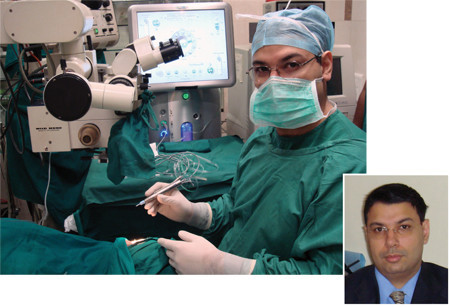
Dr Cyres Mehta (above) with the latest cataract system Stellaris
Believing that "competition is good for the brain,” he soldiered on although he remembers well his first six months as honorary at the Masina Hospital when "all I did was drink chai (tea).” Not a single patient came to him until one of the staff members needed some surgery and the success of that operation led others to him. Presently he is also honorary at the Breach Candy, B. D. Petit Parsee General and Police Hospital. "People come based on the results or on the recommendation of friends/relatives/acquaintances. There is no sudden rise in medicine. You have to wait it out,” the 38-year-old ophthalmic surgeon, who now performs 20-25 surgeries a week, has learnt.
Within a short span he has made his mark in the field of ophthalmology as mentioned in his life profile: he pioneered non penetrating glaucoma surgery in India in 2001 as also corneal ‘Wavefront’ guided LASIK in 2004. Over the years he has been frequently invited to lecture at the prestigious American Society of Cataract Surgeons, European Society of Cataract Surgeons, Egyptian Society of Eye Surgeons, Russian Federation of Eye Surgeons, the World Congress of Eye Surgeons and under many other auspices. His research on corneal amblyopia led him to coin the term corblyopia (improving the lazy eye by LASIK) which has thereafter been adopted by medical textbooks. Besides demonstrating live laser and phaco cataract surgery at different venues he is also credited with having invented and modified instruments like the surgical scythe chopper, curlicue chopper, intraocular hammock… He has been awarded fellowships of the American Society of Cataract and Refractive Surgery, St Vincentius Hospital, Germany and Shepard Eye Center, California. Among the notable honors to be conferred on Cyres are The Outstanding Achievement Gold Medal Award by the Intraocular Implant Refractive Society and the gold medal by the International Council of Glaucoma Surgeons, Switzerland.
Being a director, he gladly avails of the facilities at MIEI, "a ready institute with the most modern machinery. There are a lot of centers in Europe and USA which may not have such instruments… Buying the latest equipment like Amaris (see "The venerable visionary,” page 24) is like riding a tiger. You are either on the tiger or inside it,” Cyres draws an analogy to explain the financial risks involved when investing in heavy duty instruments as is regularly done at MIEI. "You have to be very sure that you will be able to do a quality job and attract patients” to recover the costs, he adds. Working directly with companies like Alcon and Topcon, Cyres says, "We are a few months ahead of our competitors. The new generation, platform-based machines need constant upgrading.”
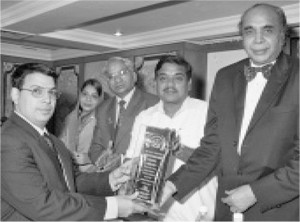
Dr Cyres Mehta (left) receiving the Outstanding Young Indian for 2005 award from R. R. Patil and Dr B. K. Goyal
The proficiency of a surgeon can be gauged from the types of equipment he can handle, the quality of surgery, the number of operations he performs, his success rate in handling difficult cases, Cyres lists the parameters. "The medical profession is like a pyramid. There is place for only one person at the top with 10,000 scratching below. To be at the top you have to climb on others. You may not be popular with your professional colleagues. Doctors who have made it big put in disproportionate work. The income is not commensurate with the work you put in,” he observes. "Medical practice is very cut-throat. When it is so competitive ethics do tend to slide a bit. But ultimately a doctor always wants the best for the patient.
"To join the medical profession is a huge, costly exercise,” warns Cyres. "You may not get any of it back. It is sad that we Parsis don’t have reservations. We need aggressive intervention. It is not that we want free water connection. We don’t want to see the community losing out. Where are the Parsi toppers? Are the Zoroastrian medical dynasties continuing? Today half the seats are reserved. With Rs 30-35 lakhs being capitation fees, how many in the community can afford that?… There is no stigma attached to failure but you have to make the grade otherwise a medical degree becomes an unofficial licence to kill. For postgraduation you should be willing to set aside further 35 lakhs. Maybe the (Bombay Parsi) Punchayet (BPP) can start a medical college affiliated to the Parsee General Hospital.” Once you have the necessary qualifications, just the basic equipment for an ophthalmologist would cost 50 lakhs, and investing in a room around two to four crores more.
Fortunately for Cyres, his father financed the cost of his entire education, starting at Campion School, progressing to Jai Hind College and then to Kasturba College for a medical degree and the Jawaharlal Nehru Medical College, Belgaum for his post-graduation before he went abroad for further qualifications. "Seeing my famous father I wanted to be like him ever since I can remember,” notes Cyres, whilst giving credit to his grandparents for bringing him up. Both his maternal and paternal grandfathers were named Rustom. While Rustom Mehta was the deputy general manager of Bank of India, Rustom Masani was one of the first builders of Bombay whose study partner at the Asiatic Library was Babasaheb Amte. Intently watching his dad’s surgery videos ever since he was in the fourth grade, Cyres says, "Even at the dinner table all we discussed was medicine.” His mother Zenobia is pleased that Cyres took up medicine compared to the younger two, daughter Shirina Khan who is now married, and son Rustom who is studying fashion designing at the London School of Fashion. Cyres is married to Vinifer (née Mistry) who occasionally helps at the MIEI as patient counselor for LASIK, having done a certificate course eight years ago. Their six-year-old son who studies at the Campion School likes to introduce himself as "Dr Bezan.” Besides ophthalmology Cyres has a consuming interest in motorcycles, owning a Hayabusa, the fastest motorcycle in the world, he enlightens us.
In the practice that he has built up, 40 percent of his patients are Zoroastrians, says Cyres, happy that Jam-e-Jamshed gave him "a big break” and "helped to spread eye care concepts.” Usually members of the community try and delay surgery till the end — "bè aanglaa dékhai taré aavé (wait until their vision is restricted to two fingers),” he observes. Hard, sticky cataracts as also weak eyes that take longer to recover from surgery, Cyres attributes to inbreeding among Zoroastrians. Getting a lot of letters and e-mails from readers, he remembers one in particular enclosing four pages of yogic asanas and enquiring which of the postures was safe for the patient!
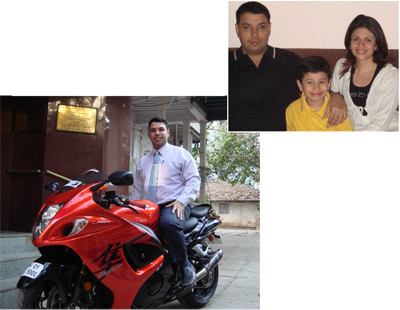
Dr Cyres Mehta with his prized Hayabusa, and (right) with Vinifer and Bezan
Equally elated was Cyres when his byline appeared in a foreign publication and he was the first Indian to be appointed editor of the Indian edition of the Journal of the European Society of Cataract Surgeons, giving him an opportunity to interact with "all the greats of ophthalmology” with the latest noteworthy updates from the fraternity of 80,000 ophthalmic surgeons worldwide including some well known Bombay-based Zoroastrians Drs Burjor Banaji, Villie Bamboat, Rumi Jehangir and Yasmin Bhagat. Comparing notes on surgery, looking at each other’s videos, Cyres admits, "There has to be a failure rate. But what is important is what you did to improve or correct the error.” He additionally serves as editor of the Indian Journal of Cataract Surgery and the journal of the Indian Contact Lens Society.
"Eye donation,” he believes, "is an integral part of civilized society. If we are going to be a beneficiary of eye donations then we had better donate too.” While conceding that "the Zoroastrian community has to be more progressive and move with the times,” he informs us that at the last BPP trusteeship elections he supported the candidature of Jimmy Mistry as he felt "the community does need younger people to stand and voice their views.” The constant infighting makes him comment, "Excessive publicization of community issues and washing dirty linen in public will not help the community. Perhaps the older people of yore were wiser.” But ask him to enunciate his religious views, and Cyres responds, "I am not a religious scholar… I can’t hurt anyone… Religion never fails to inflame people. I am more interested in the eye health of the community.”
◆ ◆ ◆
From the archive