
Cover Story
The venerable visionary
Specializing in intraocular implants, glaucoma and refractive laser surgery, Dr Keiki Mehta has come to be regarded as the Father of Indian Phacoemulsification
Soon after we were helped out of our surgical robe, had untied our face mask and removed our scrub cap we cast a look in the direction of the sterilized room hoping to thank Dr Keiki Mehta for offering us the awe-inspiring experience of witnessing him giving LASIK on his super-specialized Amaris laser, the only one of its kind in South East Asia. There was no sign of the ophthalmic surgeon; only the young lady walked out who minutes earlier had lay on the bed as he confidently and seemingly effortlessly corrected the myopic vision in both her eyes. His voice floated across: "Send the next patient in.”
Fortunately we had, or rather he had, completed the interview earlier. Having taken a half hour reprieve from his Saturday morning LASIK sessions to answer our queries, the Father of Indian Phacoemulsification (laser cataract surgery), reputed as a specialist in intraocular implants, glaucoma and refractive laser surgery, permitted us brief insights into his practice but dwelt more on the surgical advances that help an ophthalmologist offer better eye care to patients. He has many firsts to his credit as listed in his biographical sketch: implanting intraocular lenses in India in regular practice; developing the world’s first soft foldable intraocular implant as also first foldable HEMA disc lens; pioneering the advent of Excimer surgery (also known as LASIK) in India for reduction in spectacle powers…
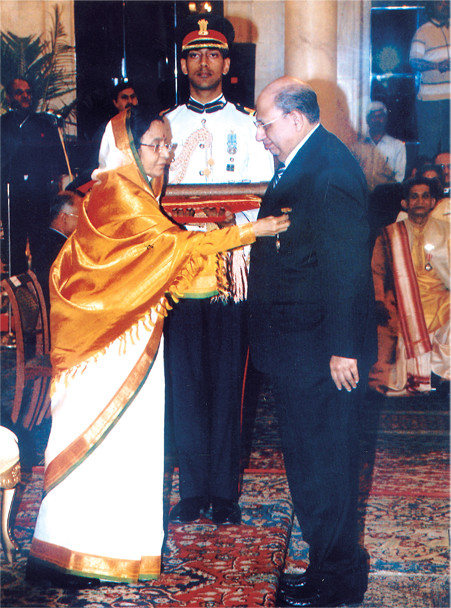
Dr Keiki Mehta receiving Padma Shri from Pratibha Patil
The advent of the superfast Amaris at The Mehta International Eye Institute (MIEI) and Colaba Eye Hospital in end 2008, the same year he was presented the Padma Shri by the President of India, is hailed by Mehta as the laser that can "achieve far higher levels of accuracy, giving superlative quality of vision.” The respected pioneer continues, "It would be like comparing the usage of cheap quality binoculars to genuine German binoculars which would give very sharp and impeccable quality vision.”
Additionally this Excimer laser, only 82 of which exist worldwide, utilizes three simultaneous computers that permit the use of true ‘Wavefront’ treatment applicable not only to the center of the cornea but also the periphery, with vision extending up to 180° to facilitate driving and make vision stable even at night. With its ability to smoothen surface irregularities, Amaris is a boon for those with irregular corneas who had earlier to wait indefinitely for a corneal graft to improve their vision but now have a chance to attain functional vision instantly.
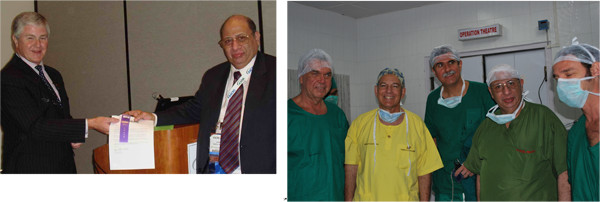
Left: On behalf of the American Intraocular Implant and Refractive Society, Dr John Marshall presents award to Dr Keiki Mehta; (right) At the EyeAdvance 2008 Congress (from left) Drs Ulrich Klemen, Biro Zsolt, Gerald Schultz, Keiki Mehta and Vincenzo Ferraro
There are two-and-a-half lakh patients awaiting corneas in India. Corneas can be damaged because of smallpox, physical injuries to the eye, lack of hygiene in rural areas, fungal infections, ulcers, explains Mehta. Of the 40,000 corneas collected each year only 22,000 are usable, Mehta has his statistics at his fingertips. "Pledging an eye has no meaning,” bluntly sums up the ace ophthalmic surgeon. "Of the one lakh pledges, only 16/18 materialize a month. Once a patient dies it depends on the relatives. Collection is not a problem; in fact most of the time this facility is unused.” He has a more pragmatic solution: There are 17 destitute deaths a day in Bombay which could generate 34 corneas from Bombay alone if the government would permit removal of the cornea from the deceased. If the body is claimed within the next three days the cornea could be refitted if the relatives so desire or alternately be used for a better cause. "The Government feels this topic is a hot potato,” says Mehta. Among Parsis, very few come forward to donate corneas. There are more among Gujaratis and most among Buddhists. In fact because of the Buddhist population in Sri Lanka, just one eye bank in Colombo is able to collect 28,000 corneas a year, he points out.
With 20 percent of his patients constituting Zoroastrians he observes, "They need to be explained. They are cognizant of the situation. On the whole they are far better patients to deal with.” Common ailments among the community are age related macular degeneration of the retina, glaucoma and cataracts, observes Mehta. Fortunately these ailments are now curable with cataract surgery in particular having leaped ahead to a stage where the operation is completed within four-and-a-half minutes thanks to the high energy microburst of warmed water in the eye that dissolves the soft cataract and the patient being sent home after two hours. With advances in stem cell research he expects a further breakthrough in treatment in the next six months.
The chief surgical director of the MIEI which is considered Asia’s most advanced eye center views ophthalmic facilities in India as "excellent… very good surgery, top-of-the-line equipment.” At their Institute alone they have 28 beds, more in the nature of hot beds which get their name from the frequency of usage because before a bed can cool after a patient is discharged, the next one has already occupied it. Their intricate diagnostic tools for the treatment of glaucoma range from the Heidelberg Retina Tomograph to check the progression of glaucoma, the Humphrey Computerized Field Analyzer to determine one’s field of view, Air Puff Computerized Pneumotonometer and Goldman Applanation to check pressure without touching the eye. Schiotz tonometry is a verification device when the surface is grossly irregular. Aiding in corneal management are Dicon Corneal Topographer that creates a map of the cornea, Specular microscopy evaluates the thickness of a cornea in 1000ths of a micron, Optikon ‘Scout’ Arc Step Corneal topo-analyzer accurately maps out imperfections in the cornea. Surgical advances in cataract removal have been possible with Leica Wild (German) Operating Microscope that gives high magnification necessary for intricate surgery, the Infiniti Cataract Surgery System, the Legacy Cataract Surgery System and the Opticon Pulsar2 Hyperpulse Cataract Surgery System. In fact the MIEI is reportedly the only institute in India to have all these three cataract surgery equipments. The Institute is also well equipped for comprehensive eye examination and treatment of retinal problems and pediatric cases. Being affiliated to the ONO Eye Hospital in Switzerland and St Luke’s Eye Institute, Texas, MIEI offers telenet consultation with international surgeons.
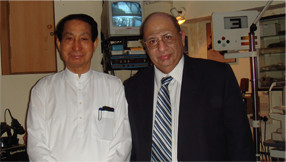
Governor of Maharashtra S.C. Jamir with Dr Keiki Mehta
"Most new ophthalmic instruments come from Germany which is the new powerhouse for the manufacture of latest, sophisticated equipment,” mentions Mehta. "Earlier it was Britain and USA but they Satyamed,” he draws an analogy to the financial crash of the Indian giant information technology company.
The global meltdown has had repercussions on his practice too, admits the chief who reportedly performs around 150 surgeries a month, 80 percent being cataract. Additionally, about 60 patients come to him for LASIK treatment each month. Mediclaim does not cover this treatment. "In times of depression, when the market goes down, the disposable income gets indisposed,” says Mehta, tongue-in-cheek. Depending on the number in the eye, LASIK treatment can cost between Rs 35,000-60,000. For those seeking jobs in airlines, merchant navy, railways, LASIK treatment offers a better chance to myopic patients, but with shrinking job markets, prospective candidates have been reviewing their options. For recruitment in the Armed Forces, PRK (photo refractive keratectomy) is recommended where laser is applied directly to the cornea and not through a flap as in LASIK. Mehta serves as consultant ophthalmic surgeon to the governor of Maharashtra, the Armed Forces and the Maharashtra Police.
With over 30 years of practice, the good doctor, in his sixties, continues to be popular. "He has patients coming to him from all over the world,” Mehta’s gentle wife Zenobia tells us. She is in charge of the contact lens department at the Hospital, having qualified as an optometrist after her marriage. One of her former patients Richa Khanduri who has been coming to the MIEI for years opted to go in for LASIK treatment last year "although I was so comfortable with contact lenses that I could sleep with them.” Recalling her nervousness on the eve of her LASIK session she recalls "Dr Mehta being wonderful. His bedside manners are so comforting. I am so happy that I went for it that this year I have brought my sister for LASIK. My grandmother who stays out of Bombay trusted only Dr Mehta to remove her cataract. Today she is here for a post-operative checkup.” The LASIK treatment that Parsiana was witness to saw the experienced surgeon calmly explain each step of the procedure as he readied the eye with a wash, polished its surface and then directed the lady to look at the red spot but not get alarmed by the strange smell from the gas that would last for only a few seconds! Mehta and his son, Dr Cyres, alternate their days of surgery at the MIEI (see "Surgical insight,” pg 28).
"I wish more Parsis would join the medical profession but that would only be possible provided they have reservation of seats,” points out Mehta. "Hopefully the new trustees [of the Bombay Parsi Punchayet (BPP)] will proceed in the matter. With 98 percent marks required (for admission in medical colleges) it has become impossible. We don’t even have one or two seats reserved for Parsis, not even at the college affiliated to J. J. Hospital. We don’t ask (the authorities). We need to be much more aggressive. We should start one more medical college. We need more doctors being a geriatric race.”
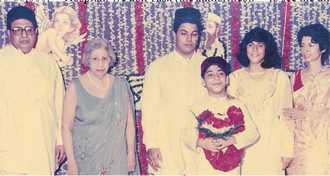
Dr Keiki Mehta with mother Sooni, sons Cyres, Rustom, daughter Shirina and wife Zenobia
Mehta’s own education was at St Xavier’s School in Bombay and subsequently at the Karachi Grammar School when his father Rustom, working for Bank of India, was sent there on a posting. Later he studied at the K. C. College in Bombay before pursuing medicine. Seeing his uncle Dr Rustom Ranji in Hyderabad, a decorated soldier, he nurtured an interest in medicine from the very beginning. He joined the Christian Medical College in Chandigarh, thereafter studied for his diploma in ophthalmic medicine and surgery and subsequently postgraduation in ophthalmology. Adding to his experience he proceeded to the Moorefield’s Eye Hospitals and Institute of Ophthalmology in London and thence to Dublin, Ireland and finally New York. Past president of the All India Ophthalmologists Association and the Intraocular Implant and Refractive Society, chairman and organizing secretary of the EyeAdvance Congresses for the past 12 years, Mehta candidly remarks, "Given an option today I would do an MBA with finance.”
His views on the community are more guarded. Queries on intercommunity marriage and acceptance of children of interfaith marriages earn a response, "I am an orthodox man.” He does though concede, "We are a progressive community. The problem is two-fold. Do we have enough boys? Genetically we need fresh blood... If I had to go, I would go to the dakhma… Theological statements are best left to the clergy. The young BPP trustee Jimmy Mistry may have a lot to say on the subject…”
On a tour around the MIEI, we get to see the different rooms and are introduced to their many eye care machines, most of whose names we find difficult to register. We see a framed photo of Mehta being presented the Padma Shri by the President of India Pratibha Patil. Zenobia mentions how they were invited as guests of the government for three days and hospitality accorded to them at the Oberoi Delhi. The awardees, each of them specialists in their respective fields, were even made to go through a rehearsal the prior day!
There are two cupboards full of the many trophies and awards he has been conferred over the years. Besides winning eight gold medals from different medical organizations in India, Mehta has also earned recognition from the American Implant Society, National Eye Research Foundation, Chicago, Asia Pacific Intraocular Implant Association, American Society for Cataract and Refractive Surgery, International Council of Cataract Surgeons, and the Instituto Barraquer, Barcelona. He enjoys the distinction of being the only Indian surgeon to have operated live at Video Cataracta in Milan, Italy at Europe’s biggest live surgery conference, as notes his curriculum vitae.
Despite his pressing engagements Mehta makes time to conduct free eye camps all over India, is chairman of the Low Vision Centre in Maharashtra and runs a 25-bed, free, charity eye hospital in an adivasi area in Karjat. Providing "best quality, loving and caring humane services to our patients through our committed, professionally oriented team” clearly remains Mehta’s visible priority.
◆ ◆ ◆
From the archive