
In Memoriam
Baliwalla's vision
Died: Naval Phirozesha Baliwalla, 77, respected optometrist who endeavored to make optometry an established profession in India while serving the family business Baliwalla and Homi, on August 31, 2005 in Bombay following complications arising from a minor surgery of his intestinal tract.
Died: Naval Phirozesha Baliwalla, 77, respected optometrist who endeavored to make optometry an established profession in India while serving the family business Baliwalla and Homi, on August 31, 2005 in Bombay following complications arising from a minor surgery of his intestinal tract.
"During his lifetime he was a beacon light to the practicing and aspiring optometrists… A giant among the eyecare practitioners in India with a worldwide reputation he was held in high esteem by the World Council of Optometry,” commented Harish Kumar from The Indian Optician, a popular magazine serving the vision care profession, trade and industry. "The soft-spoken, diminutive and fragilely built Baliwalla was an uncompromising crusader for the promotion of optometry and its practice in the country and was a prominent leader in the campaign for securing for the primary eye care practitioners their due status in the country’s eye care service with official recognition,” added Kumar.
"With his encyclopedic knowledge of the development and growth of ophthalmic instrumentation and optometric education in our country, he had always unreservedly enlightened me on these aspects,” acknowledged Vajubhai Poojara, owner of Optimed, one of the largest frame manufacturers in India, admiring the "most devoted and most resourceful fountain of inspiration to the…optometric community.”
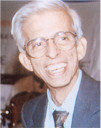
Baliwalla: fountain of inspiration
To dispense a difficult pair of glasses was a professional challenge to him and he served both the rich and the poor with equal dedication. The doyen "was such a gentle person and always greeted me so warmly and with care whenever we met at the ophthalmic rooms,” vouched the enterprising environmentalist Phe-roza Godrej. "So many visually impaired children at our Happy Home and School for the Blind received loving care and were always treated with kindness and generosity every time they visited the Baliwalla Clinic for low vision aids,” attested the director of the School Meher Banaji. In 1985 he helped the National Association for the Blind (NAB) to establish their Low Vision Aid (LVA) clinic and since then had been a member of NAB’s subcommittee for low vision. A low cost LVA trial set which he developed is sold across the country, notes his bio data.
Having worked with Baliwalla "closely in the (K. B. H. B. Eye and ENT) Hospital, Parel, for well over three decades and having received his valuable advice all the while,” the president of the Hospital Dr Kumudini Roy Choudhury viewed him as "one of the noblest human beings I have known.” In fact he was instrumental in the establishment of several institutions and private hospitals, remarked Kantibhai and Viral Purohit of the Rotary Eye Institute which runs the Smt Lilavatiben Mohanlal Shah (Bilimorawala) Eye Hospital, acknowledging his guidance at the inception of their Institute. "Quality care, honesty and loyalty were the unique characteristics of his life,” they added.
Involved with the Indian Optometric Association and the Indian Contact Lens Society since the time of their conception Baliwalla played a key role in the formulation of their policies and in organizing their conferences and continuing education programs. "This gentle and very able man did much for his profession, his city, his nation…” summed up Jay Enoch, dean of the optometry school at the University of California, Berkeley, adding, "When he spoke, I listened. He made sense, and was able successfully and repeatedly to push the boundaries of nascent modern optometry as well as eye care in general, in India.”
The third generation from the Baliwalla family to join the optical business established in 1899, Naval studied ophthalmic optics at the Northampton Polytechnic in London following his early education at Bombay’s Bharda New High School. After qualifying as a Fellow of the Spectacle Makers Company and obtaining his diploma in orthopics he returned to India. He was instrumental in bringing to India several European manufacturers of ophthalmic instruments and soon started developing some instruments locally, making them more affordable. "He was the pioneer of optical instruments manufacturing in India,” summed up Devendra Kumar of Aligarh’s Premier Contact Lens and Artificial Eye Centre. In the 1950s he was one of the first promoters of contact lenses in India.
Realizing the need for optometric education in India in 1978 he established the School of Optometry at the Municipal Eye Hospital which conducted a diploma course in optometry. In 1985 when Dr S. S. Badrinath started India’s first degree program in optometry at Shankara Netralaya, Madras, Baliwalla served on their board of studies. Keen to see Bombay have its own degree program in optometry, he formed the Optometric Education Society in 1996. Four years later he was able to establish the Hirabai Haridas Khimji College of Optometry. Struggling to raise adequate funds and find suitable premises, they were relieved when the Lotus Trust offered them 4,500 sq ft premises at the Lotus Eye Hospital on the condition that the college would be renamed Lotus College. Each year they enroll around 20 students for their four-year Bachelor of Optometry degree course. Beginning 2006 Baliwalla wanted to introduce a masters program and had succeeded in raising 15 lakhs from the Rs 33 lakhs required to start a research institute. When other communities are availing of the facilities offered by this non-profitable institution, why aren’t Parsis joining? he used to wonder.
Although refusing to get involved in any politics whether it concerned his own community or the optometric fraternity, he read a lot of books on Zoroastrianism and was very open-minded, reveals his daughter Anahita Dastur. His mornings would invariably start with a visit to the fire temple, sometimes the Anjuman Atash Behram and at other times the H. B. Wadia Atas Bahram in the vicinity of their shop at Dhobitalao. He was sufficiently motivated to learn the Avesta script and attended Dr Ramiyar Karanjia’s classes.
He was equally committed to the Freemasonic movement, confirms family friend Fali Poacha describing Baliwalla as "sincere in everything he did, with malice towards none and kindness personified. In all these years I have not once heard him speak disparagingly or unkindly of anyone but on the contrary he always saw the good aspects in everyone and in all things. His door was always open to anyone who needed solace, his hand always extended in help, ever lending a shoulder to lean upon… Full of humor, tongue in cheek, his ability to laugh at himself, his humility, always giving credit to others and taking none himself in spite of his myriad achievements were a lesson to us all.”
The commited optometrist is survived by his wife Gool, daughter Anahita Dastur and son Zarir.
Parinaz M. Gandhi
◆ ◆ ◆
From the archive