
In Memoriam
Corporator and carer
Died: Mehru Minoo Shroff, 86, founder member of the Indian Council of Social Welfare, trustee of Dr Shroff’s Charity Eye Hospital (DSCEH) and popular official accompanying Indian sports contingents to international meets, on May 4, 2013 following septicaemia and multi organ failure.
Known for her strong sense of duty and service with an instinctive ability to connect with people, Shroff made a lasting impression on her sports protégés as also on the poor patients who received free treatment at DSCEH founded by her father-in-law Dr Sorabji Shroff. At her uthamna tributes were paid by members of her family, colleagues and friends who valued her contribution.
Chairman of the DSCEH, Trilochan Singh, who had known her from the time both of them were members of the Delhi Municipal Corporation (DMC) commented that he was touched by Mehru’s "earnestness and involvement” in the Hospital. "She seemed to have mastery over all relevant details and aspects, particularly about the care of the patients most of whom belonged to the very poor strata... of the Muslim community.”
Known for her strong sense of duty and service with an instinctive ability to connect with people, Shroff made a lasting impression on her sports protégés as also on the poor patients who received free treatment at DSCEH founded by her father-in-law Dr Sorabji Shroff. At her uthamna tributes were paid by members of her family, colleagues and friends who valued her contribution.
Chairman of the DSCEH, Trilochan Singh, who had known her from the time both of them were members of the Delhi Municipal Corporation (DMC) commented that he was touched by Mehru’s "earnestness and involvement” in the Hospital. "She seemed to have mastery over all relevant details and aspects, particularly about the care of the patients most of whom belonged to the very poor strata... of the Muslim community.”
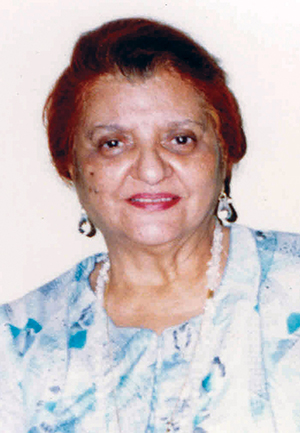 As honorary welfare officer at DSCEH Mehru would make the rounds of the wards, decide which patients had to be treated completely free, give a sympathetic hearing to any complaint and take it up with the administration and fellow trustees to get the problem resolved. She was "the link between us and our past, our values and the very purpose of being which is to serve all with the same commitment and compassion,” commented Kiran Mehta, head, Donor Relations at DSCEH. Every Thursday she would visit the poor patients at Daryaganj and distribute fruits to them. Eight years ago, when Mehta was still new to the institution, she recalled being summoned by her one Thursday: "She was sitting on her wheelchair as if it was her throne and she was the undisputed queen, surrounded by all her faithful old staff of the Hospital!”
Social welfare and sports promotion remained her abiding interests. She was a founder member of the Indian Council of Child Welfare that was constituted a year after Independence, serving on the Edwina Mountbatten Committee as also several other subcommittees. On the DMC she was appointed member by Union Health Minister Raj Kumari Amrit Kaur for two terms of three years each.
For 10 years, beginning 1948, she served as honorary joint secretary (women’s athletics) of the Delhi Olympic Association and in a similar capacity for the Delhi Swimming Olympics. At the first Asian Games in Delhi in 1951 she worked as an official, and was appointed joint secretary (athletics) for All India Olympics at Cuttack, Orissa. As manager (athletics) for the women’s team for the Third Asian Games at Tokyo and for the Commonwealth Games at Cardiff, Wales, she enjoyed the honor of being with the teams when they were entertained by the head of state, states her bio data.
At the Commonwealth Games when the star athlete of the men’s team Milkha Singh won a gold medal in 1958, he was officially under her care. As recalled by her for an article in Parsiana, "Milkha Singh who was in the Army was having a running battle with his manager who was a senior services officer and expected him to follow Army protocol even during the Games. Finally the chef-de-mission Ashwini Kumar placed Milkha under my care so that he could concentrate unhindered on his training…After that he always insisted that he be under my charge and called me ‘Mummy.’”
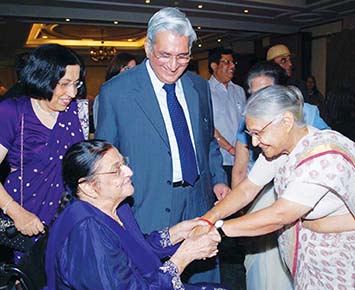
Mehru Shroff greeting Delhi chief minister Sheila Dikshit
as Niloufer and Noshir Shroff look on
Mehru’s social and sports activities came to a halt "in deference to my ailing father-in-law and our Guruji,” the late M. K. Srivastava, who wanted her to take over the running of the house and assist husband, Dr Minoo, who as chief medical officer and managing trustee for four decades had contributed to the expansion and modernization of DSCEH.
"They were a great couple. Papa was calm and she was volatile. He was an idealist and she very pragmatic. He took people at face value and she could read between the lines,” observed their younger son Dr Cyrus Shroff, a retina surgeon. Their elder son Dr Noshir, also an ophthalmologist, specializes in cataract, intraocular lens surgery and LASIK. Summed up Cyrus, "As a mother she was loving and caring but a tough taskmaster and never allowed us to shirk (responsibilities).”
Ramesh Rampal, who was in school with Cyrus for 13 years during which time Cyrus always stood first, recalled, "There were many a times when we wondered behind his back as to who or what was behind this consistent performance.” The mystery was resolved years later by his father-in-law Lt Gen Adi Sethna who told Rampal that when Cyrus stood first in the Higher Secondary School Examination, he had sent him a congratulatory telegram from Kashmir stating "Mother’s soup did the trick!” The ever vigilant army censor, fearing it was some secret message, never allowed the telegram to go through.
Whilst Mehru was known to boost the morale of her sons during their academic sojourns, she was equally concerned that the children of her staff members get good education. The health of her staff and domestic helpers was high on her priorities too and she would not only pay their medical bills but also accompany them to the doctors.
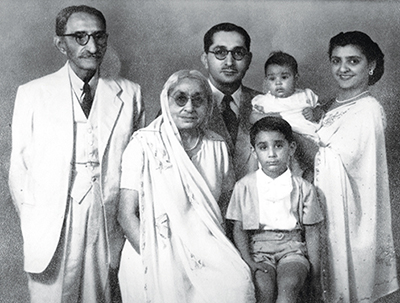
(From left, above): Sorabji, Meherbanu, Minoo, Mehru and children;
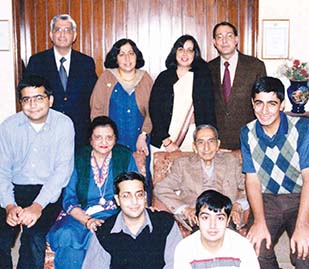
(Right) Mehru and Minoo (center) with (standing) Noshir, Niloufer, Rukshana and Cyrus,
(sitting) Kersi, Daraius, Zubin and Rushad
"The Shroffs are an institution, the likes of which are not to be seen either in the Parsi community in Delhi or in the Delhi population. This is not restricted to their activities in the sphere of ophthalmology only. Their activities in the area of philanthropy are legendary. One has to visit the Shroff Charitable Hospital in Daryaganj to experience this,” observed Yezad Kapadia, president of the Delhi Parsi Anjuman. For many years she served as secretary of the Anjuman Social Centre and had also contributed as member of the Fund Raising Committee for the silver jubilee of the Delhi Dar-e-Meher in 1986.
During the four years she was secretary of the Delhi Music Society, she was instrumental in bringing foreign artistes to the Delhi platform. For some years she had served as Guide Commissioner, Bharat Scouts and Guides. Having enjoyed the limelight in sports and public affairs, she stepped aside gracefully at the peak of her success to devote her time to welfare activities.
Born in Bombay to Nadirshah and Shirinbai Gocal, Mehru moved with her family to Karachi when she was about three years old. The playmates in her residential compound all being boys, she learnt to be plucky and adventurous from a young age. To gain admission to this inner circle of friends, she accepted their challenge of dressing in shorts and a shirt, and sporting the tail of a squirrel which she had caught, in her topi! The imp had once fallen down from a tall almond tree that left her with a dislocated shoulder and a good thrashing from her father. Another incident she recalled with glee and had caused agony to her aunt was when she managed to get her head stuck between two railings at the Victoria Gardens. Until some onlookers came to her rescue she taunted the aunt that the only recourse would be to cut off her head. On another occasion the prankster had deliberately inhaled a tiny particle that remained lodged in her nostril until her father made her smell some snuff so that the resulting sneeze would eject the intruder.
After her schooling in Karachi, Mehru moved to Government College, Lahore to graduate in botany and zoology. It was there that she met Minoo who was nominated by the Vicerine of India, Lady Irwin to study at King Edward Medical College in Lahore. Her masa Dr Eduljee Bharucha served as his local guardian. Passionate about swimming, Mehru decided to pursue a career in physical education and after receiving training at the Physical Education College in Madras, returned to Lahore. Armed with a physical education diploma, she taught in Khalsa College, Lahore for two years from 1945-47, left for India on a refugee train amidst considerable consternation at the time of Partition, and later instructed students at Lady Irwin College, Delhi for two years.
A regular agiary goer, she would book maachis and have Tandorosti prayers said for the health of family and friends, recalls Cyrus, adding, "She was equally comfortable going to Vrindavan with her husband and our Guruji and offering prayers there unfazed by the milling crowds and sea of humanity.” "Religion to her was not mere prayers and rituals but serving God by reaching out to the needy and making a difference to the lives that you touch,” remarked her niece Firoza Bharucha who appreciated that Mehru Masi was "the only one who could discipline an obdurate tot…She was tender, firm, approachable and my greatest confidante especially during my trying teens.”
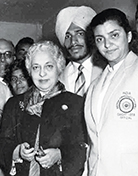
Mehru as Commonwealth women’s team manager
with Vijaylakshmi Pandit (left)
With her grandchildren she enjoyed a special rapport and as summed up her eldest grandson Daraius, "We were very lucky to have such a broad-minded Dadi. It was said that we could get away telling her things that her sons would never dare to!”
Noshir’s school friend Yogesh Vaid observed, "Interacting with Aunty, I realized one could be modern in appearance and outlook yet retain one’s customs and traditions. Every evening she would have the cook light up incense in a receptacle with which he would walk through every room. I still recall the fragrance as a hush would descend on our noisy chatter and the home felt like a temple… If there is an appropriate word to describe her, mine would be ‘regal.’ Her statuesque frame, her carriage, her posture, her elegant sense of dress, her well-groomed look, her warmth and her dazzling smile would always light up the room.”
The committed confidante is survived by her sons Drs Noshir and Cyrus.
◆ ◆ ◆
From the archive