
Observation
A comrade and companion
Activist Anuradha Ghandy had the ability to bond with both simple tribals and top intellectuals
On April 12, 2008 a beautiful life got suddenly extinguished. Anuradha Ghandy passed away at the young age of 54 due to late detection of the killer disease, falciparum malaria. Two years is a long time, yet the fragrance lingers on, intoxicating the mind with memories of her vivacious and loving spirit. Even here, in the High Risk Ward of Tihar Jail, the five sets of bars that incarcerate us cannot extinguish the aroma of Anu that permeates one’s memories. The pain one suffers here seems so insignificant compared to what she must have faced on that fateful day.
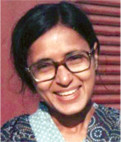
Anuradha Ghandy: struggles and sacrifice
I still remember the first day I met her, way back in mid 1972. The sparkle and brightness that radiated from her childlike face never dimmed through all the torturous years of struggles and enormous sacrifice.
The purity of her soul and her deep commitment to the oppressed never allowed hardship, physical or mental, to weigh her down. That is why the wear and tear of life could not extinguish her youth and exuberance. It was only the deadly and incurable systemic sclerosis which struck her in 2002 that suddenly resulted in her aging overnight.
Though her face grew drawn, the fire for a full life in the service of the country and its people did not diminish. Till her very last day, from six in the morning to 12 at night she was continuously on the move — meeting people, traveling, reading, writing and even cooking and cleaning. Though the disease was slowly eating away her lungs, her kidneys, her heart and crippling her fingers, Anu knew no rest. Even her arthritic knees, which grew more and more painful, did not stop her climbing stairs, trekking in the forests, and often being on her feet from morning to night.
Yet, despite her exhaustion, her pain, she never complained. Those meeting her, did not realize what she was going through.
Anu’s life traversed many paths. The progressive and democratic atmosphere of her family played a key role in molding her. She was a brilliant student at school. In her college days she was a student activist and leader. In the post Emergency period, while working as a lecturer, she became one of the country’s leading human rights activists. After moving to Nagpur in the early 1980s, she became an all-India face of the revolutionary cultural movement, emerging as Maharashtra’s foremost revolutionary personality.
Together with her job as postgraduate professor in sociology, she became a well-known militant trade union leader, heading many a worker’s struggle and even going to jail a number of times. A popular face of the women’s movement in the region, she also had a deep impact on the intelligentsia — lecturers, students, lawyers, writers and social activists — of Nagpur and Vidarbha. But her main impact was on the dalit (untouchables) movement there.
With her incisive knowledge of the dalit/caste question and her thorough study of Dr B. R. Ambedkar’s writings, she was able to effectively challenge the deeply entrenched dalit leadership, with a scientific and Marxist interpretation of the issue. We shifted our residence to the biggest dalit basti (encampment) in Maharashtra. Anuradha’s impact on dalit youth was enormous and she became a regular invitee at most dalit functions. The people of Nagpur fondly remember this senior professor, staying in a dalit basti, cycling throughout the city in the blazing sun.
Anu then shifted to work amongst the most backward tribals, living in the forests amongst them, sharing their weal and woe. And finally, in her last six to eight years she focused on the oppressed women of our country, educating them and arousing them to seek emancipation and liberation from poverty.
Through all these ups and downs we were sometimes together, often apart for months. But, the times we got together were the most cherished periods of my life. Her fiercely independent thinking was a great help to rational understanding of events, people and issues. There was no other person with whom I have had such vehement debates. This normally brought balance to my often one-sided views.
Anuradha had the rare ability to combine activism with theoretical abilities. She was a voracious reader and prolific writer — in English, Hindi and Marathi. She wrote on many topics, and her writings on the dalit/caste question and women’s issues have been important contributions to a scientific understanding of two very important societal aspects of India.
But what Anu would be remembered for most is her beautiful nature. At a time when communism has degenerated throughout the world, where power — even petty power — tends to corrupt, where ego, self-interest and craze for leadership/fame eats into the vitals of many a movement, Anu remained unaffected from the time she was an ordinary cadre to when she was a well known leader. The simplicity, the same straightforwardness, the same childlike innocence. Her face was a reflection of her emotions — unable to lie, manipulate others or indulge in intrigue. She had the ability to bond with all, from the simplest tribal to topmost intellectuals. Anu had the beauty of innocence, yet maintaining the sharpness of intellect and dynamism of a professional. It is this combination that gives Anuradha her eternal fragrance.
Kobad Ghandy is a Maoist idealogue currently incarcerated at the Tihar Jail in Delhi.
◆ ◆ ◆
From the archive