
Environment
Save our sandalwood
The community must consider alternatives to the use of white Indian sandalwood as offerings in fire temples
As early as 1998, the Indian sandalwood was listed as "vulnerable” but its status is now changed to "endangered.” And if no action is taken by the Government of India it will soon be listed as "extinct.” Once it is extinct it cannot be brought back to life. The International Union for the Conservation of Nature and Natural Resources (IUCN) is the world’s main authority on the conservation status of biological species, both terrestrial and aquatic. A series of Regional Red Lists are produced by countries or organizations which assess the risk of extinction to species within a political management unit. There are four species of sandalwood out of a total of 15 that are on these red lists.
Parsis, known to be a progressive community, should re-think their use of sandalwood for burning in fire temples. One of the four species on the red list, Santalum fernandezianum, is already "extinct,” a term meant to signal its total disappearance! The tree was cut to extinction a hundred years ago by foresters in Chile, where it was endemic and once grew abundantly.
Although the main user is the oil, perfumery and furniture industry, nonetheless Parsis should, in my personal opinion as a conservation biologist, not contribute to the destruction of the white Indian sandalwood trees (Santalum album L.) that remain in Karnataka and Tamil Nadu.
Cosmetics companies and essential oil traders have been conveniently ignoring the truth that the spike disease, overexploitation and smuggling are destroying the sandalwood forests in India. Since many years it is believed that the spike disease is caused by a virus and its transmission is by either grafting or by sap inoculation. The spike disease affects the tree in several ways: there is a reduction in leaf size, a "witches-broom” appearance of the branches and the development of floral parts into leafy structures.
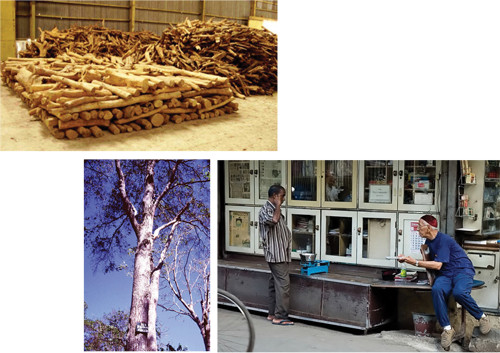
(Bottom left): White sandalwood tree in India; (right) Sandalwood seller outside an agiary in Bombay; (top): a godown in Indonesia with piles of sandalwood logs
In addition to spike disease, considerable loss of sandalwood trees has resulted due to the activities of illegal distillers, smugglers and unauthorized traders. The ever increasing demand (estimated at over 250 tons of sandalwood oil per year alone) from the attar-makers of the Middle East and Sudan, and by incense stick makers of South India, and for logs by wood carvers and furniture makers, have all resulted in severe depletion of stocks in India. This has come about despite several warnings by eco-aware groups such as Cropwatch.
In Europe, nationally run aromatherapy courses still include sandalwood oil for study and use. The international incense trade has summarily ignored the warnings of a severe shortage due to overexploitation. Cropwatch has maintained that with proper harvest and trade policies, and investments in plantations, sandalwood can be made into a self sustaining crop. Projects started on the island of Vanuatu (South Pacific), Indonesia and Australia have been agriculturally successful but the oil obtained from these sandalwood trees is nowhere near the quality and aroma obtained from trees growing in Karnataka and Tamil Nadu. This is due to soil and climate advantages in the latter two states. But at present, the future looks very grim for the sustainable use of the Indian sandalwood trees.
Another alternative to the use of white Indian sandalwood, although the cost will be prohibitive, is to import other varieties of sandalwood from the Pacific countries that grow species that are not endangered such as Sweet Quandong, Bitter Quandong, Northern Sandalwood and Australian fragrant sandalwood from Australia, Coast Sandalwood and other varieties from Hawaii, brown sandalwood from Fiji and Tonga.
The above-mentioned sandalwood species may not be as fragrant as the Indian sandalwood but at least we can say that it is "sukhar.”
Another wood that can be easily substituted by Parsis for white sandalwood is the red sandalwood (lal chandan). This tree is only found in South India at Kadapa and Chittoor located on the Tamil Nadu and Andhra Pradesh border. However, red sandalwood has been historically in great demand in China for furniture making. At one time (Qing dynasty, 1644-1912) it was reserved for the use of the royal palace only due to its shortage and uniqueness. More recently, the wood is once again in high demand in China for making butts of the Chinese AK-47 and other rifles. It is smuggled regularly from India through Nepal into China. The governments of India, Nepal and China should work together to curb this activity. Otherwise even red sandalwood will soon become endangered. The other, but inferior, form of red sandalwood is rosewood named in trade as "bois de rose” or violet rosewood which when cut is bright crimson purple changing to dark purple later. The wood from these trees has a fragrant scent when worked upon or burnt and could serve as a worthy substitute to white sandalwood.
The other alternatives are to use bawal wood or to import inferior sandalwood from Indonesia for offerings at fire temples. I have seen piles and piles of good sandalwood being offered to the fire on auspicious days at the Iranshah and other atash behrams. In this modern day and age, let us be eco-conscious and not contribute to the destruction of a fine tree that has served humanity so well through the centuries. As a progressive community let us show others that we are not dogmatic and can rise to the occasion whenever a species of Ahura Mazda’s own creation is threatened.

Associate research geneticist at the University of California, Dr Ardeshir B. Damania’s area of interest includes biodiversity conservation issues, early agriculture, crop domestication and plants of economic and medicinal values. His early career was with the Food and Agriculture Organization of the United Nations and he subsequently worked with the International Center for Agricultural Research in the Dry Areas.
◆ ◆ ◆
From the archive