
Religion
Platform for promoting peace
Zoroastrians were well represented at the Melbourne meet of the Council for a Parliament of World’s Religions
"I am proud to belong to a nation which has sheltered the persecuted and the refugees of all religions and all nations of the earth… I am proud to tell you that we have gathered in our bosom the purest remnant of the Israelites, a remnant which came to southern India and took refuge with us in the very year in which their holy temple was shattered to pieces by Roman tyranny. I am proud to belong to the religion which has sheltered and is still fostering the remnant of the grand Zoroastrian nation… Sectarianism, bigotry and its horrible descendant, fanaticism, have possessed long this beautiful earth. It has filled the earth with violence, drenched it often and often with human blood, destroyed civilization and sent whole nations to despair. Had it not been for this horrible demon, human society would be far more advanced than it is now. But its time has come, and I fervently hope that the bell that tolled this morning in honor of this convention will be the death knell to all fanaticism, to all persecutions with the sword or the pen, and to all uncharitable feelings between persons wending their way to the same goal.”
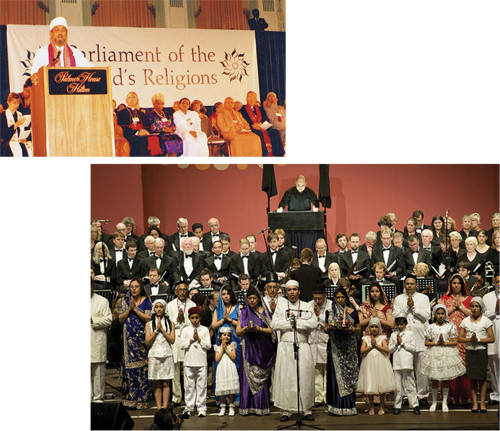
Above: Address by Ervad Kobad Zarolia at the 1993 Parliament in Chicago; (bottom) at the 2009 Parliament in Melbourne
Prophetic words indeed, spoken over a century ago by the young Swami Vivekananda, the self-invited participant at the opening of the Parliament of World’s Religions (PWR) in Chicago in 1893. The meet was held in the hall of Columbus at the Art Palace, now the Art Institute of Chicago. This was one of the over 20 auxiliary events of the World Columbian Exposition, which was organized to showcase humankind’s prowess and the mastery of technology, for it was thought at the time that all that there was to be discovered had been discovered! Vivekananda was the harbinger who heralded to the West the thought that the religions of the East were at least as profound as Christianity, the dominant faith of the West in the 19th century.
The 1893 proceedings record, "The Parsees of India and Persia profess the ancient religion of Zoroaster the renowned sage and prophet of Persia. While other religions of the ancient world, such as those of ancient Egypt, Chaldea, Assyria, Babylon, Greece and Rome, have disappeared from the face of the earth, this has survived many trials and vicissitudes and still flourishes. If not in all its pristine vigor and glory, with many of its distinctive features preserved practically intact.” The proceedings further state, "the high attainments of Dr Jamaspji Minocherji JamaspAsa, the Parsi High Priest of Bombay have received the recognition of some of the greatest universities in the world. He early expressed his admiration for the plans of the Parliament, and regretted that his age would prevent him from being a personal participant in the sessions.”
The date of the opening of the Parliament, which we now call "the first Parliament of the World’s Religions” was September 11, 1893. Little did the perpetrators of "9/11” know that they were signaling to the world the stark reality that nothing had changed in a hundred years. The words of the great Swami ring as true today as they did a century ago.
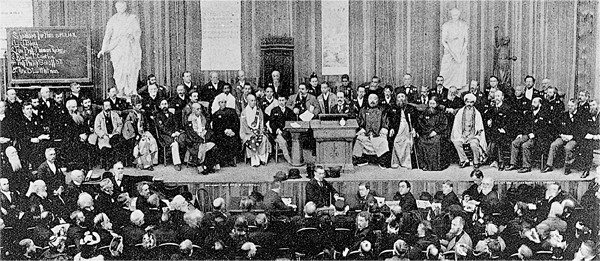
At the Parliament of World’s Religions in 1893
In the intervening period following the first Parliament of the World’s Religions several attempts were made to hold subsequent events of the scale of the first but none came to fruition. When the centennial of the 1893 Parliament was approaching, several faith representatives gathered at the Chicago Vedanta Society in 1987 to consider celebrating the centennial. Interest grew, and shortly an organization called the Council for a Parliament of World’s Religions (CPWR) was formed.
The centennial was celebrated in Chicago in 1993. The Dalai Lama, and religious heads from around the world, including our venerable Dastur (Dr) Kaikhusroo JamaspAsa, honored and inspired the gathering of over 8,000 persons with their presence. JamaspAsa, (grandson of Dastur Jamaspji, whose photograph was featured in the proceedings of the 1893 Parliament), recited verses from Ys 60.5 at the closing ceremonies of the 1993 Parliament before a gathering of thousands in Chicago’s Grant Park.
Exhausted as all the organizers were, following the success of this major undertaking, the CPWR was seeking a direction. The International Committee of which I was chair pondered long and hard for the next steps. Surely, we could not wait another 100 years! After some deliberation, we embarked upon holding a PWR once every four to five years. Thus, the third Parliament was held in 1999 in Cape Town, South Africa and the fourth in Barcelona, Spain in 2004.
For the fifth Parliament in 2009, proposals were received from several cities, among them the Singapore Interfaith Committee of which Russi Ghadiali was the chair. Through a by-now well-honed selection process, Melbourne, Australia won the bid, not only for their demonstrated ability to procure funding, now nearing four to five million US dollars, but also for their location and multi-cultural emphasis, Australia recently having made amends to their long-time underprivileged aborigine population.
Melbourne is home to several faith communities including our own. The Zoroastrian Association of Victoria (ZAV) serves an estimated 600 Zarathushtis living in Melbourne. Unlike Cape Town or Barcelona we had the distinct advantage of the support of an active local community. For the Parliaments in Cape Town and Barcelona, those of us participating had to carry everything with us — exhibits, banners, posters, books, leaflets, afargan, ses, divo, sukhad — all and sundry. Not so in Melbourne. Over a year ahead the ZAV appointed a PWR organizing committee, with Perviz Dubash, a past president and an elder of the community, Arnavaz Chubb, a gold medalist in Avesta-Pahlavi, and creative director Adil Dubash, to organize the Zarathushti effort and liaise with the local PWR office. The committee took care of every detail: preparation of budgets, fundraising, promotional flyers, hospitality for visiting Zarathushtis, the exhibit space, transportation, the Zarathushti panels, presentations and cultural programs, and a grand Zoroastrian Community Night function.
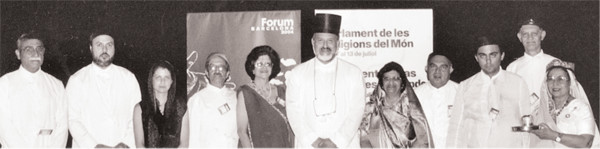
At the closing session of the 2004 Parliament in Barcelona
The Parliament was held at the state-of-the-art Melbourne Convention and Exhibition Center, December 3 to 9, 2009. Every day began with an hour-long early morning prayer worship, followed by two 90-minute sessions before lunch and two 90-minute sessions after lunch, with an evening plenary at 8:00 pm. During the day-time sessions there could be as many as 20 to 25 concurrent presentations, truly a feast for the participants who would be scrambling to go from one to the next like a child in a candy shop eyeing the many offerings, but unable to grab it all. If one was able to take in even just 20 to 30 of the over 650 presentations, we were richer for it. The experience increased our knowledge base and gave us a deeper understanding of the challenges faced by many practitioners, not unlike Zarathushtis themselves who have their share of issues and problems. This Parliament gave special emphasis towards integrating the indigenous peoples of the world who had come from every continent.
Zarathushtis were well-represented at the Parliament, with over 30 registered delegates — over 20 from Melbourne and about 10 from USA, Canada, India, UK, Sydney and New Zealand, with additional local participation for the cultural programs.
While the panel discussions and presentations were illuminating, perhaps the most satisfying moments were the informal encounters outside the lecture halls and conversations at what became our home base — the Zoroastrian Exhibition Booth. We met many old friends who have been on the interfaith circuit for many years. We renewed old friendships and developed new contacts.
The mission of the Parliament is to promote understanding and dialog, not only among the various faiths but also within each faith. With a deeper understanding, one can hope that respect for diversity will develop. And can we then not hope that will lead towards peace on earth? Theologian, Hans Kuhn, who was present in Melbourne has said that "there shall be no peace on this earth until there is peace among religions.”
Whether these Parliament events have made a difference is a matter for reflection. Wars based on religious differences still go on. Man’s inhumanity to man abounds. What should we do? The answer, perhaps, is to continue but lay more stress on intrafaith dialog, i.e. dialog within each of our communities, and implement processes that actually promote a back and forth dialog, a very difficult thing to achieve. It took a 100 years to jumpstart the 1893 Parliament. We hope it does not take another century of promoting the mission of the Parliament in every continent and every clime, before we begin to discern some results.
(For more information, photos and copies of presentations, visit www.parliamentof religions.org)
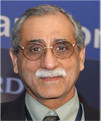
Rohinton Rivetna was founding president of the Federation of Zoroastrian Associations of North America (FEZANA) and spearheaded the founding of the Zoroastrian Association of Chicago and served as its president for eight years. He serves on the Council of Religious Leaders of Metropolitan Chicago. Founding vice president and trustee of the Council for a Parliament of the World’s Religions, he helped in forming the United Religions Initiative.
◆ ◆ ◆
From the archive