
Law
The battle of the ban
Bombay High Court Justice V. M. Kanade’s refusal to take a decision on the Originating Summons means the ban on the two priests remains in force
After three afternoons of deliberations, Bombay High Court Justice V. M. Kanade indicated he would refrain from taking a decision on the controversial Originating Summons (OS) initiated by petitioners Jamsheed Kanga and Homi Khusrokhan in regard to the Bombay Parsi Punchayet (BPP) ban on two priests from performing religious ceremonies at Doongerwadi and two fire temples.
"The best course of action is to file a suit,” noted Kanade on March 4, 2010 adding that if the BPP had agreed to let the matter be decided by an OS, "it would have been okay by me.” The BPP counsel Rafique Dada had argued that the issue was a religious one and would have to be settled by filing an adversarial suit, not an OS.
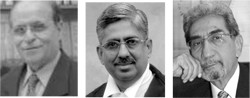
(From left ) Rafique Dada, Justice V. M. Kanade, Iqbal Chagla: assessing the legal boundaries of an OS
Counsel for the petitioners, Iqbal Chagla countered the issue was only of "interpreting the (BPP) trust deed… every attempt has been made to obfuscate the matter.” He also castigated Dada for alleging in his arguments that Kanga and Khusrokhan were irreligious and against the rituals and customs of the community. To "attribute that to the petitioners is character assassination of the worst kind.” If the present system of disposal of the dead was not functioning to satisfaction due to the paucity of vultures, people "have to find alternate means. It is a matter of choice. (The BPP) have no right to deny that right. Are we talking about the Taliban or the most progressive community in the city? The next stage will be to say, ‘We shall not allow them to enter’” Doongerwadi and the two fire temples controlled by the BPP, namely the Godavra Agiary in Fort and the Jokhi Agiary at Godrej Baug, warned Chagla. The petitioners will be then "in the same bracket as the priests.”
Referring to another OS filed by the same two petitioners and former BPP chairman Dr Aspi Golwalla, Chagla clarified it was not for installing a crematorium at Doongerwadi as alleged but rather for permitting the bunglis there to be used for funerary ceremonies of those opting for alternative methods of disposal outside Doongerwadi. He explained that Parsis believed the soul of the deceased remained on earth for four days and hence the ceremonies were required for that period. "Is this to be denied” by the trustees? "Who are they? Only custodians of property. They cannot decide what is a tenet or not a tenet…Are we going to give the trustees these powers…? queried Chagla.
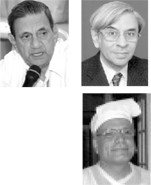
Clockwise from top left: Jamsheed Kanga, Homi Khusrokhan and Ervad Khushroo Madon
"Does the trust deed say only such and such priests are allowed by the trustees? The priests come from outside. The trustees cannot dictate which priest to call. (Parsis) have an inherent right to have the last rites and ceremonies by the priests of their choice. Are not the petitioners Parsi Zoroastrians? They are entitled as a matter of right,” stressed Chagla.
He termed the trustees "hypocrites” for citing resolutions dating back to 1905 to justify their actions. "Where are we now? 2010!” Chagla also spoke of the assault on the Russian Mikhail Chistyakov in Sanjan this February. "This is bigotry.”
The judge inquired as to "What is religious and non-religious? There are so many trusts in Bombay. They have a lot of difference of opinion. This is a highly contentious issue. I did not want to hear it. If the High Court interferes” they would be flooded with similar litigation. "The High Court should not” delve into these matters. "I have given the matter a lot of thought.”
Chagla: "This a public charitable trust, not a religious trust.”
Kanade: "Ultimately you are saying the resolution passed is wrong.”
Chagla: "If they don’t have the powers (to ban the priests) what heavens will fall?”
Kanade: "The best course of action is to file a suit.”
The next day, March 5, 2010, in his written judgment the soft-spoken judge, citing rule 246 which states "the court or the judge in chambers shall not be bound to determine any such question of construction if in its or his opinion it ought not to be determined on (an) Originating Summons,” dismissed the suit.
Ervad Framroze Mirza: accepting the ban
Presenting the BPP’s case on the first day of the hearing after Chagla had argued his case, Dada claimed that an OS is not meant "to decide complicated issues of fact.” He noted that under rule 246, the "court is not bound to determine” such suits. "The two priests (Ervads Framroze Mirza and Khushroo Madon) had not come before the court” and that one of them, Mirza, had submitted an affidavit in court the same day stating "I have suffered because of the ban but I don’t want a confrontation.” Mirza stated the petitioners had filed the OS "without my knowledge and consent” and reportedly supported the ban. According to Dada he said, "I respect the opinion of the high priests.” Mirza reportedly had "no desire to be in the same camp as Madon.” When asked for a copy of his affidavit by Parsiana, Mirza replied that he had only one copy which was handed over to the court by his advocate.
Dada argued that the present trustees had been "elected by 96 percent of the community” (the actual figure would be closer to 66 percent — editors). Noting that the high priests had termed the two mobeds "renegades,” Dada stated "this becomes a very serious matter of dispute. Is the court able to decide” such issues? Had the trustees prevented the two petitioners from appointing other priests to pray for them? "The trust deed does not say they can select the priest of their choice,” Dada reasoned. The two petitioners harbored some "other motives: confrontation” for filing the OS, he alleged. "They are against the system” of dakhmenashini, he claimed.
He said the dispute "is not of a civil nature.” The question is "whether a particular practice is contrary to religion. The court cannot decide the true tenets of a religion… this is not a secular institution or a club or something like that. It is a 340-year-old-trust — the oldest public trust in India or maybe the world.”
It is the beholden duty of the trustees to "protect and preserve the system” of dakhmenashini, argued Dada. "The trustees cannot allow renegade priests to perform” ceremonies on their trust properties. The consecrated fire "gives comfort to the soul. Cremation destroys the foundation of the faith… (Zoroastrians consider) fire a creation of Ahura Mazda. No putrid matter should be put in fire.
"In religion you do not have the right to decide. You must follow the religion…What is their motive? To say the religion has failed? An OS is not the way to do it. It is not for the courts to decide,” argued Dada.
To bolster their case the BPP cited a letter from the five high priests supporting their stand on the ban. The letter signed by Dasturs (Dr) Kaikhusroo M. JamaspAsa, (Dr) Firoze M. Kotwal, Meherji K. Meherjirana, (Dr) Peshotan H. Mirza, Cyrus N. Dastur stated:
"We are pleased to learn that the new BPP board has recently issued a directive in conformity with our earlier guidelines, whereby we have repeatedly said, that our good and upright mobed sahebs should not become hamsharik with renegade priests who encourage wrong religious practices such as cremation, and/or do the conversions of non-Zoroastrians. The imposition of a ban therefore, on Ervads Khush-roo Madon and Framroze Mirza (who continue to offer their services for performing after-death ceremonies for those who opt for cremation, in Bombay, and who facilitate the conversion of non-Zoroastrians by performing navjotes of jud-dins), should be strictly implemented by the BPP board. The BPP trustees have taken the right step in preventing them from performing any priestly rituals/prayers at our sacred Doongerwadi complex, including any ceremonies at the sagdi.
"The apex body of our community, in our opinion, should under no circumstances be seen to be giving any form of legitimacy or acceptance to these renegade priests whose actions are impacting our religion and community negatively. This timely action taken by the BPP board will strengthen the religion, as it will also serve as a deterrent to other priests, who may also seek to break away from our time-tested traditions.
"The rank and file of the clergy knows that they must follow the ancient customs and traditions of our faith, which they are obliged to abide by, once they are initiated into the priesthood. Such misguided priests, who lack scholarship and who for reasons of money and/or convenience have sought to perform ceremonies for those who have wrongly chosen the cremation route where dakhmenashini is available, are by their very actions and by their open defiance of the long standing directives of the high priests, weakening our religious traditions.
"We are pleased that as trustees of the apex body of the Parsi Zoroastrian community you have fulfilled your duty and set the right example by not permitting the above named priests and any others like them to perform any ceremonies at Doongerwadi and/or at any other religious institutions under your care.”
The defamatory WAPIZ (World Alliance of Parsi Irani Zarthoshtis) Page in The Free Press Journal of March 12, 2010 termed the judgment an "Orthodox victory” and went on to personally malign Kanga, Khusrokhan and Chagla. They also castigated lawyers Fredun DeVitre and Jimmy Avasia who appeared for the petitioners stating they "should be ashamed of themselves (as) they remained silent spectators when Chag-la, their senior, distorted and misrepresented our religious practices in court.” The three counsel and their solicitor Rashna Dastur of Dastur, Dadhich and Kalambi fought the case pro bono.
The BPP solicitors were KRY Legal – Khushroo Driver, Rati Amrolia and Yasmin Katpitia. Counsels apprearing for the BPP included Percy Ghandy and A. A. Kumbhakoni.
Extracts from Justice V. M. Kanade’s judgment
After referring to the various judgments relied on by the lawyers from both sides, Kanade related briefly the details of the case.
"The controversy had arisen after the said two priests performed religious ceremonies after cremation of the dead at places outside the Doongerwadi (Towers of Silence). They offered prayers in the said premises which was objected to by the high priests who considered such practices to be unreligious. Secondly, one of the priests viz Khushroo Madon also converted non-Zoroastrians into the Zoroastrian religion and made him a Parsi priest which is also criticized by the high priests and, thereafter, the trustees passed resolution on June 9, 2009 and imposed a ban on these two priests from performing religious ceremonies at Doongerwadi and the said two agiaries.
"According to the plaintiffs, the said two priests have not performed any unreligious practices, firstly because cremation of the dead body or its burial is not completely banned by the Zoroastrian religion and, secondly, conversion also is not an unreligious practice. It is, therefore, urged that the trustees did not have an authority to decide whether action of the said two priests was religious or unreligious and, on that basis, imposed a ban on them from performing religious ceremonies in the trust’s premises. It has, therefore, been urged by the plaintiffs that the trustees only are the custodians of the funds or the property of the trust and do not have an authority to take decision in ecclesiastical matters, whereas the trustees have alleged that it is their bounden duty to maintain the trust’s properties and ensure that religious practices are being performed in the said properties and since disposal of the dead by putting the body in a Tower of Silence is an integral part of the Zoroastrian religion, the said two priests who had admitted that they wanted to take a contrary view to the view taken in the scriptures, should not be permitted to perform religious ceremonies on the trust’s property.
"Taking into consideration the said controversy, it is evident that the issue would involve interpretation of what are religious ceremonies which are to be performed on the properties of the trust… It is not possible for this court to decide the issue merely by interpreting the provisions of the trust deed and though the questions which are raised by the plaintiffs … appear to be innocuous questions, it cannot be forgotten that they have been raised in the context and circumstances mentioned in the plaint and written statement viz the performance of religious ceremonies after cremation of dead body of a Parsi Zoroastrian. Under these circumstances, therefore, I am unable to accept the submissions made by Mr (Iqbal) Chagla, the learned senior counsel appearing on behalf of the plaintiffs that only by interpreting the trust deed, it can be declared that action of the trustees is beyond their authority given to them under the trust deed. Plaintiffs, therefore, by posing these questions to the court are asking this court to indirectly decide the cause espoused by them viz cremation of the dead and seeking a declaration that such a practice is not unreligious. In any event, this court will have to address itself to the said question while giving answers to the questions raised by plaintiffs. In my view, it is quite well settled that the complex and contentious issues should normally not be decided by the court while answering the questions raised in Originating Summons.
"There is sufficient material brought on record by the defendants which indicate that the high priests of Parsi Zoroastrians have deprecated the practice followed by the said two priests of disposing the body of the dead by cremation other than by putting the dead bodies in the Towers of Silence and of conversion and, thereby, have challenged the plaintiffs’ claim that practice followed by the said two priests is not unreligious.
"Mr (Rafique) Dada, the learned senior counsel appearing on behalf of the defendants has also relied on a substantial portion of the trust deed which states that the high priest has a right to decide the issue which, according to Mr Dada, is a conclusive decision to decide the controversy and that the conclusive decision has been given by the high priest on the said controversy, who has held that the said action of the two priests is unreligious. In the light of this material which is on record, in my view, the matter cannot be accurately and properly resolved by merely interpreting the trust deed and it will be necessary to adjudicate this issue after giving opportunity to both parties to lead evidence on this aspect which can be properly done in a suit and not in Originating Summons, more particularly because it involves religious issues which affect majority of the members of the Zoroastrian religion.”
◆ ◆ ◆
From the archive