
Comment
A grave problem
Controversy clouds all modes of disposal of the dead worldwide — whether burial, cremation or bio-cremation — not dakhmenashini alone
Parsis may feel that they are the only ones having controversies over their system of disposal of the dead. Think again — we are not! London which has a population of eight million seems overcrowded but there are millions more under the soil which has been inhabited for 2,000 years. The city is rapidly running out of burial ground — the city’s largest cemetery is trying to persuade Londoners to share a grave with a stranger.
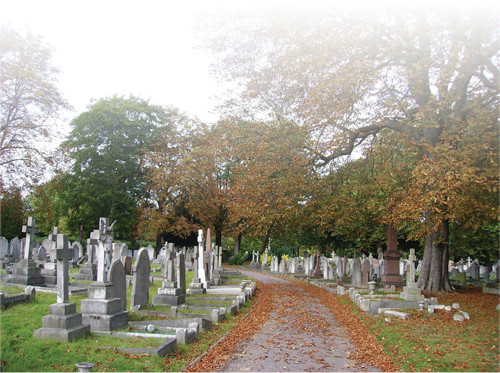
Gary Burks, Superintendent and Registrar of the City of London Cemetery, which is the final resting place of about one million Londoners says, "A lot of people say, ‘I am not putting my dad in a second-hand grave.’” The authorities have to deal with this mindset as the problem is quite British. Many other European countries regularly reuse old graves after about 20 years. But Britain does not, mainly because of Victorian hygiene obsession and national tradition. For many an Englishman’s tomb, like his home, is his castle. In many parts of Britain reusing old graves remains illegal but the City of London Cemetery is exploiting a legal loophole that allows graves in the capital with remaining space in them to be reclaimed after 75 years, according to an article in The Times of India (TOI) of October 30, 2009.
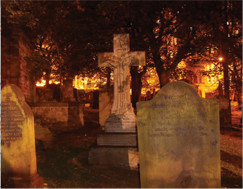
City of London Cemetery (top); "double decker” graves (above)
Due to a change in the law last year, cemetery staff have begun digging up old remains, reburying them deeper and putting new corpses on top — this is being called "double-decker” graves. These are being sold for the same price as the regular graves, for about $ 3,200 (Rs 1,44,000), mentions the TOI. Till date other cemeteries have not followed the example of the City of London Cemetery by reusing graves.
Another interesting report from London, quoted in Daily News and Analysis (DNA), January 26, 2010, states that Britain will soon have its first environmentally-friendly burial ground where human beings will be laid to rest near their loved pets. West Lindsey district council has granted permission to the village of Stainton by Langworth near Lincoln to bury humans near their pets. This will become the only place in England where humans can be near their dogs, cats and even hamsters, forever. One acre of the four-and-one-fourth acre site will be dedicated to animal burials and the rest will be a "green” burial ground for humans. Those who choose to be buried there will have bio-degradable shrouds instead of wooden coffins, with a tree or a flat plaque to mark the grave instead of a traditional headstone. This site will remain agricultural and wildlife will be encouraged. By the way, there are 19 pet cemeteries in England and Wales but till now none has been linked with human cemeteries.
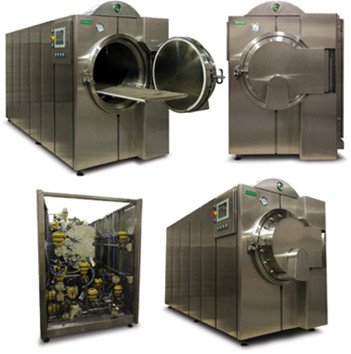
"Bio-cremation” system for chemical disposal of corpses
Turning our attention to China, due to the tremendous pressure on land, the government since the period of Mao Zedong has been trying to bring about a cultural reform of funeral services to persuade people to opt for cremation rather than burial. In spite of this, the burial tradition continues and even when families opt for cremation they wish to bury the ashes in an urn especially in their ancestral burial plots. However, these burial plots with favorable "feng shui” — near a water body or on a mountain side — come at very high prices.
Soaring land prices in China are haunting not only the living but also the dead, noted a report in the DNA of December 25, 2009. There is a wail of protests about the exorbitant "cost of dying” including the spending on "funeral services.” Due to the property market bubble, for burial plots in Shanghai the per-square-meter price is almost as high as for residential homes — this is due to the paucity of and pressure on land. The Chinese Ministry of Civil Affairs is addressing complaints about the exorbitant cost of funeral services.
The Qianjiang Evening News reported that many hospitals in Guangzhou had "outsourced” mortuary services to intermediaries, which had then refused to release dead bodies unless families signed on for expensive funeral services.
An article entitled "Bio-cremation for those dying to be green” appearing in the South China Morning Post (December 12, 2009) makes interesting reading. For those who are concerned about environmental degradation, some coffins are today made out of recycled cardboard — again there are others who refuse embalming chemicals as they seep into the soil. Cremation, which is a choice of a third of Americans, is getting a green makeover. It is now established that a standard cremation spews into the atmosphere about 400 kg of carbon dioxide — which is a greenhouse gas responsible for global warming — together with other pollutants such as dioxins and mercury vapor in case the deceased has silver tooth fillings. Besides this, each cremation consumes as much energy, in the form of natural gas and electricity, as an 800 km car trip.
A recent chemical body disposal process, alkaline hydrolysis, which its proponents also call "bio-cremation,” is attracting attention today. They say that it uses 1/10th the natural gas of fire-based cremation and 1/3rd the electricity. Carbon dioxide emissions are reduced by almost 90 percent and no mercury escapes as fillings and other metal objects such as hip or knee replacements could be recovered and recycled.
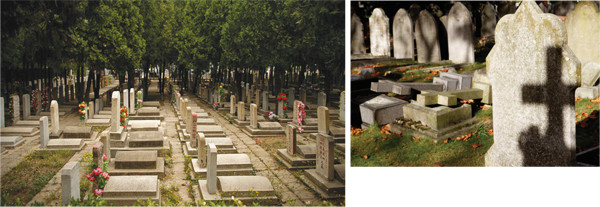
(Left): Graveyard in China; (right) "Share a grave with a stranger” in London
The Pittsburgh, Pennsylvania-based company which manufactures caskets and other funeral products is planning the world’s first commercial launch of human alkaline hydrolysis in January 2010 at a funeral home in St Petersburg, Florida. This technique is already being used to dispose of laboratory animals and medical research cadavers at a few centers. However, there are problems with this technique. Its commercial use has been delayed partly because of its cost — the equipment is four times as expensive as that of cremation. Moreover, state and provincial legislation may need to be changed, especially laws governing what can be disposed of in the water system. The other obstacle being people’s squeamishness.
The Catholic Church in certain parts of USA has already objected, stating that the practice "is not a respectful way to dispose of human remains.” In alkaline hydrolysis, the body is submerged in water in a stainless steel chamber. Heat, pressure and potassium hydroxide, chemicals used to make soap and bleach, are added to dissolve the tissue. After two hours, all that is left is some bone residue and a syrupy brown liquid which is flushed down the drain. The bones can be crushed and given to the family as with cremation. Allen Bessel, president of Transition Science, a Toronto based company, says, "This is the first new alternative to come into the (cremation) market in over 100 years.” Paul Rahill, president of the Cremation Division of Matthews International says that the public response has been mostly positive; however, an attempt to introduce this in New York State about two years ago was opposed by the Catholic Church and others. As a result, the bill was dropped.
In view of the global ecological devastation and its serious consequences, man has begun to make necessary adjustments in the various modes of disposal. It is evident from the above that every form of disposal has its problems.
In certain western countries, bodies are kept in vaults located in buildings constructed for this purpose. After a certain period, the vaults are emptied, the contents given to relatives and the vault reused for another corpse. Again, very old graveyards are being converted to gardens for public use.
The eco-friendly system of disposal adopted by Zoroastrians has certain advantages — dakhmas last for centuries and occupy only a small piece of land. Over the centuries, dakhmas have undergone changes. For example, the oldest operating dakhma in Bombay, called the Sethna dakhma having the central well, surrounded by three rows of pavis for men, women and children was built in 1756. Even after 250 years, it is in good shape and with proper maintenance it would certainly last for many more decades. Vultures have been necessary for our system. About 10 years ago, these scavengers birds disappeared, thus weakening our system. Fortunately, at this critical juncture, solar concentrators were introduced at Bombay’s Doongerwadi, thus harnessing solar energy. These solar units have gradually been introduced in six other cities of India. However, in my opinion, it is necessary to further strengthen our system so that it would work effectively even during the rainy season.

Founder president of the World Zarathushti Cultural Foundation and a scholar of Zoroastrianism, Dr Homi Dhalla has represented the community at various international conferences and interfaith meets. Among the community projects he is involved in are the conservation of Bahrot caves, the Sanjan excavation, documentation of Parsi history and the introduction of solar concentrators at Bombay’s Doongerwadi.
◆ ◆ ◆
From the archive