
Comment
“Pulling people apart”
Questioning the right of trustees of charitable organizations to issue religious edicts, an Originating Summons and subsequently an appeal was filed in court
Let me say at the start that religion is not the subject matter of this case. We (Jamsheed Kanga and I) raised a question whether the trustees of a charitable body like the Bom-bay Parsi Punchayet (BPP) have the power under the trust deed to issue bans that impinge on the rights of Parsi Zoroastrian beneficiaries of the trust. A large number of people have compli-mented us for taking this matter to court and say they support us.
Our concern was not merely about the banning of two priests from three places of worship. The purpose of the ban was a clear warning to deter other priests — two today, could well be 20 tomorrow. Predictably, we have now seen one more ban promulgated in respect of intermarried ladies (contrary to an earlier position taken by the BPP itself, not so long ago) and have witnessed the very unfortunate behavior of some of the trustees during the period preceding the navjote ceremony of the Maloo-D’Souza children. A sensible Punchayet would try to bring people together. This one appears bent on pulling them apart.
Sadly today, several sitting trustees confuse the agendas of other organizations they belong to with that of the BPP. When a trustee sits at the ‘BPP table’ the trustee must wear the ‘BPP hat.’ Edicts of any kind (by whatever name called) are clear manifestations of the ‘religious dogma’ espoused by such other organizations. In religion, true religion, there can be no place for dogma.
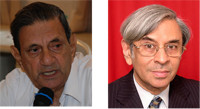
Jamsheed Kanga (left) and Homi Khusrokhan: Attempting to limit political abuse
As petitioners, we maintained a dignified silence once the court proceedings commenced, but the respondents were clearly attempting to run a parallel trial in the media. On two occasions, one-sided versions of happenings in court were not only reproduced in an advertorial space bought each week in a local newspaper, the supplement was then distributed in the High Court Library and Bar Association Reading Room! Large sums of money must have been wasted on such publicity and yet, ironically in the same breath, it is stated that the case cost the BPP a sum of Rs 24 lakhs. Surely one could say the same about the regular and continuing wastage of funds on such meaningless publicity which could well be used for charitable purposes. I can’t comment on fees charged by other professionals, but I can categorically state that the lawyers who appeared for us have not charged us a single paisa, demonstrating their strong belief in what they considered was a just cause.
Speaking about the inappropriate use of media during the case, a statement made by senior counsel Iqbal Chagla in the course of his opening remarks about High Priests was intentionally and mischievously taken out of context and splashed around in the Press just to try and cause embarrassment. He was, contextually at the time, drawing a distinction between the Zoroastrian religion and other religions where the word of High Priests amounts to canon law. In Zoroastrianism, indisputably we have High Priests, but equally indisputable is the fact that there is no canon law.
We respect our High Priests as individuals who are spiritual and have dedicated their lives to the cause of religion. Our High Priests would certainly have their own opinions, some based on scholarship and some based on their personal beliefs. But priestly views cannot override law and that too the settled law of the land. Even the present High Priests have differing views on the religion. It is well known that scholars do differ in their opinions and are we to cast aside the views of eminent scholars of the past, such as the experts examined by the court at the time of the Petit vs Jeejeebhoy case in 1908, just because some of our High Priests today hold a different view? Have the views of scholars like Dastur Jamaspi Kaikhushru JamaspAsa, Dastur (Dr) M. N. Dhalla and K. R. Cama suddenly become irrelevant to us? At a later hearing Chagla clarified that he meant no disrespect to anyone, but that of course was never reported. The personal malicious campaign carried out by some of the trustees against our lawyers and about us has not only lowered the dignity of the office of the trustee but also the prestige of the community.
Also regrettable was the fact that the respondents chose to drag into this matter the issue of the Originating Summons that Kanga, Dr Aspi Golwalla and I put our signatures to some years ago for permitting the use of a bungli for prayers for those who opt for cremation or burial (elsewhere), despite it having nothing to do with this case. It was wrongly alleged in court that Kanga and I were in favor of abolition of dakhmenashini and for building a crematorium at Doongerwadi. Our case, at that time, was simply against denial of the use of bunglis and thereby denial of prayers for the departed souls. I would never put my name to anything that could even remotely result in a closure of the system.
I believe that dakhmenashini is an excellent and eco-friendly system of disposal of the dead. But, a functioning system has to have two essential elements: exposure of the dead to the sun and allowing the body to be (quickly) consumed by vultures. In the absence of one or the other (or, sometimes, as in the monsoon months, both) the system cannot possibly be said to be functioning in the manner that it was designed to operate. Parsis today, particularly religious Parsis, agonize about the difficult choice that they are faced with when they lose one of their dear ones. The majority would never choose another system if dakhmenashini was functioning as it was intended. The choice of mortuary practice is an intensely personal matter and must be left to the will of the deceased person or immediate family members. In denying the use of bunglis, Parsi Zoroastrians are also effectively denied the four days’ prayers, the presence of family members at the place where the paidast was performed and the tranquility of Doongerwadi. The moment of death is a time of great distress for families and encumbrances like the denial of prayers only cause more pain. If only it were truthfully accepted that dakhmenashini is not functioning today the way it was intended to, then and then alone, would people realize that there is absolutely no logic in discriminating against those who choose cremation in India as against those who choose cremation abroad.
During the case, and even today, a lot of very eminent and sensible people have lent us their support, good wishes and blessings. While we were seeking the advice of various people on whether or not to go in appeal, one of our most eminent Parsi lawyers said to us, "History will not forgive you if you do not file an appeal and allow this to be the final order in a matter as significant as this.” We asked him whether it is worth the personal humiliation and angst one has to go through against opponents who see nothing improper in character assassination and defamatory statements. And his answer was even more profound: "If you are true Zoroastrians and believe in ashoi, you must go ahead!”
A fellow of the Institute of Chartered Accountants of India and a postgraduate from the London School of Economics and Political Science, Homi Khusrokhan was managing director of Glaxo, Burroughs Wellcome (India), Tata Tea and Tata Chemicals. He is currently on the board of several companies in a non-executive capacity and is vice president of the Bombay Natural History Society.
◆ ◆ ◆
From the archive