
Law
The battle of the ban
Whether the ban on two priests from performing religious ceremonies on Bombay Parsi Punchayet property is legal or not is now before the Bombay High Court
The hearing for admission of an Originating Summons questioning the "power of authority” of the Bombay Parsi Punchayet (BPP) trustees to ban two priests from performing religious ceremonies at three specified places will be heard by Bombay High Court judge Abhay Oka on January 7, 2010.
The matter came up for hearing on December 15, 2009 when counsel for the petitioners Jamsheed Kanga and Homi Khusrokhan, and the defendants, the BPP and its trustees argued briefly on the legal technicalities of the case. When Oka inquired if notice for the hearing had been served on the BPP, the trust’s counsels Ashutosh Kumbhakoni and Percy Ghandy replied in the negative. Counsel Iqbal Chagla appearing for the petitioners read out the notice sent to the BPP regarding the hearing on December 15.
Kumbhakoni argued that the BPP resolution banning Ervads Framroze Mirza and Khushroo Madon from praying at Doongerwadi, the Jokhi Agiary at Godrej Baug and the Godavra Agiary in the Fort area had been passed in the month of June and as the petitioners had waited till December to approach the court there was no urgency for taking up the matter for admission. It was then pointed out the advertisement was only published in September. In any event Khusrokhan had written to the BPP regarding the ban on August 3, 2009 after reading earlier press reports.
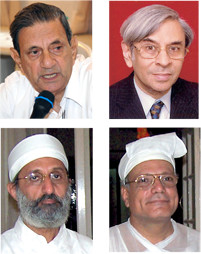
Clockwise from top left: Jamsheed Kanga, Homi Khusrokhan, Ervads Khushroo Madon and Framroze Mirza
Kumbhakoni noted that the "two priests have not come before the court. Others have come.” He and Ghandy said as the suit was an Originating Summons the question of an interim injunction did not arise. But the matter was left open for arguments.
The Originating Summons filed by Kanga and Khusro-khan on November 20, 2009 states the case "has been filed for the determination of questions relating to the powers/authority of the trustees and rights of the beneficiaries under the Trust Deed, the proper administration of the trust, and consequential reliefs and directions as prayed for herein, arising out of the purported ban imposed by the present trustees on two Parsi Zoroastrian priests… The purported ban has been imposed as a result of certain Zoroastrian religious ceremonies allegedly conducted by the two priests, which as alleged by the said trustees are ‘unreligious,’ being (i) praying for the dead who were cremated; (ii) performing navjote ceremonies of children of Parsi girls married to non-Parsi husbands; and (iii) performing marriage ceremonies as per Zoroastrian rituals of any one Parsi marrying a non-Parsi spouse. These ceremonies are admittedly not conducted within the premises of the Doongerwadi or the said two agiaries. The allegations are that such ceremonies are conducted at premises other than Doongerwadi and the said two agiaries…
"It appears that at the board meeting, dated September 8, 2009, the said Khushroo Madon tried to reason with the trustees that he had committed no wrong and cited teachings of priests and scholars such as late Dastur (Dr) Maneck Kanga, late Dastur (Dr) Jamaspi JamaspAsa and other eminent scholars and priests in support of his arguments. However, the trustees refused to retract the purported ban. It appears that (BPP chairman) Dinshaw Mehta (Defendant No. 2) went so far as to say that if he did not stop praying at the Doongerwadi, he would be physically thrown out. Out of the six trustees present at the meeting, Defendant No. 3 (Arnavaz Mistry), Defendant No. 7 (Noshir Dadrawala) and Defendant No. 8 (Armaity Tirandaz) are reported to have remained silent…
"In the meanwhile, learning of the purported ban from press reports, Plaintiff No. 2 (Khusrokhan) wrote a letter dated August 3, 2009 to the trustees of Defendant No. 1 objecting to the ban purportedly imposed on the said Khushroo Madon for the reasons set out in the said letter, including that the same is beyond the powers of the trustees. He stated that there was no necessity for the trustees to promulgate or endorse a ‘ban’ on a particular practice especially when it pertains to the subject of religion. He further urged them to reconsider the ban and put up a clarificatory statement as to the practices disapproved by the trustees as soon as possible…
"Thereafter, the plaintiffs, through their advocates sent a letter dated October 16, 2009 to the trustees, objecting to the arbitrary, illegal and discriminatory ban which is beyond the powers of the trustees. The plaintiffs called upon the trustees to forthwith desist from acting in furtherance of the aforesaid purported resolutions imposing the ‘ban’ on the said Khushroo Madon and the said Framroze Mirza, and to instruct the Doongerwadi and the two agiaries accordingly…
"The purported ban has been a result of the trustees’ allegations that the aforesaid certain ceremonies conducted by the said two priests are ‘unreligious.’ It is submitted that to describe these solemn religious rites and ceremonies as ‘unreligious’ would contradict the tenets of the Zoroastrian faith.
"As per the Trust Deed, the Doongerwadi is to be used and frequented as heretofore by every member of the Parsi community professing the Zoroastrian religion as a place for exposure of the dead and for the performance of the religious rites and ceremonies. It is submitted that the trustees do not have the authority or the power under the Trust Deed or otherwise in law, to prevent a Parsi Zoroastrian priest from performing Zoroastrian religious rites and ceremonies in the trust’s premises on the alleged ground that the trustees believe that the said two priest(s) have performed the aforesaid ceremonies. Thus, as per the trust deed, when the trustees purportedly imposed the ‘ban’ on the two priests from performing religious rites and ceremonies at the Doongerwadi and the said two agiaries, the said decision and consequent actions of the trustees were and are acting completely without authority, illegal, null and void.
"Further, the trustees do not have the authority or power under the Trust Deed, to dictate on religious matters and are, therefore, not competent or entitled to declare the abovementioned ceremonies as ‘unreligious.’ Their powers, as per the Second Schedule of the Trust Deed, are restricted to financial and administrative management of the properties held in the trust under the Trust Deed. The Parsi Zoroastrians have absolute right to choose any duly ordained Parsi Zoroastrian priest to perform prayers, rites and ceremonies for them at the Doongerwadi and the said two agiaries, and the trustees have no power whatsoever to impose restrictions, fetters and conditions on such choice and freedom of members of the Parsi Zoroastrian community, including the plaintiffs, who are the beneficiaries under the Trust Deed. Furthermore, no trustee can prevent a duly ordained Parsi Zoroastrian priest from performing Parsi Zoroastrian religious prayers or ceremonies in the Doongerwadi or the said two agiaries for the aforementioned reasons. Also, the personal views of certain priests, with regard to the said purported ban on the said two priests is completely irrelevant, extraneous and misplaced for the purpose of construing the Trust Deed and the powers of the trustees thereunder, and the said certain priests are not competent to opine on the powers of the trustees in law nor authorize them to go beyond the Trust Deed.”
"Earnest appeal”
In his letter of August 3, 2009 annexed to the plaint, Khusrokhan, a former managing director of Glaxo Wellcome, Tata Tea Limited and Tata Chemicals Limited stated, "Our community is being torn apart today with these constant dissensions, which are growing in intensity and becoming uglier by the day. I genuinely fear that we will witness the inevitable consequences of a ‘house divided against itself’ and I would hate to be the silent bystander who did nothing about it and let it happen — hence this earnest appeal to you…
"All persons, including dasturjis, can have beliefs of their own. In this case, Madon’s personal beliefs are in fact shared by many like-minded Zoroastrians today, including many residing abroad. Can we not agree to disagree on certain beliefs and live in peace and harmony with each other? Do we, as an enlightened community, wish to be accused of functioning through ‘fatwas’ and edicts?...
"I have yet to come across prayers recited with such perfect diction and clarity as those recited by Madon. I was brought up in an orthodox Parsi home in Surat, where (mobeds) from the agiary nearby came… to pray in our family home. Listening to Madon brings back those childhood memories of prayers as they should be recited. It is ironic and unfair that one who practices his vocation with such dedication and commitment should be unjustly treated in this manner.
"It is (a) blatant lie to say that he offers his services for disproportionate monetary gain. I have had the experience of utilizing his services on two separate occasions and can personally vouch that his charges are not excessive as compared to other Mumbai priests. Those who had the temerity to allege otherwise in the (non-Parsi) Press should hang their heads in shame!
"The BPP can today position itself as an apex body that works to unify and bring people together. Unity is the need of the hour — not creating disharmony and further dissensions. I am no legal expert but I doubt whether this issue really falls within the remit of the BPP. By involving itself in matters of religion, the BPP is embarking on a slippery slope, from which there will be no easy recovery...
"For the above four reasons I strongly urge that the ‘BPP ban’ imposed, if indeed true, is reconsidered and a clarificatory statement on the subject put out by the BPP as soon as possible. It is always open for the BPP to clarify that it does not approve of a certain practice, but there is absolutely no necessity to promulgate or endorse a ‘ban’ on a particular practice, especially when it pertains to the subject of religion.”
On October 16, 2009 the solicitors for Kanga and Khusrokhan, M/s Dastur, Dadhich and Kalambi wrote to the BPP trustees noting that no reply had been received to Khusrokhan’s letter of August 3, 2009 and stated their clients objected to the "ban” on the two priests.
They referred to a notice displayed at Doongerwadi dated September 11, 2009 which states:
"Important Notice To Whomsoever It May Concern
"Please note that at no point of time should Ervads Khushroo Madon and/or Framroze Mirza be permitted to perform any obsequies ceremonies at Doongerwadi including bhoisarna or any other rituals performed in or around the Dadgah Saheb, at Doongerwadi.
"As per the five High Priests’ directions, if any other priest is found to follow in the footsteps of Ervads Madon and/or Mirza then similar action will be taken against them, as well.
"These instructions are to be followed scrupulously and if the same are not adhered to, then suitable action will be taken, which please note.
C. S. Panthaki
Sr Executive Welfare”
The letter asked the trustees to withdraw the ban and "remove the offending notices at the Towers of Silence.”
"Within their rights”
The trustees’ solicitors KRY Legal replied on November 12, 2009 stating: "The trustees of the Bombay Parsi Punchayet (BPP), as per the General Trust Deed are the custodians of all the properties as vested with the BPP Trust which inter alia includes the Towers of Silence, Godavra agiary and Godrej Baug fire temple. Hence our clients are well within their rights to put up notice dated September 11, 2009 at the offices of the Tower of Silence prohibiting Ervads Mirza and Madon from performing any obsequies ceremonies.
"We draw your attention to the meaning of the word ‘renegade’ as defined in the Compact Oxford Dictionary Thesaurus and Word Power Guide (Indian Edition): ‘Renegade — a person who deserts and betrays an organization, country, or set of principles’ (emphasis provided).
"In as much as both Ervads Madon and Mirza perform the four days’ after-death ceremonies for those Parsi Zoroastrians whose bodies are cremated, facilitate the conversion of non-Zoroastrians by performing navjote ceremonies of ‘Juddins,’ performing navjote ceremonies of children of Parsi women married to non-Parsi men and performing marriage ceremonies as per Zoroastrian rituals of any one Parsi marrying a non-Parsi spouse, all of which are totally against the tenets of the Zoroastrian faith; the term ‘renegade’ is both appropriate and fitting. In fact, as priests both Mirza and Madon, by their above actions have failed to maintain the ‘dignity and grace’ of the noble profession of priesthood they profess…
"It would be very pertinent to point out that the five High Priests, two of whom are renowned scholars on the Zoroastrian religion in their own right, have themselves referred to Ervads Madon and Mirza as renegade priests and described their practices as ‘wrong religious practices.’ In their letter dated August 27, 2009 they have commended the action taken by our clients against Ervads Madon and Mirza and recommended that the ban be strictly implemented against such priests. Our clients wish to point out that the opinion of the five Head Priests who are academically qualified on the subject of religious and unreligious practices, would without doubt prevail over our clients, irrespective of what your clients’ views are on the said subject…
"You have mentioned that our clients did not have the courtesy to reply to a letter dated August 3, 2009 as addressed to them by one of your clients, Mr Khusrokhan. Vide the said letter dated August 3, 2009 your said client has not asked for a reply but has rather in his last line stated ‘I eagerly await your decision on this matter.’ By posting the notice dated September 11, 2009, our clients have expressed their decision in the said matter…
"The action taken by our clients is in good faith and in the performance of their duties as trustees of the BPP to preserve and uphold the traditional rituals and ceremonies, in their pristine form, as also to reinforce the faith of the members of the Parsi/Irani community reposed in them. The question of revoking the same does not arise.”
The Originating Summons plaint was drawn by advocate Yugandhara A. Khanwilkar, settled by advocate J. C. Pereira, further settled by Chagla and the solicitors are M/s Dastur, Dadhich and Kalambi. Counsels for Kanga and Khusrokhan also included Jimmy Avasia and Fredun Devitre.
A matter of interpretation
The following questions arise for determination as a matter of interpretation of the General Trust Deed of 1884:
Whether under the Trust Deed the trustees are entitled to prevent any duly ordained Parsi Zoroastrian priest from performing Zoroastrian religious rites and ceremonies in the premises of the Doongerwadi and the said two agiaries?
Whether the Trust Deed empowers the trustees to restrict Parsi Zoroastrians in their choice of a duly ordained Parsi Zoroastrian priest to conduct Zoroastrian religious prayers and ceremonies at the Doongerwadi and the said two agiaries?
Whether the purported ban on the said Framroze Mirza and the said Khushroo Madon, was within the power and authority of the trustees under the Trust Deed?
◆ ◆ ◆
From the archive