
Politics and Policy
“Resolve the disputes”
The Supreme Court has asked the warring factions to mediate on the contentious priests ban case
Supreme Court judges Markandey Katju and Gyan Sudha Misra have recommended the appointment of a mediator in the dispute over the banning by the Bombay Parsi Punchayet (BPP) of two Parsi Zoroastrian priests they term "renegade.” Respondents to the special leave petition (SLP) Jamsheed Kanga and Homi Khusrokhan who had moved a divisional bench of the Bombay High Court (BHC) challenging the ban had won in March this year.
If both parties cannot agree on a mediator before the next April 18 hearing, the judges may appoint one. Justice Katju reportedly told the parties that he had asked former solicitor general Tehmtan Andhyarujina if he would mediate in the dispute. Andhyarujina informed the judge he was one of five interveners in the case supporting Kanga and Khusrokhan and therefore could not act as a mediator.
"Parsis are a tiny community in India, but they have made an outstanding contribution to the country in various walks of life, and the whole nation is proud of them,” noted the two justices. "We are, therefore, sad to notice some disputes between them inter se, as in this case. Prima facie, we have suggested to the learned senior counsels for the parties that an attempt should be made to resolve the disputes between the parties by mediation, and for this purpose learned senior counsels stated that they would like to seek instructions. If the learned counsels for the parties agree to a particular mediator or mediators, they can inform us the name of that person or persons, or if they leave it to us, we may appoint some neutral and expert mediator or mediators in the matter.
"We make it clear that a mediator cannot decide any dispute (unlike an arbitrator) but he can only help the parties to come to a compromise by his expertise. If the mediation fails, then, of course, the matter will come back to the Court for adjudication but, in our opinion, this is a matter where first an attempt should be made to resolve the dispute by mediation…
"On April 18… learned counsels for the parties may inform us whether they have agreed on the mediator/mediators, or whether they have agreed to leave it to the Court to appoint a mediator.
"Till then, status quo granted by the high court to continue.”
Commenting on the judgment in his "Parsi Tari Arsi” column in The Bombay Samachar of April 10, columnist and noted solicitor Berjis Desai observed that "by its very nature, such mediation is not binding unless the court appoints an arbitrator. However, woe betide the BPP, if they do not agree to the mediators’ recommendations even though they may not be legally binding.”
Five High Priests Dasturs (Dr) Kaikhusroo JamaspAsa, (Dr) Firoze Kotwal, Kaikhushro Dastoor Meherji-rana, (Dr) Peshotan Mirza and Cyrus Dastur also filed a second SLP before the Supreme Court, according to the Jam-e-Jamshed Weekly of April 10. The priests alleged the BHC divisional bench order striking down the ban was done "without noticing the powers and authority of the High Priests to defrock/expel a renegade priest and without coming to any findings as regards its validity… There will be complete anarchy within the community, as different factions will purport to follow their own interpretation of the religion. As a result, the religion itself will be completely diluted and will become unrecognizable and non-functional.”
Udvada High Priest Dastur Khurshed Dastoor did not join the petition and had earlier stated in an interview in the FEZANA Journal of Fall 2010 that "I am of the school of thought that once you are ordained as a navar or martab no one can defrock you as you have been ordained in the house of God.”
Leading lawyers appeared for both parties. Dr Abhisek Manu Singhvi, Mukul Rohatgi, M/s Karanjawala and Company and others appeared for the petitioners (BPP), while Fali Nariman, Shyam Divan, M/s Gagrat and Company and others appeared for the respondents. The BPP had spent around Rs 50,00,000 (US $ 1,11,111) in the litigation before the single BHC judge V. M. Kanade in 2010. The appeal before the divisional bench may have cost another Rs 25,00,000. The Supreme Court charges are much higher and lawyers like Singhvi and Rohatgi according to India Today (December 8, 2010) charge Rs 2,50,000 to Rs 3,00,000 per appearance and Rs 25,00,000 for a full day. The lawyers for Kanga and Khusrokhan, both in the High Court and the Supreme Court, have all appeared without any charges. Several top lawyers are said to have refused the BPP brief supposedly on account of the trustees passing disparaging remarks about former Supreme Court judge Sam Variava, Andhyarujina and counsel Iqbal Chagla in The BPP Review and the WAPIZ (World Alliance of Parsi Irani Zarthoshtis) Page in The Free Press Journal.
On April 8 the BPP moved the BHC requesting a clarification (praecipe) be issued regarding statements made in the judgment by Justices Dr Dhananjay Chandrachud and Anoop Mohta. BPP counsel Rafique Dada wanted to clarify paragraph 26 of the judgment on the banned priests which read "the court has been informed by counsel appearing on behalf of the respondents that in certain cases, such as for instance, where the family is indigent, the trust may provide the services of an ordained priest where it is sought.” Dada asked for a praecipe to state that the subsequent sentence of the judgment was not his point at all: "However, a beneficiary of the trust for whom the endowment has been created and who may utilize the Towers of Silence for the exposure of the dead in accordance with the religious rites and ceremonies of the faith is entitled to engage the services of a duly ordained Zoroastrian priest.”
Chandrachud agreed that the latter statement was his and he was not quoting Dada. However, Dada insisted that an order should be passed to this effect.
"Perjury”
In another development the advocate for Russian Zoroastrian Mikhail Chistyakov and Meher Master-Moos has alleged the trustees of the BPP have played "a fraud on the honorable (Bombay) High Court besides criminal conspiracy and perjury.” In a legal notice dated March 28, 2011 to the trustees, lawyer Bapoo Malcolm alleged that a troop of around 50 Parsis led by BPP chairman Dinshaw Mehta, comprising members of WAPIZ, the Parsi Resource Group (PRG) and others "robbed my client the petitioner No. 1, Mikhail Chistyakov, of his precious life-work of translating the Yasna Avestan, a Zoroastrian prayer book, into Cyrillic. They also robbed photographs of Chistyakov’s training. These photographs were taken by one of my clients on February 9, 2010 at commencement of the educational training program…
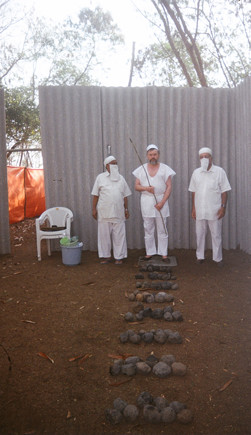
Ervad Khushroo Madon (right) is said to have left Sanjan a day prior to the alleged assault on Mikhail Chistyakov (center)
"The robbed materials… were then used by you (the trustees), in sworn statements, in the originating summons No. 1909 of 2009 (the priests ban case) along with other purloined material, making an attempt to pass them off as original evidence collected by you. The said WS (written statement) was filed between February 22 and 28, 2010 during the week following the attacks, assault and battery and dacoity.”
Malcolm alleged Mehta has misled the court, "and you have concurred as co-defendants in the said WS, that Ervad Khushroo Madon, who according to you was supposed to be teaching the Russian Herbad Mikhail Chistyakov on that day, ‘ran away’ on seeing the large mob attacking them on February 19, 2010. The true facts are that there was no one at the said College on that day save the petitioners and two or three of the staff. Ervad Madon was in Bangalore from the previous day.”
He claimed a "photocopy of his airline tickets attached,” would substantiate his allegation and that the trustees had committed "perjury under oath in a court of law.”
◆ ◆ ◆
From the archive