
Comment
Friends, philosophers and guides
Whenever the Bombay Parsi Punchayet has been faced with religious issues, it has sought the advice and guidance of our high priests
In court proceedings this February/March in the matter of two priests of the community who were prohibited by the Bombay Parsi Punchayet (BPP) from praying at Doongerwadi, the role of the high priests in community affairs came up for consideration. Iqbal Chagla, a redoubtable lawyer of the Bombay High Court argued the matter representing two respected and highly placed members of the community who took up cudgels on behalf of the priests. During the course of his arguments, Chagla submitted that all priests are of the same status, and there is nothing like high priests and low priests in the Parsi community.
I have known Chagla for long. He is married to a Parsi and has a vast circle of friends in the community. Quite a few of his relatives and associates are also Parsis. He certainly could not have meant to hurt the feelings of the community or downplay the role of the high priests. A counsel merely acts on instructions received and has to put his best foot forward to buttress the case of his client.
Even during my experience as a trustee of the BPP extending over a period of 20 years, several instances come to mind which throw illuminating light on the issue involved. I can verily say that in almost all matters where there was a need for the BPP to consider a religious issue, we always relied upon the advice and guidance of some or all the high priests, whose number we can count on our fingertips. Even in the above case, the BPP contended that it had taken this step after consulting the high priests.
The most glaring example that comes to mind is that of a great stalwart of the community and my good friend, the late Neville Wadia, who was born a Christian (his father having converted to Christianity before his birth) and became a Zoroastrian towards the fag end of his life. A large majority of the community welcomed him with open arms as one of their own, and not as "return of the prodigal.” Throughout his life Wadia really loved to be a Zoroastrian. Even when he was professing Christianity, he took great interest in community matters, particularly in relation to the properties and valuable assets that his forefathers had bequeathed for its benefit. In his case, many opinions were given by our respected Dasturs (Dr) Hormuzdyar K. Mirza, Kaikobad Phirozji Dastur, Meherji Kaikobad Meherjirana, Sardar Hormuzdiar Noshirwan Dastur, (Dr) Firoze Kotwal, (Dr) Kaikhusroo M. JamaspAsa and Noshirwan M. Dastur, on the issue of his initiation into the Zoroastrian faith. All were not of the same view, although the majority was in favor, as an exceptional case. The matter was also discussed at a BPP meeting and the trustees approved the proposal by a majority decision with only one dissenter.
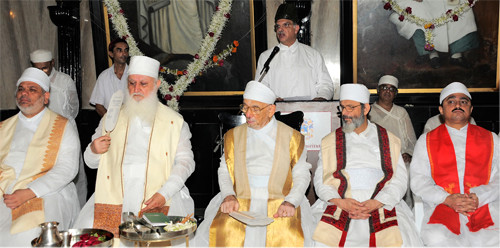
(From left): Dasturs Khurshed Dastoor, (Dr) Firoze Kotwal, the late Meherji Meherjirana, (Dr) Peshotan Mirza and Cyrus Dastur Photo: Aspi H. Patel
Incidentally, many in the community may not know that there was a problem as to how Wadia could be admitted into the Zoroastrian faith at such an advanced age. Could it be through a navjote ceremony or through some other ritual? Strictly speaking, a Parsi born of Zoroastrian parents is formally initiated into the Zoroastrian faith by performing of the navjote ceremony, which is limited to children up to the maximum age of 15. What could be the way out in the case of Wadia? The high priests considered the matter fully and a majority of them advised that he should first undergo certain ceremonies, including having a "nahn” or "ablution bath” preceding the navjote ceremony. Wadia would thereupon be free to enter agiaries and atash behrams. It was also opined that on his demise he could be taken to Doongerwadi like any other Zoroastrian. Wadia sincerely opted for the same, as indeed he believed that it is not only a part of our religion, but it is the natural way of disposal of the dead.
Soon thereafter came the case of his son, Nusli. Though removed from the community by reason of a religious factor due to an exigency of birth, he was also, and still is, attached to it in body, mind and spirit to the same extent as many upper class Parsis are. That he was born a Parsi, there is no doubt. That he sincerely wanted to be a Zoroastrian, there was also no doubt. I recall a talk with him at a function at Cusrow Baug when he mentioned that if the BPP trustees would be agreeable to his entering the Zoroastrian faith, he would readily do so. We had welcomed his father with open arms only a few years ago, and here was his son who wanted to follow in his footsteps. His ancestors also, to use the words of Mahatma Gandhi, belonged to "the splendid Zoroastrian faith.” Having known Nusli from close quarters when I was chairman of the BPP, as he was a member of one of the important committees thereof, his mannerisms, talk, thoughts, actions, truly reflected the typical Parsi Zoroastrian character. Many non-Parsis in the country, including well-known industrialists and politicians address him as "bawa.”
In due course Nusli forwarded to me a letter addressed to the trustees intimating about his navjote on October 8, 1995 and the blessings he had received from the three high priests, Mirza, JamaspAsa and Kotwal.
Nusli’s case was discussed at length at the BPP trustees’ meeting. A large majority were of the view that a stand had already been taken in the case of his father, and accordingly they saw no reason to disagree with the opinion of a large majority of the high priests. Whilst so deciding we also took note of the fact that our Rivayats do refer to cases in ancient Iran about Zorostrains who had gone out of the fold and came back after a gap of a few generations, provided they went through the required formalities. This was one of my last major assignments before I retired as chairman of the BPP in 1994.
Another case where the high priests played a prominent role is that of the late Roxan Shah, a Parsi married to a non-Parsi and whose relatives desired that her body be consigned to the Towers of Silence. The high priests were not in favor of Shah being consigned to the Towers of Silence. Two of them, Mirza and JamaspAsa, wrote to clarify that the matter was closely connected with our community not only as Zoroastrians, but also as citizens of India. They observed that their opinion was based only on religious practices, traditions and customs without taking into consideration "the Constitution of India and the laws of the land.” They also pointed out "that some counsel argue that under the Constitution of India, a citizen including a Parsi Zoroastrian has every right to practice his religion, tradition and custom as he decides.”
Another case that came up for consideration before the trustees was in respect of Joseph Peterson, whose navjote was performed in USA, and his admission into the Zoroastrian faith. For the enlightenment of the trustees of various agiaries and atash behrams, as also regarding visits to Doongerwadi during the funerary ceremonies, the BPP trustees on their own resolved that notwithstanding the navjote Peterson would not be entitled to the benefits of the trusts in India as a Parsi Zoroastrian, as per the decided case law on the subject in light of the relevant provisions of the relevant trust deeds.
While this article was being finalized on a weekend, news was published in Jam-e-Jamshed that the two high priests of Udvada, Dasturs Khurshed Dastoor and (Dr) Peshotan Mirza, had alerted the BPP about the initiation of a non-Parsi into the Zoroastrian priesthood. They said that this is against our religion because a priest can only be ordained from a priestly family, as mobedi is hereditary. Without going into the merits of the matter, this is also to confirm that the high priests do continue to play a prominent role in the affairs of the community on religious issues.
Then came the news that the Bombay High Court had dismissed the originating summons in the matter of Ervads Framroze Mirza and Khushroo Madon who had been banned by the BPP from reciting prayers at the Doongerwadi and the two agiaries under its control. The court has upheld the BPP’s right to ban the said two priests. It is sincerely hoped that in view of a very large section of the community, including in particular all the high priests who are in favor of this order, this matter will be given a decent burial and not pursued further.
Though we belong to an educated community, the opinions of the high priests cannot be ignored. The high priests remind the community of what it at times forgets. They do not supply the defects of human intelligence, but fortify the feebleness, if any, of the BPP’s resolutions. They are men of God who have always walked amongst the members of the community and made their religious learning felt in heart and in soul. They come to our aid with the zeal of friends, philosophers and guides. They never roar when they have nothing to say. Let us bow before the high priests with gratitude and grace, for guiding the community.
Former chairman of the Bombay Parsi Punchayet and a senior partner of Mulla and Mulla and Cragie, Blunt and Caroe, Eruch B. Desai is a director of around 15 companies and trustee of the General Electoral Trust formed by the House of Birlas and some other trusts. He has also made representations before the authorities for amendments to the Indian Companies Act and the Monopolies and Restrictive Trade Practices Act. He mainly attends to corporate matters including mergers and acquisitions.
◆ ◆ ◆
From the archive