
Books
Stretching the boundaries
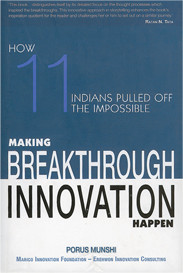
Making Breakthrough Innovation Happen: How 11 Indians Pulled Off the Impossible by Porus Munshi. Published in 2009 by HarperCollins Publishers, A-53, Sector 57, NOIDA, Uttar Pradesh 201301. Pp: xviii + 236. Price: Rs 295.
It is a daunting task to review a book like Porus Munshi’s Making Breakthrough Innovation Happen: How 11 Indians Pulled Off the Impossible. What can one possibly say about a work which has won a series of accolades from eminent stalwarts in the field of industry and politics! Whether it is Ratan Tata, Dr A. P. J. Abdul Kalam, Montek Singh Ahluwalia or N. R. Narayana Murthy — just to name a few — each has expressed nothing but admiration for this work.
What haunted Munshi and is the raison d’être for this book’s inspirational work is the simple question: "What does it take to make orbit shifting innovations happen?” To arrive at a suitable answer, he met over 180 people in different organizations across 40 industries and sectors — not merely corporate, but social and public as well. What has plagued him is not to determine the practices and the methods which led to the innovations but the thought processes, not the "external manifestations” but "the internal mindsets and beliefs that drive orbit shifting innovations.”

Porus Munshi: laudable work
Munshi found the embryo of such innovation in the identification of an impossible challenge which faced the individual and which appealed to the heart rather than the head. It most often took the shape of a task which everyone considered impossible and could only be made achievable by stretching the boundaries of reality. The origin, he strongly advocates, is not in the "idea” but the "challenge.” He cites the example of Arla Foods which was to be the first to put milk and milk products into space. In the case of Dainik Bhaskar, the newspaper group, the challenge was to be the leader from the very first day in every city they decided to launch their newspaper thereby destroying the myth that no local language newspaper could cut across different states the way English newspapers have. They succeeded in increasing the circulation "by a factor of ten” in a span of 10 years. The fact that there are more than 24 million blind people in the world and almost one-third of them do not need to be blind, was the challenge which made Dr Govindappa Venkataswamy create the Aravind Eye Hospital.
Once the challenge crystallizes the ideas come into play to formulate different strategies to attain the goal. Munshi delineates the laborious process Dainik Bhaskar followed in Jaipur to achieve the goal they set for themselves. Massive and extensive surveys were involved in every phase of the creation for the new venture. As a result, readers even agreed to pay for an advance subscription for a period of six months. After examining the needs of the people of Chandigarh, they decided to launch a newspaper which had articles in Hindi and in English and once again met with stupendous success. The leaders of Dainik Bhaskar did not believe in clichés like "don’t rock the boat” or "be practical.” Their success lay in willing to "max it” and even die in the attempt to recreate themselves.
Similarly, to address the problem of blindness where only a simple surgical intervention could remedy the situation and the realization that there are not sufficient doctors to perform the surgeries, resulted in Aravind Eye Hospital’s creation of an "assembly line technique of surgery.” This not only increased the productivity by 10 but also resulted in reducing the costs of the operation by a significant extent. Munshi tells us that 30 percent of the patients pay a fraction of what they would normally have done and the remaining 70 percent are treated free. And yet the Hospital where 2.4 million outpatients are examined and almost three lakh cataract surgeries are performed annually manages an operating profit of 35 percent.
According to Munshi, the sure route to failure is the principle of searching for precedents, indulging in negative attitudes that the task is insurmountable and refusing to deviate from routine and the age-old trodden path. He discusses the cases of CavinKare, ITC-IBD and Bosch India, all success stories which resulted in thinking out of the box. G. K. Ranganathan of CavinKare with a capital of just Rs 15,000 took on a multinational like Hindustan Lever in a David and Goliath like battle and managed to make his product Chik the largest selling shampoo in Tamil Nadu. The International Business Division of ITC grew from Rs 300 crores in 1999 to Rs 3,000 crores in 2008 to become the most sought after trading partner in rural India. Bosch India took up the challenge of controlling emissions from diesel engines by creating a strategy to make alterations to the high pressure pump instead of the expensive modifications to the engine.
Mere challenges and innovations cannot lead to success; you need to infect the team with an immensely high level of passion and enthusiasm if orbit shifting innovations are to succeed. Munshi cites the contribution of the late Dr Homi Bhabha who propelled India into the nuclear age. Fired by the challenge to set up a nuclear research institute, he managed to convey this vision and dream, and fashion it into a reality by infecting the imagination of several people — the Tatas, the British, who were in power at that time, Jawaharlal Nehru, and even wealthy and benevolent Parsis who gladly donated land for his venture.
In Trichy, J. K. Tripathy managed to transform the city in a mere span of two years by reducing the crime rate by almost 40 percent to make it a haven of communal peace. The only way this was possible was to make "all the stakeholders — community, police, politicians, bureaucrats and NGOs — work together in considerable harmony.” By "inspiring people,” giving them complete responsibility for the task, and by demolishing all the skeletons of past practice and belief, Chola Vehicle Finance grew its asset base from Rs 140 crores in 1998 to Rs 800 crores in 2002 which now amounts to Rs 4,000 crores. It was only through self belief and an immense level of commitment and team work that Titan managed to make a watch which was extremely slim as well as water resistant at the same time, a feat which even the Swiss thought was impossible.
Munshi feels that all this is a waste if one does not constantly keep in mind the problem of entropy and decline and have systems of constant vigilance in place to keep this at bay. Varaprasad Reddy of Shantha Biotech managed to reduce the price of the course of the Hepatitis B vaccine from Rs 2,250 to Rs 150. Munshi describes his efforts at manufacturing and selling the product in the face of overwhelming odds yet remaining committed to his position and refusing to dilute his stand. Within two years municipal commissioner S. R. Rao transformed Surat from one of the filthiest cities in India to the second cleanest city by persistent and constant effort and vigil. Munshi charts the progress of Su-Kam which, with an initial capital of Rs 10,000, today has 50 percent of the market share and a turnover of Rs 6,000 crores.
Munshi often shares the personal details of the individuals facing the challenge and this adds another dimension to the book and makes it even more fascinating reading. The most outstanding of these personal tales is that of Venkataswamy of Aravind Eye Hospital and his remarkable grit in refashioning his own life when he suffered from severe rheumatoid arthritis at the beginning of his career. He realised he would not be able to cope with the heavy work involved for gynecological operations and went back to medical school and studied ophthalmology.
The only drawback to the book are the shaded paragraphs and the boxed observations which Munshi feels obliged to introduce to accommodate his comments on the narrative and tell the reader how to interpret the events he is describing. He seems to overstate his position and drive home the point a bit too forcefully. This, I feel, is unnecessary and causes a distraction and an interruption in the narratives which are instructive and pleasurable to read. Munshi’s style is clear and cogent and his ability to describe the process of these innovations is fascinating. This educative experience shall enthrall not only the persons in power and authority but also the lay reader. Firdaus Gandavia
◆ ◆ ◆
From the archive