
Books
A life transformed
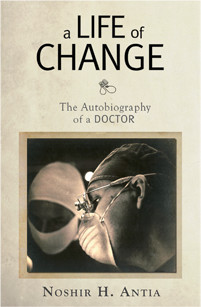
a Life of Change: The Autobiography of a doctor by Dr Noshir H. Antia. Published in 2009 by Penguin Books India Private Limited, 11 Community Centre, Panchsheel Park, New Delhi 110017. Pp: xvi+189. Price: Rs 299.
"At least one side of my family had its head and heart in the right place,” notes the opening sentence of the book. It sets the tone for the ensuing pages where we learn to admire the medical messiah who respected health and honesty to medicine and materialism. Under the benign influence of his maternal grandfather Rustomji Hormasji Madon he learnt to honor those who used their hands with their head and heart. Not surprisingly, the same hands of Dr Noshir Antia, shown extended in a greeting with the Shahbano of Iran had unflinchingly examined lepers as found in the juxtaposition of two photographs in the book, one below the other.
Blessed with an enquiring mind and dogged determination to improve the health scenario in India, Antia’s unflagging zeal contributed to his making marked progress in plastic surgery, treatment of leprosy and burns, and promoting rural health care initiatives. "Antia’s autobiography tells in a delightful style, laced with humor, the story of an extraordinary individual who distinguished himself in many fields and adorned whatever he touched,” notes the foreword to the book by national research professor, M. S. Valiathan.
Considering that Antia’s first choice of a career was forest service, like his maternal grandfather Rustomji Madon and uncle Framroz, until deterred by them, and he later enlisted for the air force until his paternal uncle Col Piloos Antia intervened, as Antia declared, "Medicine was obviously fated to be my profession.”
Preferring to improvise and find ingenious solutions, he remarked, "It is a pity that we have lost our ability to solve our own problems and always look to the West for solutions that may be inappropriate for us.” In the course of his overseas training he was much influenced by Sir Harold Gillies, "a surgical genius and very unorthodox as a person.” He had further imbibed from Gillies that it is nature that heals wounds and the surgeon’s job is to help, and not hinder nature.
In the spartan conditions that prevailed in post-war England he had learnt that there was a lot that could be achieved under trying circumstances. But convinced that India was more ‘need based’ as a society and so presented an opportunity to do good work in less than ideal conditions he returned to his homeland. "I had always intended to come back to India, to be with my parents, and to use the experience I had gained in the UK for the benefit of our people,” he declared.
After a nine-year stint in the UK when Antia returned to India he joined the Jehangir Nursing Home in Poona, established by Dr E. H. Coyaji whom he respected for although Coyaji was "only a medical graduate… he was extremely well read and had a strong desire to help the poor and needy.”
It was in Poona that Antia felt the need to work for leprosy patients, "not out of charity for the afflicted poor but out of an intense desire to explore a major field that was, until then, uncharted in medicine using my experience in reconstructive surgery.” He conducted surgery at the lepers home at Kondhwa with the barest minimum aid. Fear of leprosy among his colleagues meant that he did not have a trained surgical or nursing assistant or an anesthetist and it was the patients who were required to help out. "The absence of electricity and running water did not pose any insuperable problem to an over-enthusiastic surgeon keen to transform the appearance of his patient.” A glass enclosed room served as an operating theater, a folding wooden table as an operating table which once collapsed during surgery, necessitating the rest of the operation be performed on the floor!
Though he would have preferred to see the leprosy patients accepted by their families, he realized that many of them chose to stay back at the hospital rather than face the outside world. They would be given a paltry sum of six rupees a month as pocket money. When the patients contributed these six rupees to present Antia a silver platter before he left for Bombay to start the Plastic Surgery Department at the J. J. Hospital, he acknowledged this gift as one "I value more than any monetary gain or awards.” Among the honors he had been conferred were the Padma Shri and the G. D. Birla International Award for Humanism.
When he began admitting leprosy patients to his Tata Department of Plastic Surgery, surprisingly objection came in from the dermatologist in charge of the Leprosy Department at the Hospital. So great was the phobia that in the outpatients’ Dermatology Department a wall had been erected to segregate leprosy patients from others. "I just broke down the wall and again no one protested at what was, admittedly, blatant interference in another’s department… These experiences proved that if you take the bull by the horns and vigorously push an idea which you firmly believe in, after careful thought and some pilot experimentation, there is cooperation and even appreciation, no matter how unconventional the idea.” Refusing to give preferential treatment to anyone, be he a minister’s child, he declared, "Pressure tactics have never cut any ice with me!”
Bold and non-conventional, Antia could appreciate a footwear being hurled at him by one of his leprosy patients. But not so his students and physiotherapists who were aghast at the patient’s temerity. Antia congratulated the offender because he perceived it to reflect rehabilitation, giving the patient the self-confidence to speak up.
Always one to oppose deceit and corruption he referred to the glycerol tragedy in the mid 1980s when 12 patients died at the J. J. Hospital after being wrongly administered glycerol in place of glycerine. Instead of admitting its error, the hospital administration chose to keep it under wraps "a grossly unethical thing to do” which led to Antia writing to the national Press. This resulted in the famous Lentin Commission being appointed under Justice Bakhtawar Lentin whose report "was a salutary lesson to the medical profession on the perils of suppressing its misdeeds.”
Antia did not shy away from his own errors either. After persuading the Sir Dorabji Tata Trust to fund the air conditioning of the entire ward, a rare luxury in those days, when he discovered that the air conditioning resulted in extensive cross-infection of patients by the re-circulated air, hindering a patient’s recovery, he got the air conditioning unit dismantled. Although initially annoyed, the donors later appreciated his reasons. The book also referred to the animal house established to test the viability and drug sensitivity of the leprosy germ. As noted Antia, "On hindsight I believe that torturing animals for the welfare of humans is hardly justifiable. Science is insensitive to the harm it does to animals for selfish motives, and is also doing something similar to the human species with the undertaking of several unethical clinical trials in our part of the world.”
Throughout his career he found that he worked much better with people who were not already highly qualified: "I can train fresh, willing and open minds more effectively, for they are receptive to new ideas and not confused by a mechanical education…” he reflected. On one occasion he had selected a 16-year-old girl, Kitty Merchant, as his theater nursing assistant and even succeeded in teaching her how to undertake simple skin grafts and suture minor wounds regardless of the doctors who considered it unethical to allow unqualified persons to undertake such work.
Always willing to risk and dare, he acknowledged, "I was deeply attached to my work — the more difficult it was, the more interesting I found it. I had this rather selfish gambler’s streak that pushed me to take career risks regardless of the consequences to myself or my family… I now realize the sacrifices she (wife Arnie) made in order to fulfil my desire of building a new and problematic career in plastic surgery in Bombay…
"My outrageous demands were generally tolerated (though not always acted upon).” He was keen that both their children, Rustom and Avan be sent to a neighborhood municipal school in Bombay for being educated in a government school himself he felt that elite schools alienate pupils by inculcating values that are at odds with the socioeconomic conditions of the vast majority in the country. But this suggestion was anathema to everyone else in the family.
While his early exploration and surgical sojourn cover the first 77 pages of the book, more than 100 pages are devoted to his research efforts and initiatives that preoccupied him in later years. As he conveyed, "Not many people understood my urge to do research which was a far cry from surgery. Many doubted the sanity of such a radical decision. Also, I felt that it would help me get away from the routine of managing an already well established department and it would help my colleagues to grow and take greater responsibility. It would demonstrate that the plastic surgery department that I had nurtured for over a decade could stand on its own feet.” Justifying his decision to take a break from surgery he subsequently added, "I was right in going because it enabled me to develop research at the J. J. Hospital on my return and, more importantly, led to me to establish The Foundation for Medical Research (FMR) which is now an internationally acclaimed institution.” Believing in "the enormous potential of almost all human beings who can bloom if they are encouraged and not suppressed in a hierarchical system of education and work” he refused to adopt didactic teaching methods saying, "Apprenticeship rather than formal education enabled my students to develop their talents as in our guru-shishya (teacher-student) tradition.”
Focusing on problems like leprosy, multi-drug resistant tuberculosis and waterborne diseases, as also testing of medicinal plants, the FMR has demonstrated that "excellence in research is possible without spending vulgar sums of money. It shows that people who have confidence, motivation and purpose work better than those with extravagant degrees,” he justified his efforts.
For the stability and continuity of FMR he gave credit to "the three women who have been working here since its inception — Nerges Mistry, Tannaz Birdi and Vanaja Shetty.” Genuinely happy to see his researchers progress he commented, "Many among our staff have worked under my guidance and then have gone on to do better than I have. This is as it should be for they stand on my shoulders and not sit on my head!” He was only concerned that the many scientists trained at the FMR "undertake their work with integrity and vision and not be pressurized by commercial or unethical considerations that are rampant today.”
Convinced that "women are more sincere,” he opted to train women for the medical care programs in different villages like Parinche. Subsequently he wrote, "Our women health workers were not very educated but were very intelligent. It also proved that achieving good health is more a social than a medical, techno-managerial function.”
When the President of India Pratibha Patil, who was earlier the governor of Rajasthan, presided over a meeting of the Association of Plastic Surgeons of India in Jaipur in 2004 she was surprised when in the course of his keynote address, instead of extolling on plastic surgery he focused on decentralization and the catalytic role of women health workers in transforming the dismal health scenario. Initially thinking he was senile, after visiting Parinche the following year she was convinced that the model was practical!
Whilst the village leaders and power brokers initially welcomed his health services, hoping to get mileage from his programs, once the trained and better informed women started demanding their rights, the leaders became hostile, forcing Antia’s team to withdraw from the Mandwa area. Although some perceived the closure of the Mandwa project as a failure, for the pragmatic Antia it meant inspiration to study the social and economic factors involved in rural health care that led to the starting of the Foundation for Research into Community Health (FRCH).
Whilst involved with the FRCH and the FMR until he died at the age of 85, in earlier days he was involved in founding professional associations and societies like the 3R Society (for Reconstructive Surgery, Rehabilitation and Research), the National Association of Equal Opportunities for the Handicapped, the Burns Association of India, the Association of Plastic Surgeons of India, the Indian Society for Surgery of the Hand, and the Association of Rural Surgeons of India. Disillusioned with the functioning of some of these institutions he chose to dissociate himself from some of them later.
Always preferring to refer to his country as Bharat rather than India, Antia believed the future of his nation lay in releasing "the minds of our people from the mental and material shackles that still remain the legacy of the Raj.” A great proponent of Panchayati Raj for it checks the misuse of power, he stressed, "Neither democracy nor dictatorship can give us a just government.”
The autobiography, unfortunately, does not share the doctor’s views on his religion or his community. But his stance on world politics, economics and scientific temper have been conveyed in the chapter "Home and Abroad.” Irked by his US friends’ unquestioning acceptance of science and technology as their gods, Antia reiterated his belief "they make useful slaves if used with wisdom.” P. M. G.
◆ ◆ ◆
From the archive