
Books
Tale of transformation
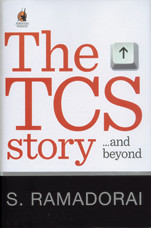
The TCS story… and Beyond by S. Ramadorai. Published in 2011 by Penguin Books India Private Limited, 11, Community Centre, Panchsheel Park, New Delhi 110017. Pp: 304. Price: Rs 699.
Rarely has this reviewer come across a book in which the Prologue is as significant as the contents themselves. The TCS Story… and Beyond by Subramaniam Ramadorai is one such book. Ramadorai, a quaint figure gifted with a brilliant mind and an inborn capacity for hard work, was ambitious to make a mark in life and a name for himself, yet was incredibly shy, always wanting to be part of a crowd.
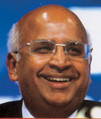
It was during the family’s regular visits to their native village Sangalipuram, that Ramadorai learnt to appreciate "nature, hard labor… doing things yourself and seeing the results.” He also got the opportunity to listen to religious discourses which gave him insights into the rich heritage of his country. Graduating from Delhi University with a BSc degree in physics and mathematics in 1968, Ramadorai worked at the Physical Research Laboratories founded by Vikram Sarabhai where he was able "to develop a scientific temperament and curiosity and understand the importance of good work ethics.” He won a scholarship to study at the University of California at Los Angeles (UCLA), from where he completed his master’s degree in Computer Science. He started working for National Cash Register Corporation in Hawthorne, a suburb of Los Angeles, earning $ 12,000 a year — very good money for a young computer science graduate.
Just then his parents discovered a pretty bride for him, Mahalaxmi (Mala for short), born and brought up in South India. Before they got married Ramadorai had to agree to two conditions she laid down: he should leave the US and take a job in India; and when their first baby was born he should take leave for a month to be with her and help look after the little one. "That was the only time,” Ramadorai grumbled, "I took a month-long holiday in my life.”
Ramadorai joined Tata Consultancy Services (TCS) in 1970 happy to associate himself with the Tata Group "where being ahead of the curve, investing in the future and building excellence around people have always been central themes.” That J. R. D. Tata, known for his audacious vision, had taken a keen interest in the founding of this institution was another factor that drew Ramadorai to TCS. His mentor, F. C. Kohli, taught the new recruit the importance of under-promising and over-delivering to clients. There were days when the youngster worked from 4.30 a.m. to 11.30 p.m. to meet a customer deadline.
His career presented him with new opportunities like going to the Massachusetts Institute of Technology (MIT), Sloan School of Management to do a senior management course that changed his perspective radically. He became convinced that "in order to succeed TCS needed to expand and become a truly global company that embraced a multi-disciplinary approach towards problem-solving and was willing to take risks in order to reap bigger rewards. The visit to MIT reinforced my belief that information technology was going to have a huge impact on almost all aspects of our lives and that innovation was a key driver of change.”
A passionate believer in team work and developing leadership qualities in every member of the team, he initiated the practice of inviting his team to his residence on Sundays. They met in a friendly, convivial atmosphere to discuss certain issues raised the week before, with Mala serving them South Indian coffee and sweets. This initiative was continued by the team with each member inviting others to their residence on Sundays. The member who happened to be host had naturally to become leader for the day. Of course, some objections were raised about working on Sundays, but Ramadorai had learned "never to be afraid of opposition, by keeping in mind that a kite rises against and not with the wind.” His team’s achievements spoke for themselves and Ramadorai rocketed himself to become TCS’s CEO (chief executive officer) in 1996.
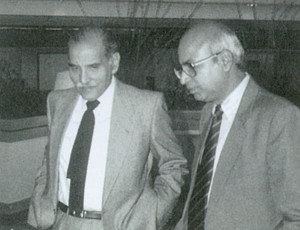
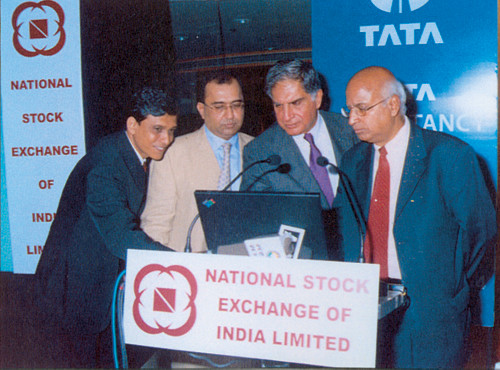
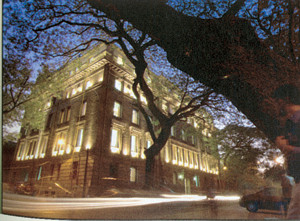
Subramaniam Ramadorai (top) with his mentor F. C. Kohli; (below left) at the launch of the TCS IPO at the National Stock Exchange with Ratan Tata and others; TCS House
Leveraging the extended network of the Tatas, and Tata Electric in particular, one of their first external contracts was from a power company in Iran. The Shah of Iran was in power and India was a friendly partner. Much more important was a distribution agreement with the famed Burroughs Corporation under which TCS sold Burroughs’ systems in India and provided maintenance and support. This helped TCS in terms of fundamental concepts in micro-programming and software architecture, as well as the software operating systems. "As a field manager I had to work with my hands using screwdrivers, pliers, and, yes, sometimes sticky tape to fix the equipment and keep it running. We could have bought new machines instead, but the ‘do it yourself’ approach saved precious foreign exchange and forced us to learn about system software and the support of hardware.”
In short, TCS played a pioneering role in establishing offshore developmental centers in India to provide high-end solutions to global corporations. Further, it spearheaded Indian industry through the IT (information technology) boom, using the Y2K (Year 2000) challenge to its advantage. It successfully expanded and sealed its operations world-wide, while simultaneously going public with India’s biggest ever IPO (initial public offering) in 2004.
The final words are Ratan Tata’s: "Ram is a key member of the close-knit team which has made TCS into an end-to-end global IT (information technology) services company; this is a narration of the country’s transformational journey which deserves to be widely read.”
The book’s title is The TCS Story… and Beyond. The "Beyond” was sealed when, on retiring as CEO and MD (managing director) of TCS in October 2009, after almost 40 years of dedicated service, Ramodarai was invited by the Prime Minister of India to be his advisor on skill development with Cabinet rank status. This will fulfil his ambition to contribute to "the creation of a demographic dividend by skilling millions of Indian youth.”
BURJOR K. KARANJIA
◆ ◆ ◆
From the archive