
Books
Engineering solutions
An Engineer’s Guide to Invention and Innovation by Cawas Phiroze Nazir. Published in 2013 by Unicorn Books, F-2/16 Ansari Road, Daryaganj, New Delhi-110002. Pp: 152. Price: Rs 275.
"Analysis and creativity are brought together in this book by Cawas Nazir, an illustrious alumnus of the University of Sheffield,” writes Harm Askes, head of department of Civil and Structural Engineering, University of Sheffield, UK on the cover of Nazir’s book An Engineer’s Guide to Invention and Innovation.
It is a highly practical book that draws upon Nazir’s years of experience as a former director of M/s Dastur and Company, Calcutta, one of the country’s renowned consulting firms. It is a compilation of his visionary thinking in the fields of civil, mechanical, structural, renewable energy and aerospace technologies. His research is based on his experience and interaction of over three decades with multidisciplinary teams of design engineers.
"Analysis and creativity are brought together in this book by Cawas Nazir, an illustrious alumnus of the University of Sheffield,” writes Harm Askes, head of department of Civil and Structural Engineering, University of Sheffield, UK on the cover of Nazir’s book An Engineer’s Guide to Invention and Innovation.
It is a highly practical book that draws upon Nazir’s years of experience as a former director of M/s Dastur and Company, Calcutta, one of the country’s renowned consulting firms. It is a compilation of his visionary thinking in the fields of civil, mechanical, structural, renewable energy and aerospace technologies. His research is based on his experience and interaction of over three decades with multidisciplinary teams of design engineers.
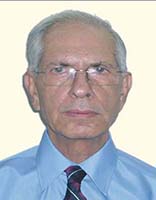
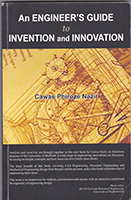
Cawas Nazir: "Nothing is impossible"
In the preface, the author says the book has been specially written for the use of students, practicing engineers and designers to show how they could develop their creative skills to produce inventive solutions.
This well organized book has been divided into four parts, with the first one covering the qualities needed to produce useful inventions and providing an overview of various techniques used in creative problem solving. "To begin with,” Nazir advises, "do not concern yourself with questions of economics and cost but ask yourself ‘Can it work? Can it give a better solution to an existing problem?’”
Being able to handle a negative response is a big part of a successful inventor’s psyche. As Mark Twain said, "The man with an original idea is a crank until the idea succeeds.” Criticism and scorn are heaped aplenty on people who think out of the box. But if they are strong in their belief, persons with grit and determination can pursue their dreams.
The book reveals that builders of railways in the early 19th century were warned that speeds of 50 m.p.h. would cause nose bleeds. Today, the Meglevs (trains running on magnetic levitation) travel at a speed of 501 km per hour.
In 1962 the Noble Prize winning scientist Denis Gabor failed to anticipate the success of email and the modem. He said, "Transmission of documents via telephone wires is possible in principle but the apparatus required is so expensive that it will never become a practical solution.”
All these examples show that nothing is impossible. If one can dream it, one can do it. Would-be inventors must be strong in self-belief and not deterred by criticism.
Leonardo da Vinci (1452-1519), the celebrated Italian painter, sculptor, inventor and engineer left behind sketches and notes on inventions like a spring driven vehicle, armored car, helicopter and other flying machines, to name but a few, long before their time.
The second part of the book discusses innovative ideas and new concepts. The examples given cover a spectrum of engineering fields including civil, structural, architectural, mechanical, renewable energy and aerospace technology. From multi-span suspension and cantilever bridges, novel low-cost housing, to a reusable satellite launch system, concepts are explained with scientific reasoning and simple diagrams.
Products and technologies are dealt with in the third part, along with innovative solutions for which complete specifications have been filed by Nazir to obtain patents. Of nine patents that Nazir applied for between 1979 to 2009, five have been granted and four are still under process. The patents granted include: Improved process for construction of a tunnel in soft ground, patent no. 150023, 1979; Rolling mill with stand, patent no. 154580, 1982; Bi powered bicycle, patent no. 178767, 1993; Birobic bike, patent no. 183649, 1995 and Concrete auger pile, patent no. 171152, 1999.
The last and perhaps the most important part of the book informs inventors of the various steps in obtaining a patent. It explains to the lay person varieties of patents, what may be patented, what is not patentable, documentation for filing an application and other minute details not commonly known.
Nagpur born Nazir did his schooling and BE in civil engineering from that city before going to Sheffield for the Masters degree. On his return from the UK he joined M. N. Dastur and Company and remained with them till he retired in 1999. During his working years he was deputed to consulting engineering firms in Germany and the Union of Soviet Socialist Republics.
The author, who has contributed articles to national and international scientific journals, is a recipient of three gold medals and numerous best paper awards. His book has evoked much interest in technical institutes all over the country.
◆ ◆ ◆
From the archive