
Trusts
“A new charter for social investments”
Delivering the 43rd A. D. Shroff Memorial Lecture Nandan Nilekani depicts how technology can be leveraged to provide identity and social welfare to India’s poor
"The third leg of the tripod” for the inclusion of the common man in India’s economic prosperity is how Nandan Nilekani described the unique identification (UID) number that every Indian citizen will eventually acquire. The other two legs are mobile telephony and on-line banking, the chairman of the Unique Identification Authority of India told the audience cramming Bombay’s Y. B. Chavan Centre on October 27, 2009. Former chairman and managing director of Infosys Limited and an icon of India’s super power in the field of computer technology, Nilekani was delivering the 43rd A. D. Shroff Memorial Lecture titled "Identity, Markets and Social Welfare,” sponsored by Shrenuj and Company Limited.
"As India surges ahead, we are recognizing that the reality of its impressive expansion cannot mask the landscape of its poverty — its slums, its faltering agriculture sector, and its low achievements in literacy, education and health access…The challenge here is that poverty is never just about shortages in food, clothing or the lack of a house. Rather for the poor, poverty is a condition of their lives, caused by a lack of access to the various resources and economic systems that are available to the rest of the country. The poor lack access to skills that would earn them a higher wage, to markets that would bring them better prices for their goods, to good schools and health care that would give their children a chance for a better life. And they are often surrounded by the social norms of caste and class within their community that further limit their opportunities,” Nilekani painted in the anomalies in the socioeconomic scene.
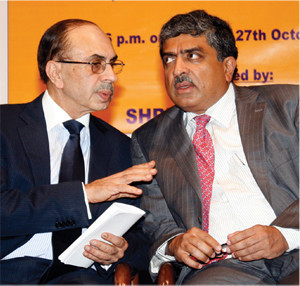
Adi Godrej (left) and Nandan Nilekani: concern for inclusive growth
According to Nilekani, government support price in wheat and rice together with a lack of access to markets created a mindset among farmers that feared to try other, more profitable crops. The provision of free electricity or tariffs that covered but a tenth of the cost of production has resulted in mounting losses to state electricity boards and ruled out the possibility of large scale investment and expansion. In the Punjab, free electricity plus the provision of subsidies for water intensive crops has depleted the ground water levels by 60 percent which Nilekani cited as an example of the quixotic outcome of India’s indirect subsidies. If one of the most fertile areas in the country ends up becoming drought-prone, it will result in the people becoming poorer.
Another aspect of indirect subsidies is the endless need for monitoring. When subsidies and funds are delivered through local public agencies "it puts disproportionate power in the hands of local officials, who get to decide who gets the benefit, and who does not. Such decisions at the local level often fall victim to caste and group politics,” said Nilekani, giving the example of a minister who found a village divided into dalit and non-dalit halves, with the dalits having no source of water. The minister instructed the local authority to install a pump to rectify the situation but when he visited the village again a month later he found that the second pump had also been installed next to the original one in the non-dalit sector of the village!
Social welfare as structured today has become a hindrance for economic growth, noted Nilekani: "The cost of wasted subsidies is in reality much more destructive than we perceive. Government expenditure needs to stimulate growth in order to generate tax revenues that fund future government expenditure. Fuel and food siphoned from the PDS (public distribution system) are resources diverted away from human capital investment, and future wealth. Money spent on unproductive schools means millions more of uneducated, illiterate children, and lost demographic opportunity. Subsidy losses thus form a vicious cycle — this is money spent without generating productivity, jobs, better human capital, and more resources. This, in turn, fuels inflation, and is a long-term hit to the country’s finances.”
Nilekani contrasts the Indian scenario with the system of direct welfare subsidies in the West where government funds for the unemployed, the elderly, etc are transferred directly into their bank accounts linked to their social security numbers, enabling the citizens to spend or save as they desire, to access private or public educational and healthcare services — a change that came about in the 1940s and 50s. "This gave the poor unprecedented autonomy and choice, opportunities to participate in the broader economy,” he noted.
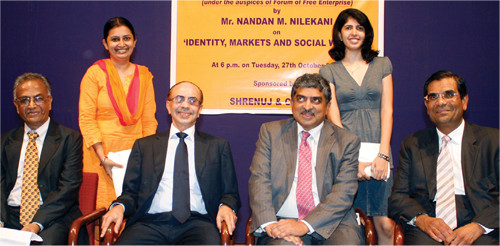
L to R: S. Divakara, Amritha Nambiar, Adi Godrej, Nandan Nilekani, Hufriya Kavarana and S. K. Doshi, director of ADSMT
In India barely six percent of the villages have a bank even today. It is the change in the technology of the banking system which could be the enabler of a system of direct subsidies to the poor. "Till the 1980s we didn’t use the word ‘computer’ in banks. We called them ledger posting machines! We were afraid to use the word because of labor,” noted Nilekani, adding, in 1994 private sector banks entered the market. On-line banking developed in the last 10 to 15 years with the concept of core banking where all accounts are with the bank and not with a particular branch as was the case earlier, he stated.
Even more ubiquitous is the mobile phone. "As access to the mobile phone nears 450 million people across the country, this unassuming device is at the forefront of efforts to connect with the poor, and provide them with services.” Nilekani says, "The most recent flagship schemes such as NREGA (National Rural Employment Guarantee Act) for example, are direct benefit programs that provide cash payments to residents. The government is also planning to offer direct benefits such as cash and health insurance to families in states such as Punjab, Haryana and Bihar, if they keep their daughters in school. And the Planning Commission is implementing a conditional cash program for mothers through the Janani Suraksha Yojana, where an expectant mother receives cash benefits if she accepts pre and post-natal care for her child.”
There are about 40,000 ATMs (automated teller machines) in India now, in urban areas and small towns, Nilekani noted, adding that a typical ATM transaction featured about Rs 3,000 whereas the typical mobile recharge in rural areas amounted to Rs 10.
With the mobile network and on-line banking in place, the crucial missing factor is a way of identifying the individual beneficiary. Governmental databases, be they the PDS ration card or the NREGA employment card, have been subject to manipulation. "Across states such as Maharashtra, Uttar Pradesh, Bihar and Orissa, not more than two in five below poverty line (BPL) families have ration cards, while non-poor families in the same village are known to have one or even two.” In the case of the NREGA "duplicate muster rolls across many parts of the country and ghost beneficiaries are weakening a valuable scheme,” noted Nilekani. The lack of coordination between government databases is one reason for what Nilekani calls India’s "thriving entrepreneurship in fake documents.” With unreliable identity verification, he says "it is extremely easy today to access services multiple times, and misrepresent identity.”
To offset this weakness the UID (a random number of 16 digits, as Nilekani confirmed during a session with the editors of The Sunday Express, November 29, 2009) will coordinate each individual’s biometric indicators: all 10 fingerprints, a photograph of the face and possibly of the iris, to ensure uniqueness. "When a person applies for a UID number, the central database will run a check of the person’s biometrics against its existing records, to make sure that the individual hasn’t already enrolled. This effectively eliminates duplicates from the database. Government agencies across the country can then use the UID database to confirm the identity of people accessing their benefits and services, and eliminate fraud and duplicates in their systems, he notes.
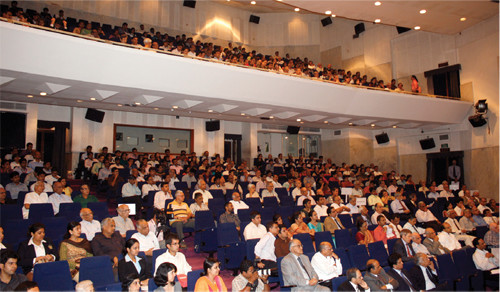
A few empty seats until the lecture began
The existing problems in identifying beneficiaries has also meant that many a genuine applicant for government handouts is denied the facility because he/she is unable to provide proof of identity: no documents, no rent receipts, no electricity bills. The poor work in the unorganized sector and migrate to where work is available. Hence they also lose their village moorings — there is no one who can vouch for them — and though needy, are "faceless” to government.
The information in the UID database would be centrally located with access from all parts of the country, says Nilekani. "The verification of the identity would also be instant — biometric readers at public and private offices would be able to instantly link up on-line with the UID database, and confirm if the person is indeed who she says she is.”
According to Nilekani the Reserve Bank of India is in favor of bringing on-line banking to the poor via the use of mobile phones. As the base of mobile usage expands, more and more people will be drawn into the ambit and direct benefit programs on a national scale would be feasible.
Nilekani envisages three kinds of direct benefits for the poor: unrestricted cash benefits, where a sum of money would be transferred into the bank accounts of the targeted beneficiaries for them to spend or save as they wish; conditional cash benefits where the benefits are available only if they undergo job training, keep their children in school, and take them to regular health checkups and immunizations, for example. "This kind of benefit becomes in essence, a human capital investment,” says Nilekani. The third kind of direct benefit is in the form of restricted cash vouchers for food or schooling, for electricity or water.
"With transfers to UID-linked bank accounts…the service would be automatic, and both the government and resident would know at once whether the benefit has been delivered or not. This would also give the poor and the disadvantaged more autonomy — he is no longer subject to the whims of his local public agencies when it comes to accessing essential services,” comments Nilekani. In time the government would be able to fine tune the groups to which benefits are directed, he adds.
"In rural India, cash is a powerful catalyst for both social and economic change. The social scientist Andre Beteille has noted that the feudal structures in villages across India began to break down only when money, rather than land, became the major form of wealth accumulation… Even today in villages in north and central India, the most backward castes are still paid for their work with food and clothing, and thrive on a barter economy. They are essentially chained to the places they work in, since they lack even the basic savings to migrate towards more urban areas where they might find work... In these regions, the direct cash benefits that the UID could enable would help long-disadvantaged groups to migrate to cities, participate in markets, and establish businesses. The increased financial autonomy of marginal groups in rural areas would also have a long-term, cleansing effect on local politics and hierarchies.”
Nilekani however emphasizes that the UID is no more than an enabler. It would be up to the government agencies to seize the opportunity for change, to leverage the technologies available to build the human capital that Ardeshir Shroff had envisaged 60 years ago. Paying tribute to one of India’s original economic thinkers, Nilekani said, "Often, when discussing the economic policies that emerged in the 1950s, we see that a belief in the effectiveness of a planned, government-directed economy was widespread among Indian politicians, economists and businessmen.
"Ardeshir Shroff was an exception — he was an economic thinker and industrialist who was a vocal supporter of competition, liberalization and the creation of intellectual capital even in the 1940s and 1950s. He recognized early on the essential weakness of a government-dominated system — that a player in an economy cannot also be its referee.
"Shroff was a liberal, but not a libertarian. His faith in an open economy was accompanied by support for public investments that fostered inclusive growth. He envisioned a country which invested in education, and in developing talent and initiative that would in his words, ‘remove intellectual deadness and stimulate the accumulation of capital.’”
Reiterating the vitalizing impact on the Indian economy of millions of the poor adequately fed, properly educated and productively employed, Nilekani concluded, "The UID can be the beginning of a new charter to leverage our social investments to broaden access to the economy and our markets. For the poor, it can become a bridge to the middle class, and a bridge between markets and our welfare systems. It would enable us to combine the security of our social systems with the opportunities of our markets. If we do this right, we are at the cusp of reforms that could change the lives of Indians across the country in the most fundamental, transformational ways.”
Nilekani’s lecture was preceded by Adi Godrej’s welcome address. The vice president of the Forum of Free Enterprise (FFE), the institution founded by A. D. Shroff in 1956 in the teeth of disapproval of India’s socialist minded government, recalled Shroff’s contribution to the Bombay Plan articulated by fellow industrialists, "setting out a 15-year perspective for private enterprise with minimal controls.” One of India’s delegates to the Bretton Woods conference in 1944 that established the international financial system as we know it today, Shroff had initially drawn the ire of Lord John Maynard Keynes, the reigning economist of the 20th century. "Keynes had initially described Shroff as a ‘highly articulate maverick filled with suppressed malice,’ but later appreciated his delineation of India’s problems,” noted Godrej.
S. Divakara, honorary secretary of the A. D. Shroff Memorial Trust, announced the award of the Trust’s (ADSMT) prize of Rs 15,000 to Hufriya Kavarana, a student of the Sydenham College of Commerce and Economics, for scoring the highest marks in Banking at the MCom final examination in 2008-09. When the prize was instituted in 1967, the amount had been Rs 500, noted Divakara. Amritha Nambiar who scored the highest marks in Banking while completing the postgraduate diploma in business administration in 2009 from S. I. E. S. College of Management Studies became the first recipient of the Trust’s award of Rs 20,000, instituted in 2008. College teams who had participated in the discussions sponsored by the Trust on Nilekani’s book, Imagining India, were presented copies of the biography of Nani Palkhivala, the iconic lawyer and economist who had been a long-term president of the FFE.
◆ ◆ ◆
From the archive