
Philanthrophy
How charity works
Industrialist and philanthropist Darius Forbes urges charitable trusts to assess the impact of the monies they disburse
At first it appeared the chairman of the Toyota Foundation had dozed off during Sir Dorab Tata Trust director Russi Lala’s presentation. Darius Forbes nudged Lala to cut short his talk. Lala concluded and then asked the five-member Japanese heads of their country’s largest charitable foundation what they could do for India.
The Toyota head asked his colleagues for permission to address the five-member Indian team (the Japanese ensure the number of delegates is the same so as not to embarrass their guests; they speak only after seeking consent of their other team members instead of thrusting themselves on the others as we do in India, observed Forbes).
"Why should we in Japan help anyone in India?” enquired the Toyota trust chief.
"Japan is a rich country,” replied the soft-spoken Forbes adding, "How are you contributing” to the less fortunate?
The Toyota spokesperson asked Forbes if he had visited Japan before. Forbes replied he had been to Tokyo many years earlier. What had he noticed during his visit? queried the trust leader. Forbes mentioned the people were very polite, friendly, etc. "What else about the place do you recall? Anything about the traffic?” Forbes thought and recalled many people wore scarves over their faces. The Toyota trust boss nodded: "And now you don’t see any scarves.” The choked, polluted air that had caused people to cover their faces had gone. Toyota poured millions into developing fuel efficient vehicles, he noted, and lessened engine exhaust globally while increasing revenues and becoming one of the premier automobile manufacturers. The research was funded by the Foundation.
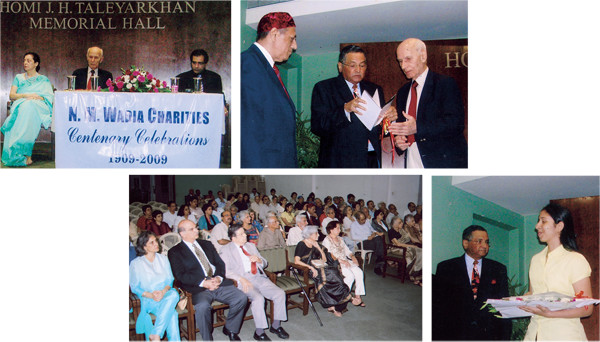
Clockwise from top left: Homai Modi, Darius Forbes and Khushru Panthaki; Marzban Giara, Burjor Antia and Forbes; Natasha Bala and Antia; a section of the audience
At a talk entitled, "Doing good today and a better tomorrow” to mark the centenary of the N. M. Wadia Charities on October 30, 2009 at the Homi J. H. Taleyarkhan Memorial Hall, Forbes emphasized the importance of the end result while giving charity. He referred to a project his granddaughter was doing along with other students while at college on the west coast of America to ascertain the impact of charity.
"There are millions of charitable foundations,” said Forbes. But in India, "Eighty-five percent are religious trusts. Only 15 percent are for other charities.” He termed it "ironic that we mix religion with charity. Religion is a personal matter. Don’t sit and preach to others. That is not your job. Honor and respect every religion.” He felt trusts would "serve society better if the two were separate.”
Forbes who is the chairman of the Forbes Marshall Group based in Poona, inquired, "How much does the individual” who is a recipient of charity "give back to society?... If I give Rs 100 is it not right to expect that the individual will pay back one rupee more than 100?... It is our responsibility to see that they contribute... Very rarely do you find individuals coming back to tell you how they have spent the money. Find out, assess… how the charity worked… its highest impact.” He suggested a one to 10 scale rating to determine the effectiveness keeping in mind the settlor’s wishes. "Charities do good work. Can they not do better?” he queried.
It was with this objective in mind that the Ford Foundation had sent Lala, him and three others to southeast Asia —Bangkok, Hong Kong, Singapore and Japan — to ascertain how charities there functioned and their effectiveness. "They wanted to make sure they would obtain the right answers.”
Taking root
Forbes narrated a chance occurrence that prompted his company to enter the health care arena. He was witness to an accident in the Chinchwad-Pimpri area outside Poona when a car with four passengers fell into a nullah. The driver of the vehicle was unhurt, an old man was shaken but two women lay unconscious. With the help of bystanders the ladies were moved into Forbes’ car and driven to the Sassoon Hospital in Poona where they were first told to register the case with the police at the hospital before any treatment could begin. The industrialist approached a doctor for assistance but was brushed off by the doctor who said, "I’m too busy.” Finally a young doctor was coaxed to examine the women.
At that time there were no medical facilities in the Chinchawad-Pimpri area and thus "the germination of an idea for health care,” took root. Today his company sponsored health clinic, Shehernaz Medicare Centre, sees around 150 patients a day.
"As Parsis we don’t lack in philanthropy,” he observed. H. T. Parekh, Lala, Forbes and a few others have started the Centre for Advancement of Philanthropy (CAP) in 1986. The organization specializes in areas of charity law, finance management, resource mobilization and human resource development.
In his introductory remarks Wadia trust chairman Burjor Antia said the Forbes Marshall group which specializes in steam engineering and control instrumentation solutions employs around 987 people and has an annual turnover of Rs 500 crores. Antia spoke about Motlibai Wadia who lost her husband early in life "nurtured both her sons, Nowrojee and Nusserwanjee.” She and her sons constructed the structure that hosts the Iranshah fire in Udvada and in 1922 bought 35 acres in the northern suburb of Jogeshwari on which Malcolm Baug is constructed.
To commemorate the centenary the trust has initiated the N. M. Wadia scholarship which was awarded to 17-year-old Natasha Sarosh Bala. Bala secured 95.5 percent in the State medical entrance exam and stood 20th in Bombay amongst the 2,00,000 students who appeared. She has secured admission to the prestigious G. S. Medical College of the K. E. M. Hospital. He exhorted the Malcolm Baug resident to "do research in the field of medicine.”
Indian Red Cross, Maharashtra State, honorary secretary Homai Modi who organized the function on behalf of the Wadia Charities stated that "Humanity was the guiding force behind any charity.” Wadia trustee Khushru Panthaki offered a vote of thanks.
◆ ◆ ◆
From the archive