
Books
Making medicine meaningful
At the launch of Dr Noshir Antia’s autobiography a Life of Change tributes were paid to his radical approach to improve health
"This book reveals the multidisciplinary blend to a great extent — of the surgeon, biomedical scientist and public health expert,” remarked Dr Nerges Mistry, director of The Foundation for Medical Research (FMR), at the Bombay launch of Dr Noshir Antia’s autobiography, a Life of Change. The title "would have you believe that his life was a logical extension of one phase to another (but) a reader who knew Dr Antia well would know the tremendous effort he exerted to change both in internal thoughts and externally to fluid circumstances and needs. This dynamic evolution of his life took its toll in the form of inner conflict and incessant introspection but it also gave him the highest respect from his peers, colleagues and students,” she added.
Capturing the span of eight decades, the autobiography was one of his last projects. In fact, he could not sign the memorandum of understanding with the publishers, Penguin, for it reached his home just as his ashes were brought from the crematorium in June 2007, Mistry informed his friends and admirers who had packed the British Council Auditorium on June 30, 2009.
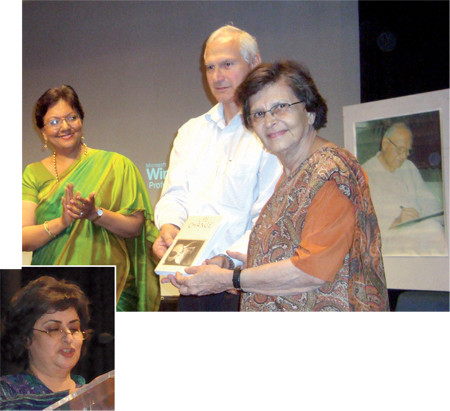
(From left) Srilatha Batliwala, Jamshyd Godrej and Arnie Antia; (inset) Dr Nerges Mistry
"Health for all” was his mission, summed up chief guest Jamshyd Godrej, managing director of Godrej and Boyce, when releasing a Life of Change in the presence of Antia’s wife Arnie. Commending Antia’s "pathbreaking” efforts to "make science relevant to a vast majority of people” Godrej believed the medical profession in India needs to internalize the good doctor’s ideas on how medicine should be dispensed and how 90 percent of simple ailments can be cured if the womenfolk in the villages are adequately trained. Being a trustee of the FMR that Antia had founded, Godrej was familiar with his pioneering work in the field of leprosy and neurology. In the course of their frequent interactions at Mandwa Godrej recalled how Antia would fondly talk of the two Indias — urban or cosmopolitan; and the rural one characterized by ignorance, hope and doubts.
"Most of us would trace our self confidence, intellectual development, capacity to work independently, our ability to hold our own in the most hallowed settings, and most of all to work to the highest intellectual and social standards to this time in our lives when we were recruited and set afloat by a man who did not have the time or the imagination to control us, tell us how to do our jobs or expect anything but the best from us,” noted Srilatha Batliwala. She remembered the time when as a fresh graduate from the Tata Institute of Social Sciences she had been hired by him to start a health policy research wing at The Foundation for Research in Community Health (FRCH) and had, along with another recruit Padma Prakash, created a respectable library on public health issues and produced a lengthy paper on the history of health policy in India since Independence that has become a benchmark.
Presently a research fellow at the Hauser Center for Nonprofit Organizations, Harvard University, and scholar associate at the Association for Women’s Rights in Development, in the course of her keynote address Batliwala referred to Antia’s "farsighted and pioneering ideas” that he propounded with his "characteristic vigor and passion.” Besides unconsciously building next generation leaders, he realized the importance "of marrying research and action in order to solve important social problems…He founded the twin institutions of FRCH and FMR to combine both immunological and health policy research with hands-on community health work in the Mandwa and Uran project.” She gave Antia credit too for his "prophetic focus on democratization, on democratizing health.” When he raved "close down all the hospitals and clinics and ensure people have clean water and enough food and their health will dramatically improve” it reflected "one core obsession: true democracy.”
Although she viewed him as "a prophet before his time,” she clarified, "If all this makes Antia sound like a saint, we all know he wasn’t! We all know his fierce temper, not to speak of his temperamental-ness, his mercurial moods and the occasional lash of his tongue… Like most men of his generation, and like most doctors, he was very conscious of the hierarchies of age and position. But at heart he always respected us as fellow-travelers…” And finally after eight years when she chose to move on, he expressed, "You must never hitch your wagon to an organization. Always hitch your wagon to a cause and you can serve that cause from many different organizations.”
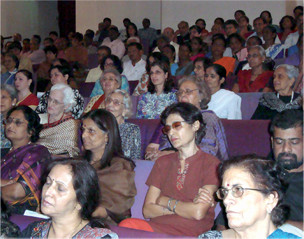
A section of the audience at the Bombay launch of Dr Noshir Antia’s book
Noted public health activist from Bangladesh, Dr Zafrullah Chowdhary reminisced of Antia’s last visit to Bangladesh just a month prior to his demise. He humorously referred to Antia as being one of the surgeons "used to playing drama in the operation room that is their theater.” He further added, "Surgeons become angry when things do not change,” and noted, Antia trusted female health workers "because men do not have patience… He became crazy for the betterment of the people.”
One of the other speakers that evening who chose to celebrate Antia’s "useful and joyous life” was Baby Tai Takawale, a seventh standard pass, accredited health care worker from Parinche (one of his successful rural health care projects), who in her talk in Marathi equated Antia with Gandhiji and gave him credit for imparting lessons on cleanliness and health, as also medical skills which gave them confidence to undertake simple surgical procedures and assist pregnant women to deliver babies.
Antia’s personal assistant for five years from 1985-90, Jasmine Naterwalla Sahukar recalled her first job at the FMR where she "was initially intimidated” having received such "negative reports” about him. In retrospection she acknowledged that the years she spent there were a "great learning experience for me.” Besides gaining confidence she learnt that "if you want to do anything you have to strive for excellence… work with passion.”
"This evening represents more than just a book release,” conveyed Mistry, adding, "It represents an opportunity to honor a man who has been described as a great son of India, a man who was known to be gentle and caring by some, and by others as totally uncompromising, moving ahead with bold and innovative steps… In the later part of his life, he may have been greatly frustrated by contemporary trends and what seems like the appropriation of community interests by commercial and consumerist forces and even more so by his increasing difficulty in effectively challenging this course of development…”
The writing of this memoir was mainly on the insistence of one of his researchers Padma Prakash, mentioned Mistry. She also gave credit to Sherna Gandhy, an editor of The Times of India, Poona, for revising drafts to make it eminently readable. Later Dr Kaveri Nambisan supplied Antia the necessary contacts with Penguin after which executives from Penguin, Ravi Singh and Akash Chakraborty undertook to give the book its final shape "so that his story and experience are left behind for us and posterity,” as noted Mistry.
Whilst images of Antia were periodically flashed on the screen behind, evoking nostalgia and fond memories was the playing of the concluding Frank Sinatra song, I did it my way.
◆ ◆ ◆
From the archive