
In Memoriam
Transformation of the surgeon
Died: Dr Noshir Hormasji Antia, 85, eminent plastic surgeon who inspired legions of committed doctors and researchers to focus on community health in rural areas of India, on June 26, 2007 in Poona following malignant malaria.
"Dr Antia’s contribution in the fields of surgery, biomedical research and public health are legendary. Even more remarkable was his ability to inspire ordinary people to do great things. The passion and persistence in his character, his outspokenness and his integrity allowed him to build institutions that were small in size but great in impact. The Foundation for Medical Research (FMR) was one such institution which he impregnated with his sterling qualities,” noted the condolence resolution passed by the FMR as a tribute to their founder director and trustee.
"He painted a far wider and integrated canvas on overall development, linking rural health to human rights and good governance on one hand and biomedical research on the other. He pursued this approach relentlessly to the end... He cherished and cultivated this wide bonding with his native charm and zeal,” acknowledged the resolution from the trustees of The Foundation for Research in Community Health (FRCH).
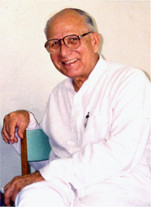
Dr Noshir Antia: Pro-people health care
Referring to the establishment of these two Foundations in 1974, director Nerges Mistry acknowledged the support Antia received from two industrial families — Godrejs and Sheths of Great Eastern Shipping — "who deferred to his courageous vision of a research institute that would encourage and promote indigenous thought and solutions.” At the public condolence meeting convened by these two organizations at the Bombay House Auditorium on August 9, 2007, Mistry told the audience that "the recent award to the FMR as a Centre for Excellence for TB research owes as much to his development of science and the scientists…as it does to the technical objectives.” The Dr Noshir Antia Virtual Centre for Excellence (under the Department of Biotechnology, Government of India, inaugurated on August 10, 2007) is "a tribute to his inspiration that allowed us to discover the potential and drive in ourselves.”
Many a speaker at the condolence meeting remembered well the lessons they had imbibed from Antia when observing him and interacting with him. "He was not only an excellent teacher but an ethical and compassionate man who taught students to look after the poor and unfortunate and give them the best treatment possible,” remarked plastic surgeon Dr Behman Davar who was one of Antia’s early students. "He was a scientist, a researcher, administrator, plastic surgeon, leprologist, public health specialist, Gandhian, policy analyst, development expert, activist. But above all he was a great human being, a true hero who transformed the lives of many,” conveyed Dr Mukund Uplekar who is leading the division of tuberculosis at the World Health Organisation, Geneva. "The time I spent with Antia was the most creative, most productive, most satisfying part of my life. There was a rich variety of ideas he was bubbling with, pursuing many of them at one time — spending hours looking at leprosy germs under a microscope, talking to patients afflicted by it, training village women in development and health care under a banyan tree, writing computer programs on health care, supporting activists in different causes…”
"There is India and there is Bharat,” Antia was wont to impress on his associates, urging them not to serve the India which is shining and has everything, but the "Bharat to which we must apply ourselves,” reminisced Antia’s first houseman Dr Sunil Pandya, presently neurosurgeon at the Jaslok Hospital. When working for leprosy patients Antia believed in paying "maximum attention to the reconstruction of a cured hand — so necessary to earn a living.” In fact his chief photographer at the J. J. Hospital was one of the leprosy patients successfully rehabilitated by Antia.
"He was warm, witty, eloquent and friendly and yet brusque and opinionated,” commented Dr Atul Shah, present head of the department of plastic surgery at the J. J. Hospital who took "pride in being a student of a legendary teacher like Antia.” Shah related an incident in those early years when Antia, finding a simple instrument missing at an operation table when Shah was the senior registrar, came charging into the second theater with surgical knife in hand demanding to know "Where is Dr Shah?” Antia’s intolerance of inefficiency was reported by another speaker too just as several of his assistants testified to his care and concern for his patients.
The public health specialist believed: Western models of health care are not suitable to 95 percent of rural India. To be intelligent you do not have to be educated. The women who participate in his programs have a lot to teach him. At his rural projects at Mandwa and Parinche the training of community health workers became a reality. In fact two of the "Tais (elder sisters)” had come to pay their respects at the condolence meeting and spoke in Marathi and Hindi of how Antia encouraged them to be self reliant and improve their lot with government measures like the Right To Information. The success of a program depends not on an individual but on the entire chain, even the seemingly insignificant people are an important link, he stressed.
"Antia was chiefly responsible for many of the pro-people healthcare decisions that were made by the Indian government. Much as he abhorred politicians, he saw it as his duty to engage with them to make an equitable health policy a reality,” wrote surgeon-novelist Kavery Nambisan in a tribute to Antia in The Hindu. "A man remarkably free of pettiness, he made friends with all. He was greatly influenced by the educationist J. P. Naik and the activist Anna Hazare and often spoke of them with affection and gratitude. Of course, his greatest friend was his wife Arnie, a charming lady deeply interested in his ideas and projects. They were lucky enough to have had 50 years together. After his death, it was obvious that she was not going to waste time in grieving. She talked eagerly about the future prospects of the organizations he had set up and about his soon-to-be-published autobiography…Antia completed his memoirs a few months before he died,” added Nambisan.
Yet another of his mentors was Dr E. H. Coyajee at Poona’s Jehangir Nursing Home where Antia served as surgeon after nine years in England where he worked in over 11 hospitals under stalwarts like Sir Harold Gillies, considered the father of modern plastic surgery and A. B. Wallace who pioneered new treatments for burns. The stigmatized leprosy patients living behind barbed wires at Kondhwa on the outskirts of Poona inspired him to practice his newly gained skills in plastic surgery with the encouragement of Coyajee. Working in primitive conditions at Kondhwa with no assistant, anesthetist or antibiotics and with patients providing torchlight illumination, Antia had to improvise constantly.
When Dr Shantilal Mehta, Antia’s former teacher and then dean of the J. J. Hospital in Bombay invited him to start and head the department of plastic surgery, he could not refuse the offer. Soon the Tata Trusts under the distinguished Prof Rustom Choksi recognized his genius and supported him through the establishment of The Tata Department of Plastic Surgery (TDPS) which he headed from 1958 to 1980. With the funds received from the health, education and welfare departments of the US government he was able to initiate research in leprosy and burns at the laboratories of the TDPS after which the notion of leprosy being a dermatological disease was modified to one having a neurological base.
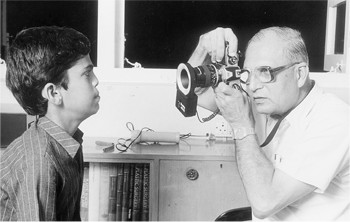
Dr Noshir Antia examines a patient (circa 1986)
Continuously cautioning his juniors not to be pressurized by unethical consideration, however lucrative, his principles were put to test when the Indo-US vaccine program was thrust on India in the 1980s. Antia opposed the move. He was pressurized to withdraw his stand; the US funds were withdrawn. But "as always his views were resolute and uncompromising backed by an incisive questioning that was sincere and forthright without awe or pomp…The shift of passion from the rigor of scientific thought to softer social aspects occurred in the late ’70s and early ’80s as his experience of rural realities grew. The sahib in him changed completely to a native and was forcefully expressed by a change in his garb. Gone was the anglicized attire, replaced with an elegant garb of kurta and churidars,” notes a tribute written by his assistant Mistry who considered him a "friend and mentor par excellence… (Although) there was the famous temper to contend with… we soon realized its success in stoking the fires in our bellies…”
He felt that Parsis, because of their westernized upbringing, were often divorced from the realities of India and its rich culture and philosophy. Though fond of the good things of life, he consciously lived a non-ostentatious, simple life believing in Gandhiji’s message that material requirements should be enough to meet one’s needs and not satisfy greed, as pointed out FRCH trustee Dr Armaity Desai at the condolence meeting. She also remembered how he felt obligated "to modify medicine to serve the needs of those who have starved to pay for my medical education.” FMR trustee Jamshyd Godrej referred to "Noshir’s foresight” and his scientific endeavor to extend help to the lowest level. Senior neurologist Dr Noshir Wadia who had presided over the condolence meeting too had remarked how Antia was never impressed by five star hospitals or expensive medicine but only had "a great desire to do something for rural health, for the poor, the leprosy and burns patients” to which end he gave up his lucrative practice and position.
Born in a middle class family in Bombay, he spent his childhood in rural Hubli. At the Anglo-Urdu High School where he studied he mixed with underprivileged boys and learnt Persian whilst picking fleas off the maulvi’s coat, notes his life profile. His academic journey took him through Esplanade High School, Bombay, Fergusson College, Poona and Grant Medical College, Bombay from where he earned his MBBS qualification (after a foiled attempt to join the Royal Air Force during World War II). He chose to become a doctor in the British Indian Army but a quick discharge enabled him to sail for England where he became a Fellow of the Royal College of Surgeons.
Charity to him meant creating an awareness in people of their own potential and helping them realize it without creating dependency. Although born of a priestly class, he was never a believer of rituals or doctrines. In later years he became a ‘nature worshipper.’ To him the practice of science primarily meant revering nature and her forces in all their wonder. What appealed to him the most was the tag of integrity that was appended to Zoroastrians. He often used to say that it was not decimated numbers but the lack of integrity that would sound the death knell of the community.
A founder of over 15 national associations and author of over 350 multidimensional publications and five books, Antia won recognition with different awards like the Hunterian, the Maliniac and the Fellowship of the American College of Surgeons. He was bestowed the Padma Shri and the Birla International Award for Humanism. Twice he was nominated for the Ramon Magsaysay Award. But the award the dedicated doctor treasured most was the one given to him by a leprosy patient who boldly threw a prosthetic footwear designed by Antia at his face. To the committed medical practitioner this epitomized the successful rehabilitation of a cowed down leprosy patient!
The sincere surgeon is survived by his wife Arnie, son Rustom and daughter Avan.
◆ ◆ ◆
From the archive