
Books
“The importance of being Nari”
A monograph of the works of the late architect Nari Gandhi was released on his 16th death anniversary
When Nariman Dossabhai Gandhi did not write to his family for several months while apprenticing with Frank Lloyd Wright in the USA his distraught mother, Najamai, hesitatingly wrote to the internationally renowned architect to inquire regarding the well-being of her son. The family was full of trepidation that Wright may be annoyed at the intrusion on his time and contemplation.
Instead the visionary sent a handwritten letter in reply stating, "Nari was doing very well and was amongst the best in the class.” Gandhi’s rationale for not replying? "He was too embarrassed to talk about his success,” related his brother Jimmy at a function to launch a monograph of Nari’s work at the Sir J. J. College of Architecture on August 18, 2009. The 164-page coffee-table book with 87 color photographs of Gandhi’s buildings and interiors was released by Sadruddin Daya, the former sheriff of Bombay and a longtime friend and patron of the unconventional but brilliant architect. Daya believed the book would go a long way in gaining Gandhi "international recognition.”
Not that Gandhi would have sought it. "A rose does not preach the virtue of beauty,” Jimmy quoted Nari as often saying. He would justify his simple garb of khadi kurta and pyjama alluding once again to the rose that "does not show but surely spreads its fragrance.” Nari often chastised Jimmy for "showing off.” He advised him instead "to show dignity and character.”
As an organic architect, Nari would "use a diverse range of materials from near the site” where he was working, said Jimmy. "He was a great tree lover.” Indeed some of the photographs on display at an exhibition of his works at the College to coincide with the book launch showed homes built around or encompassing trees.
As the website architectnarigandhi.org mentions, when Gandhi built a house for Daya he did not install any doors. He believed doors created barriers. But when pigeons started entering the home, Daya had a glass door put in. So incensed was Gandhi that for two years he did not visit the site.
Noted architect Tehmasp Khareghat who was one year junior to Gandhi at the College and who was present at the function explained to Parsiana that in organic architecture natural materials for the building and the interiors are sourced preferably from the surrounding area so that the "structure becomes part of the environment.” The inside and the outside of the structure then becomes a homogenous whole.
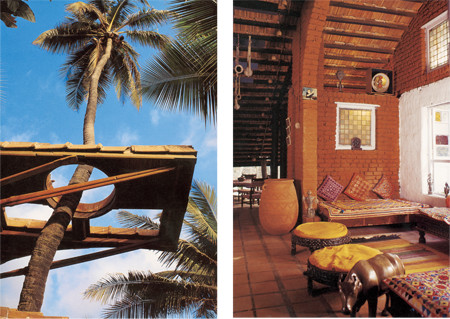
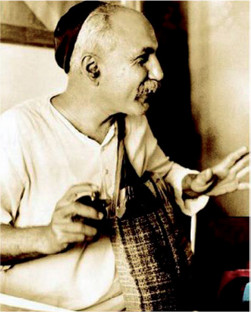
Organic architect Nari Gandhi (top) with his creations: weekend house at Versova (right) and farmhouse at Revdanda (far right)
After Wright’s death in 1959 Gandhi studied pottery at Kent State University for two years. He returned to India in the early 1960s and taught at the University of Baroda Academy of Architecture. He worked with an architectural firm but the idea of "being a cog in another man’s machinery,” did not appeal to him. He only listened to that "little voice inside. Nobody is going to tell me what is wrong and right… ‘I don’t quite like the idea of sahebgiri (kow-towing),’” he used to say.
Nari studied at St Xavier’s School and was "a quiet and serious student,” recalled Jimmy. "He never ignored criticism.” Though the family hailed from Surat, Nari developed "a meaningful command of English very fast.” He was also "an excellent painter” using water colors. Prof Bilimoria at Sir J. J. College noticing Nari’s talent "encouraged him to go abroad. Nari read in The Saturday Evening Post about a fellowship program with Wright. He sent in his drawings and was selected.
Gandhi was "a devout Zoroastrian” and believed in "utmost cleanliness,” stated Jimmy. He took "fastidious care about visits to the toilet.” Nari studied various religions and concluded all converged in the same ideals. He was influenced by the religious philosopher J. Krishnamurti. "All religions serve all mankind,” Nari said and believed in the "brotherhood of man…for him religion was a matter of faith and heart,” said his brother.
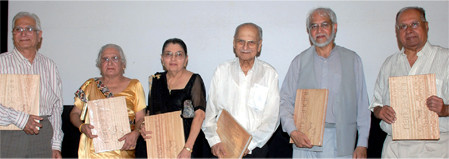
(L to R) Dali Gandhi, Khorshed Adrianwala, sister-in-law Nergish, Jimmy Gandhi, H. Masud Taj, Sadruddin Daya
That the book launch was held on the day of Nari’s death 16 years ago "means a lot to us,” observed Jimmy. Nari’s sister Khorshed Adrianwala and brother Dali were present at the function. News of their brother’s death in a tragic car accident near Khopoli while on his way to a site reached the family three hours later. "Oh God you have taken the faresta (angel) of our house,” lamented Najamai to whom Nari was very close. "There was no time to say goodbye,” noted Jimmy. "God takes away the best, first,” he added, wiping the tears from his eyes. Nari was one of six brothers and sisters (the others being Pesi and Zarin Vachha).
Rajiv Mishra, principal of Sir J. J. College, complimenting the publication of the monograph said "works speak more than words.” Pranav Upasani, one of the book’s publishers said Gandhi’s name "resonates in the classrooms and corridors” of the College. The large turnout, many of them young faces, bore out his observation. Searching for some material to publish they came upon this unpublished work, he explained. The idea of the book was conceived by Daya 15 years ago. The concept was reviewed, redesigned and published by Upasani and Yashwant Pitkar on behalf of the Art and Design Book Press at the Foundation for Architecture (www. forarc.com). The book, priced at Rs 3,500 is printed by Jak Printers.
The author of the book, architect and poet H. Masud Taj while stressing the "importance of being Nari” recited some lines of a poem he had written for the tome. His poetic effort was inspired by visiting several of the structures Gandhi had built, he noted.
"I had met Nari Gandhi 30 years ago. I should say I was lucky,” said Pitkar. "I saw most of his work” which inspired him to publish the monograph.
Due to exigencies of space the review of the monograph will appear in our October 21, 2009 issue.
◆ ◆ ◆
From the archive