
Medicine/Health
Form and transform
Dr Sam Mahaluxmivala who founded the Plastic Surgery Department at the Nair Hospital 50 years ago was recognized with a Lifetime Achievement Award
He brought a new smile, figuratively and literally, to several faces ravaged by trauma. The deformed limbs that he restored helped his patients feel taller. Skin scorched by burns was made thicker to withstand the subsequent stares. Many are the disfigurements that Dr Sam Mahaluxmivala must have transformed during his 50 years of practice as a plastic surgeon. His patients who were able to regain a semblance of normalcy may have lost touch with him but the doctors who trained under him continue to venerate their mentor who offered them "a life changing experience.”
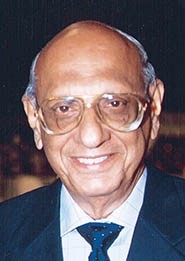 Several were present to celebrate the golden jubilee of the Department of Plastic Surgery at the Topiwala National Medical College and B. Y. L. Nair Charitable Hospital from January 18-20, 2014. "My contribution was for the first 25 years. For the next 25 years it has been run by people whom I have trained,” mentions Mahaluxmivala who founded the Department in 1964 after his training in the UK and USA and made it comparable to international standards. As chairman of the Organising Committee of the Golden Jubilee Celebrations, Mahaluxmivala was overwhelmed that his "fellow plastic surgeons…(had) come from various parts of India and even from far away England” to show their solidarity. Dr Mathangi Ramakrishnan, a senior plastic surgeon, had specially come from Madras to present the Lifetime Achievement Award to 83-year-old Mahaluxmivala. The chief guest at the function was Dr Suhasini Nagda, director in charge of medical education and overall administrator of all hospitals under the Bombay Municipal Corporation, with Dr Ramesh Dhamal, dean of Nair being the guest of honor.
When Parsiana interviewed Mahaluxmivala at his residence on March 6, 2014, the plaque presented to him had already been hung up on a corridor wall to join the other honors he had been conferred over the years. In his inaugural address at the golden jubilee event, the octogenarian surgeon acknowledged the initial encouragement he had received from chief honorary surgeon Dr V. K. Desai who assigned him five beds solely for plastic surgery patients and the doyen of ENT surgery Dr L. H. Hiranandani who was a "source of great inspiration and support.” He further commented that the Department "has been fortunate in having a succession of dedicated, loyal and hardworking alumni and their contribution to their alma mater cannot be overstated. They have tolerated all problems including my short fuse!” Currently the Department is in the capable hands of Dr Amresh Baliarsing and Dr Uday Bhat.
The golden jubilee souvenir released on the occasion is replete with messages from several alumni who appreciate their training under the "hawk” eyes of Mahaluxmivala who besides plastic surgery taught them discipline, bedside manners, human relations and punctuality. A perfectionist who demanded the same level of exactitude from his juniors, be it in observing the proforma system that he introduced to meticulously store patient details or the dressing done after surgery, he had a reputation for being "very difficult to please.” The juniors knew though that beneath the veneer of a "scary boss” was a very soft, gentle, warm, kind and generous teacher. From him they also learnt how to host parties and social etiquette.
Several were present to celebrate the golden jubilee of the Department of Plastic Surgery at the Topiwala National Medical College and B. Y. L. Nair Charitable Hospital from January 18-20, 2014. "My contribution was for the first 25 years. For the next 25 years it has been run by people whom I have trained,” mentions Mahaluxmivala who founded the Department in 1964 after his training in the UK and USA and made it comparable to international standards. As chairman of the Organising Committee of the Golden Jubilee Celebrations, Mahaluxmivala was overwhelmed that his "fellow plastic surgeons…(had) come from various parts of India and even from far away England” to show their solidarity. Dr Mathangi Ramakrishnan, a senior plastic surgeon, had specially come from Madras to present the Lifetime Achievement Award to 83-year-old Mahaluxmivala. The chief guest at the function was Dr Suhasini Nagda, director in charge of medical education and overall administrator of all hospitals under the Bombay Municipal Corporation, with Dr Ramesh Dhamal, dean of Nair being the guest of honor.When Parsiana interviewed Mahaluxmivala at his residence on March 6, 2014, the plaque presented to him had already been hung up on a corridor wall to join the other honors he had been conferred over the years. In his inaugural address at the golden jubilee event, the octogenarian surgeon acknowledged the initial encouragement he had received from chief honorary surgeon Dr V. K. Desai who assigned him five beds solely for plastic surgery patients and the doyen of ENT surgery Dr L. H. Hiranandani who was a "source of great inspiration and support.” He further commented that the Department "has been fortunate in having a succession of dedicated, loyal and hardworking alumni and their contribution to their alma mater cannot be overstated. They have tolerated all problems including my short fuse!” Currently the Department is in the capable hands of Dr Amresh Baliarsing and Dr Uday Bhat.
The golden jubilee souvenir released on the occasion is replete with messages from several alumni who appreciate their training under the "hawk” eyes of Mahaluxmivala who besides plastic surgery taught them discipline, bedside manners, human relations and punctuality. A perfectionist who demanded the same level of exactitude from his juniors, be it in observing the proforma system that he introduced to meticulously store patient details or the dressing done after surgery, he had a reputation for being "very difficult to please.” The juniors knew though that beneath the veneer of a "scary boss” was a very soft, gentle, warm, kind and generous teacher. From him they also learnt how to host parties and social etiquette.
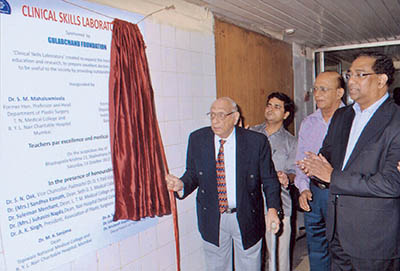
Dr Sam Mahaluxmivala inaugurating the Clinical Skills Laboratory
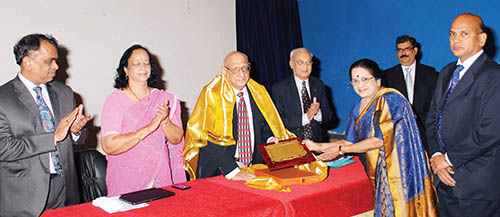
Dr Sam Mahaluxmivala receiving plaque from Dr Mathangi Ramakrishnan with
(from left) Drs Ramesh Dhamal, Suhasini Nagda, Narendra Pandya, Uday Bhat and Amresh Baliarsing
"My greatest satisfaction is my alumni,” conveyed Mahaluxmivala. "I kept them as part of the family. They would come over to my house. I would take them to the Willingdon Club.” Even the golden jubilee celebrations included a dinner at the Willingdon Sports Club when the alumni who had trained at the Department over the past 50 years got an opportunity to interact with the present batch of trainees. Although Mahaluxmivala ceased to be head of department in 1989, being professor emeritus, he has continued his association with Nair and conducts lectures whenever invited.
Two years ago when the Department inaugurated the Clinical Skills Laboratory, they invited Mahaluxmivala to unveil the plaque. This Laboratory is "one of only two in the country to simulate an operation theater” with ‘fresh’ non embalmed cadavers where postgraduate plastic surgery trainees and consultants can learn or assess different operative procedures. Besides the special cadaver preservation units, there are high definition cameras with audiovisual cables that instantly relay the surgical skills to audiences outside the Laboratory, states the former president of the Association of Plastic Surgeons of India who being a guest lecturer at several national and international conferences clearly recognizes the need for such a facility. The two-day workshop on ear reconstruction organized by the Department as part of its golden jubilee celebrations on January 19-20, 2014 was held at this same Laboratory.
"As I tell my juniors, plastic surgery is a superspecialty where we are not dependent on expensive and sophisticated machinery. With specialized instruments that we can carry in our bag, we can go anywhere and operate,” reinforces Mahaluxmivala who has devoted 70% of his expertise to reconstructive surgery as against 30% to aesthetic surgery. "Patient confidentiality with regard to aesthetic surgery prevents me from disclosing any information regarding the surgery and the reaction of the patient but in most cases, if not all, the results were much appreciated,” he recalls.
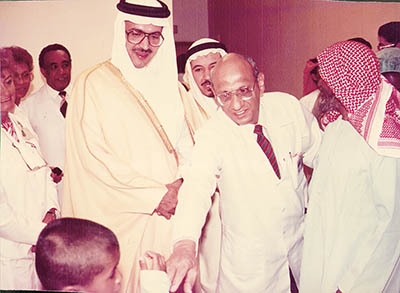
Mahaluxmivala at the King Fahad Specialist Hospital
Amongst his reconstructive surgeries, one of his most rewarding cases concerned an NRI (non-resident Indian) from the Middle East suffering from cancer of the throat. The disease was so advanced that the upper food passage (oropharynx), the upper air passages (larynx), all muscles and other tissues in front of the spine had to be removed by an eminent ENT surgeon. "I was then given the task of reconstructing his throat passage so that he could swallow instead of having liquid fed through a tube from his nose into the stomach.” Due to post operation bouts of bleeding which had affected the blood supply to the brain, the anesthetist declined to give him general anesthesia. The challenge before Mahaluxmivala was to reconstruct the food passage from the neck to the upper chest. "I performed the reconstruction in stages solely under local anesthesia and the joy and satisfaction when he swallowed his first mouthful through the reconstructed throat passage was shared not only by me and the patient but by the entire nursing staff on the floor. He remembered me every year thereafter.”
Mahaluxmivala preferred to do aesthetic operations under local anesthesia with sedation. He reveals how patients in America would undergo breast augmentation under local anesthesia while in the UK even a mole would be removed under general anesthesia. As against seven out of 10 middle aged women in New York who must be opting for face lifts and openly announcing its virtues, in India it would not be even one in 10, he shares his observations. Among aesthetic surgeries, breast implant requests were once the highest but have now fallen behind liposuction. Currently in India, plastic surgeons must be doing 60% reconstructive work and 40% aesthetic, he believes.
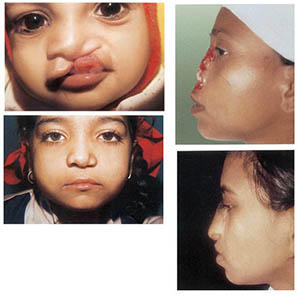
Cleft lip and palate (above) and facial reconstruction surgeries performed by Mahaluxmivala
With many aesthetic jobs currently undertaken by dermatologists, the veteran surgeon observes that the advent of laser treatment has changed the scenario with special sessions at conferences being devoted to this subject. The treatment of baldness is a major cosmetic breakthrough, he says, and refers to hair transplants where 500-700 strands are virtually repositioned.
International assignments too had come Mahaluxmivala’s way after his retirement from Nair. For three years he was in Saudi Arabia starting the Plastic Surgery and Burns Unit at the King Fahad Specialist Hospital and serving as secretary of its Medical Education and Research Committee. Thereafter he accepted several consultant plastic surgeon appointments under the National Health Service in London.
Based on his annual series of lectures delivered to postgraduate students of Bombay University, Mahaluxmivala has authored a book Plastic Surgery: A Compendium published in 1998 that is meant to be "a useful guide and reference book for practising plastic surgeons and …of interest to students of allied specialties.” The 236-page paperback includes 178 computer generated line drawings and 32 color photographs. Looking at the grotesque images even a lay reader can appreciate the art and skill required to restore deformities and malformations caused by trauma, injuries, tumors, burns… Recalling a lecture by Mahaluxmivala who had shown pre and post operative photographs of an angelic face that had suffered a contused lacerated wound, one of his juniors acknowledged, "This became a decisive factor…when I switched from cardiovascular and thoracic surgery to plastic surgery.”
Besides teaching and serving as coordinator for the hospital management course conducted by the Bombay Management Association, Mahaluxmivala has had a long association with the University of Bombay as a teacher, examiner for the MBBS and MCh (plastic surgery) examinations, as member of the University’s faculty of medicine, as also senate, board of studies in surgery and council of postgraduate teachers. He has served as examiner for the University of Madras as also the Postgraduate Institute at Chandigarh and as member of the board of studies in plastic surgery at the Banaras Hindu University.
When urged to share his views on reservation of seats for the Parsi community, the senior surgeon opened up: "Sixty years ago when Sir Homi Mody said the Parsi community does not require reservations, the scenario was different. But now with 30-50% reservation of seats in Bombay and more than 50% in places like Madras for schedule castes, tribes and other backward classes, our really good and deserving students are losing out on postgraduation MD (Doctor of Medicine) or MS (Master of Surgery) options of their choice.” With limited openings in Bombay, after completing their MBBS,they are compelled to appear for the DNB (Diplomate of National Board) examination conducted in Delhi with results being declared after several months. The competition then becomes unfair, realizes Mahaluxmivala who after standing first in his final MBBS in surgery, had earned his MS from the Bombay University and subsequently qualified as a Fellow of the Royal College of Surgeons. Possessing a "sense of aesthetics and a liking for art,” he feels that is probably what made him undertake his basic training at the Plastic Surgery Centre, Queen Mary’s Hospital Roehamption, UK, and at the Cornell Medical Center in New York.
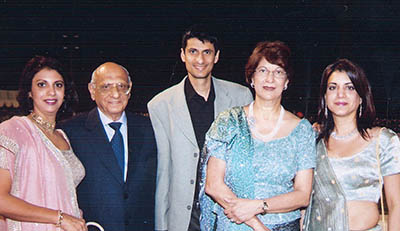
Drs Sam and Narges Mahaluxmivala with children (from left) Zareen Kotwal,
Dr Jehangir and Pervin Poonawala
Prior to Mahaluxmivala starting the Department of Plastic Surgery at the Nair Hospital, Dr R. J. Manecksha had introduced the city’s first plastic surgery unit at the G.T. (Gokuldas Tejpal) Hospital, Dr N. H. Antia had launched the Tata Department of Plastic Surgery at the J. J. Hospital, and Dr Charles Pinto at the K.E.M. (King Edward Memorial) Hospital. "When we started, three of the four (leading plastic surgeons in Bombay) were Parsis; that was the proportion.” Dr Hirji Adenwalla who is regarded as the father of cleft reconstructive surgery in India was busy expanding the multispecialty Jubilee Mission Hospital in Trichur. After 25 years there may not be any eminent Parsi surgeons, fears Mahaluxmivala.
Whilst continuing with his private practice at Bombay’s Northcote Nursing Home for 50 years, Mahaluxmivala was also affiliated with the B. D. Petit Parsee General Hospital and the Bombay Hospital. "I was the first plastic surgeon to be appointed at the Parsee General, to be followed by Drs Behman Daver, Hoshang Bhathena and Rustom Ginwalla.” At the Parsee General he was required to do more reconstructive than aesthetic surgery, he reveals, although he has undertaken abdominal reduction and nose correction jobs too. "Relative to its population size, Parsis do seek more aesthetic improvements,” he concedes.
Even after he closed his private practice seven years ago his loyal patients insisted on coming to him saying "kai nahi hoo tamaaraa ghéré aavas (don’t worry I will come to your residence)” until he resolved to give away all his tools, implements, books to his ex-students and the Nair Hospital.
To keep himself abreast of new developments in the medical field, Mahaluxmivala devotes his time to reading journals and annual reports of different institutions considering that now there are entire medical centers devoted to plastic surgery. He reads at least one book a week plus the papers, including Parsiana "carefully, word to word,” he says.
He spent his formative years at the Bharda New High School and Elphinstone College in Bombay. Happy to have been raised on sound Parsi values like "being honest and careful with your money,” he and his wife Dr Narges who too had studied at the Topiwala National College and is a consultant in clinical development research, have sought to inculcate the same ethics in their children by ensuring that they "do not get spoilt” and learn to travel by public modes of transport. Their eldest daughter Zareen Darius Kotwal works at the British Deputy High Commission in Bombay, second daughter Pervin Eddie Poonawala has relocated with her family to Bombay after being in London for over a decade, and son Jehangir is a consultant orthopedic surgeon specializing in knee and hip replacement surgery in London. The parents take pride in reporting that he is course director for the FRCS (Orth) course at the Royal College of Surgeons of England and is on the faculty and invited speaker at the University of Cambridge and University of Warwick. He is married to Anamaria who practices as a family physician in London. Describing himself as "a religious Zoroastrian,” Mahaluxmivala adds, "I pray every day and wear the sudreh-kusti. Amongst my children, son Jehangir who is the most religious makes it a point to visit the fire temple on his trips to Bombay.” Preferring not to express his views on dakhmenashini, he states, "It is functioning, in a different way. The fact that over 70% of the community goes for dakhmenashini speaks for itself (The figure is over 90% in Bombay — editors).”
Refusing to be drawn into any controversies concerning the Parsi community, he remarks, "We should avoid bickering. It is unfortunate that friends become enemies.” After years of litigation he is now in control of the Late R. D. Mahaluxmivala Charity Buildings Trust that gives scholarship assistance of Rs 30,000-50,000 each to select applicants for postgraduate studies in different subjects. Whilst vetting the 32 applicants, half of whom are women, he is pleasantly surprised that even young ladies are choosing to pursue their academic dreams in places like Chandigarh and Vellore. Dismayed by the community’s combative seniors, he would prefer to focus on these promising youngsters who offer a ray of hope.
◆ ◆ ◆
From the archive