
The Avatar of the age
Knowledge, love and action lead to the realization of God, transcending all religions, believe the followers of Meher Baba
Adenwalla states, "I must admit that I was very reluctant to take on the task of writing this article for I feared I would not do justice to a theme which has been very central to my life. However, the fear that if I did not write it I would regret it even more, compelled me to take this on.”
This piece is accompanied by several photographs taken by noted photographer Homyar Mistry of Homz Prints, a Meher Baba devotee of many years.
• • •
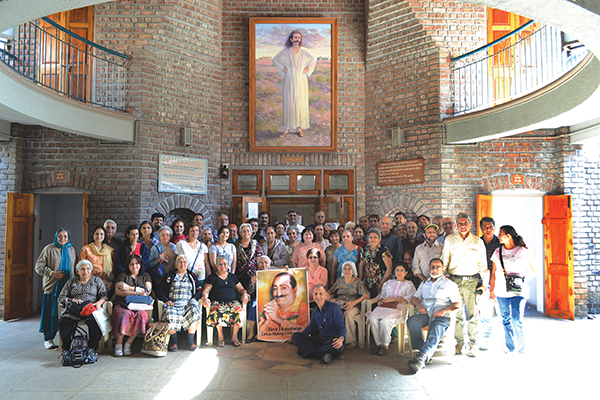
Group of pilgrims from Bombay at the foyer of the ashram Photo: Homyar Mistry
The concept of an avatar is essentially a vedantic concept. It is believed that God comes again and again in different forms every time the wick of righteousness burns low in the world, to give mankind a push towards his goal, which is God realization. The message that every avatar gives is essentially the same but he gives it a complexion to suit the times.
Every organized religion believes that its founder in isolation is the true and only prophet. The Hindus believe in the avataric concept but their avatars are only those within their fold. Meher Baba’s is a universal concept which enfolds and then transcends all religions. In his philosophy there is no difference between Hindu, Muslim, Buddhist, Christian, Parsi or Jew. He states emphatically that I came as Ram, I came as Krishna, I came as Zoroaster, I came as Mohammed, I came as Christ, I came as the Buddha and now I have come as Meher Baba. I am the Avatar of this age.
 To accept man as God is a difficult proposition by any standards. I was personally drawn to Meher Baba in slow stages of acceptance; mine was not the way of a dramatic spiritual experience or a sudden revelation which many have experienced. My father-in-law Sarosh K. Irani was, from the age of 18 years an ardent follower of Meher Baba. On my many visits to Ahmednagar he would often ask me, "I am going to see Baba, would you like to come?” and I would go more for the drive and the pleasure of his company. I would sit in the Mandali Hall and listen to this man whom people said was God in human form and watch him communicate with his disciples through an alphabet board and later by hand gestures.
My concept of God was that of an old gentleman with a white beard who sat up in the clouds, was a good sport, played cricket and gave you the benefit of the doubt. I was not ready to accept the idea of God taking human form. I noticed that Baba had the most beautiful hands and the most expressive eyes and said the most profound things. He seemed to emanate concern and love for all things around him, including animals. He would single me out and ask me what I was doing and show interest in whatever I told him. Slowly by degrees and over the years and by close and critical observation I came to the conclusion that this was no ordinary man and that there was perfection writ all over him. He was not mad and he was not an imposter or a cheat. I said to myself, why would this perfect man want to commit this colossal fraud on mankind by saying that he was the Avatar of the age when he was not? And that is how, by slow degrees I became a Meher Baba lover.
It changed my nature and my life.
I was witness to Baba’s love, his compassion, his wisdom and an all pervading gentle humor. I realized that Meher Baba’s path is comprehensible to thought, intelligence and understanding but it cannot be understood by the mind alone, for the concept defies human understanding. One has to look beyond and of course one must be ready for it. I once said to a very close Baba lover, Faredoon Driver, whom Baba had nicknamed ‘Padri,’ "Padri, I do believe that Baba is perfect but I can’t accept him as God.” He tapped his watch and said, "Why do you worry, your time has not yet come.” I also found it strange that none of Baba’s close followers including my father-in-law, forced their beliefs on any one. If someone said something derogatory about Baba and at that time there were many, they listened without comment and sometimes with a smile. Baba’s instruction to them was never to be offended or contradict such attacks against him for these people too were doing his work unknowingly.
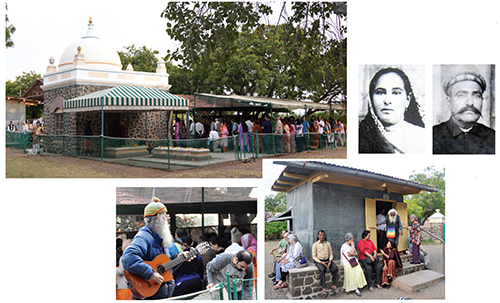
Merwan Irani was born on February 25, 1894 at the Sasoon Hospital in Poona. His parents Shireen and Sheriar were Persians of the Zoroastrian faith. Sheriar in his youth was a spiritual wayfarer who roamed over Iran and parts of India in search of God, a God he could not find. Later, when he was much older, an inner voice told him to stop wandering, marry and have children and that one of his children would find what he was seeking. His second child Merwan fulfilled this prophecy. Merwan was a healthy, loving and unselfish boy who loved cricket and hockey and was popular with his friends and teachers. Baba reminisced about his childhood, "As a boy I had nothing to do with spirituality. My father was a dervish and had roamed through Iran and India, begging and searching for God. He taught me verses from Hafiz and other poets but I had no interest in such things.” As he grew up Merwan’s interest widened and before he passed out from St Vincent High School in Poona he read deeply both Western and Eastern literature and poetry. His favorite was Hafiz, the great mystic Persian poet. Merwan entered Poona’s Deccan College at the age of 17, distinguished himself in his first year but was not destined to complete his college education.
What transpired in 1913 defies scientific explanation and centers around an astounding old Afghan woman of 107 years named Hazarat Babajan who sat under a certain tree in the center of Poona. There she sat come rain or storm and rarely moved from that spot. She was believed to be one of the five perfect masters of the time. Merwan used to pass Babajan as he rode home on his cycle from college. He started spending more and more time with this woman and one day in 1913 Babajan kissed Merwan on the forehead. "I was drawn to her as steel to a magnet. With just a kiss on the forehead Babajan made me experience indescribable bliss which continued unbroken for nine months. She made me realize in a flash the infinite bliss of God realization. I had no consciousness of my body. I could not eat. My mother thought I had gone mad but my father who was a seeker understood what was happening to me but said nothing. Doctors were called in but to no avail.”
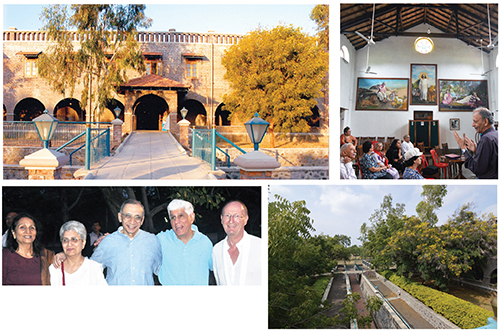
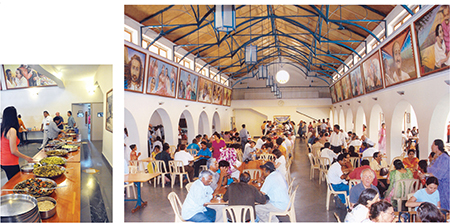
One night when Merwan was sitting at Babajan’s feet she pointed to him and said to the others, "This child of mine will create a great sensation in the world and do immense good to humanity.” She then guided him with the words, "Ab téra hissa koi Hindu sé lé lé. (Now take the rest of your share from some Hindu).” At the end of nine months Merwan meandered on foot through Ahmednagar to Shirdi where he was drawn to Sai Baba, the second perfect master he was destined to meet. He instinctively fell at his feet. Sai Baba lifted him up, looked into his eyes and exclaimed "Oh Parvardégar.” There are two explanations for this — that he recognized Merwan as the Avatar of the age or that he saw the infinite beauty of this man and exclaimed "Oh God.”
That night Merwan was closeted with Sai Baba in a hut and they sat in communion the whole night. Gustadji, a follower of Babajan who had been dispatched by her to look after Merwan, was stationed outside to prevent any disturbance. At dawn, Sai Baba emerged from the hut and Meher Baba followed. Gustadji is said to have told people later that when Sai Baba came out he brushed against him and Gustadji felt a strong electric shock that nearly threw him to the ground. It is said that Merwan then made a straight line to the nearby temple of Khandoba in which Upasni Maharaj was staying. It seemed as if he knew where to go. One doesn’t know, but perhaps the guidance may have come from Sai Baba.
Merwan related, "When I came near enough to him, Maharaj greeted me, so to speak, with a stone which he threw at me with great force. It struck me on my forehead exactly where Babajan had kissed me. It hit me with such force that it drew blood. The mark is still on my forehead. But that blow from Maharaj was the stroke of divine knowledge.”
Merwan spent several years with the perfect master Upasni Maharaj, becoming more and more normally conscious of the ordinary world, while simultaneously experiencing the bliss of realization and the intense suffering connected with our world of illusion. Merwan relates, "Maharaj made me know what I am, just as Babajan made me feel in a flash what I am. During this period I used to sit every night with Upasni Maharaj in a hut behind closed doors. On one of the last such occasions Maharaj folded his hands to me and said ‘Merwan, you are the Avatar and I salute you.’” This was the final transition of Merwan Irani to Meher Baba. Baba later explained that Upasni Maharaj brought him down to human consciousness so that he could perform his duties as the Avatar of the age. He was then 28 years old and ready to embark on his avataric mission. I quote, "I stayed for four months in a small jhopdi (hut) on the edge of some fields in a very thinly populated area of Poona and was surrounded by a few men who formed the nucleus of my mandali and it was one of them who started calling me Meher Baba. This was long before they had any clear idea of my inner state. Some were directed to me by Babajan and Upasni Maharaj, others came to me on their own.”
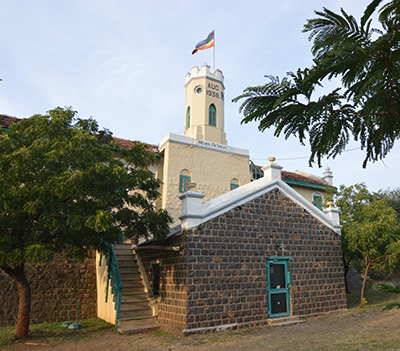
Meher Retreat
In May 1922 Maharaj addressed a large gathering of his followers and said, "Listen to me most carefully, I have now handed over my key to Merwan and henceforth you are all to stick to him and do as he instructs you.” In 1922 Baba established his first ashram in a house in Bombay which he called Manzil-e-Meem where 40 men of all faiths stayed with him under strict spiritual guidance. My father-in-law was one of them. Then Baba moved to an old First World War military camp near the village of Arangaon a few miles from Ahmednagar. He called the place Meherabad and it is where his tomb now stands. Here he created a small model town of some 500 souls where he built a hospital, a dispensary and a school for the spiritual training of young boys and a home for lepers. Concurrently Baba put his mandali through severe spiritual training and discipline. For long periods Baba went through fasts living on water and half a cup of coffee; the boy who brought him his coffee would drink half of it. It is said that he came out of these fasts radiant and full of energy.
.JPG)
Afarganiu at the base of the samadhi dome
On July 10, 1925 Baba went unobtrusively into physical silence. He often promised to break his silence but he never did till he dropped his body on January 31, 1969. He once told his followers that in my previous advents I have spoken much but mankind has not listened to my words, therefore in this advent I have decided not to speak. Baba with his mandali travelled all over India and the world contacting advanced souls and God-intoxicated people called "masts” to give them a push towards God realization. He reoriented the Sufi order and set up a major ashram at Myrtle Beach, South Carolina. He met with two major car accidents, was badly injured with multiple fractures but through these ordeals he spoke not a word. He had predicted both these accidents and explained them as part of his universal work. At times he explained that the Avatar suffers to take on the suffering of the world. Many miracles have been attributed to him but he firmly denied having performed any of them. "It is your faith in me that makes it happen,” he said.
One is often asked what Baba’s teaching is. He himself said, "I have not come to start a new religion but to string all religions like beads on one string.” Ultimately he explains his philosophy thus: "The purpose of life is to love God: and the aim of life is to be one with God. To do this you have not to renounce the world but to remove low desires, dishonesty and hypocrisy, then in the midst of activity you will be loving God.”
He instructed his acolytes to love and obey Him. In this and in many other ways he tried to destroy their egos. He said, "If you are full of yourself where is there room for me?” Therefore God realization is nothing but self-realization. Think of it this way — God says, "You are the bubble, I am the sea, when the bubble bursts I am you and you are me.” Baba says, "I do not interfere with any religion and permit all to follow unhindered their own creeds. When compared with the love of God, external ceremonials have no value.” Note, he does not say that religions are of no value. He says ceremonials have no value.
Because Baba is so clear about who he is, he has often been asked why in different avataric forms every avatar does things in a different way. His answer is very clear. He says, "Every avatar adopts a particular aspect according to the times in which he manifests but the message is not very different and His work is the same.”
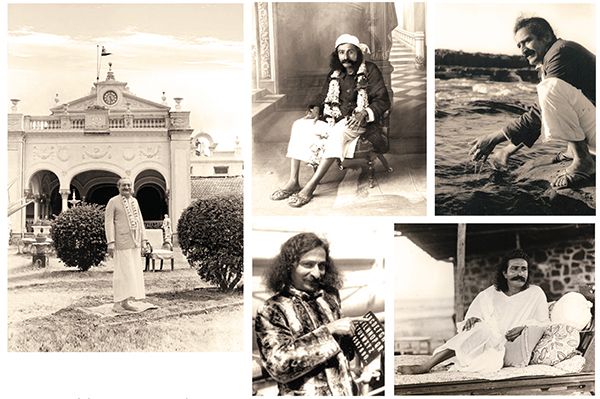
Favorite images of Meher Baba
In 1958 Baba issued what he called His universal message and this is what He said…
"I have not come to teach but to awaken. Understand therefore that I lay down no precepts. Throughout eternity I have laid down principles and precepts but mankind has ignored them. Man’s inability to live God’s words makes the Avatar’s teaching a mockery. Instead of practicing the compassion He taught, man has waged crusades in His name, instead of living the humility, purity and truth of His words men have given way to hatred, greed and violence. To get nearer to God you have to get further and further away from I, my and mine. You have not to renounce anything but your own self. It is as simple as that, though found to be almost impossible. It is possible to renounce your limited self by my grace.
"I repeat, I lay down no precepts when I release the tide of truth which I have come to give. Men’s daily lives will be the living precept. The words that I have not spoken will come to life in them.
"I am the divine beloved who loves you more than you can ever love yourself. What had to happen has happened; and what has to happen will happen. There was and is no way out except through my coming in your midst. I had to come and I have come. I am the Ancient One.”
Baba’s universal message has a touch of authority and it is startling to those who do not believe in his divinity. The cosmic implications of Meher Baba being the Avatar of this age might seem utterly unreasonable; to some it may even sound absurd. Is it therefore possible that this remarkable individual who touched the hearts of millions the world over was living in a state of delusion? Sir Thomas Hopkinson, a famed journalist of the Second World War in his book Much Silence does not think so. Neither does Charles Purdom of Garden City fame in his book The God Man think so, nor does Alan Cohen, a famed Harvard professor of psychiatry in his book The Mastery of Consciousness think so. Irene Conybear, daughter of the man who wrote the famous text book of medicine talks about Baba in her book, "The notion of avataric reappearance is reasonable according to messianic expectations of most major religious traditions.” Even the apocryphal New Testament in one passage says that Zoroaster prophesied the coming of Christ. Moses foretold the advent of Jesus. Both Mohammed and Jesus alike indicated that they, or one like them, would come again. The followers of Mohammed are now expecting the return of the Mahdi and the Hindus are watching for the Tenth or Kalki Avatar, while Christians are still looking for the second Advent. Today the Buddhists are gathering together in expectation of the return of the Buddha; for did not Gautama say, "There will be Buddhas after me”? He also stated that "2,500 years after me, my law will have known its end. Another Buddha, the Greatest of them all, will come into the world. He will regenerate it and establish the new law.” Cohen writes in his book, "One cannot help but think in retrospect of the millions who knew of Mohammed and Jesus and the Buddha but who failed to accept them because the chance seemed so slight that the avatar, or even a great spiritual teacher, was really at hand.”
Francis Barbazon, the celebrated Australian poet who spent long periods with Baba in Ahmednagar as a member of the mandali, writes, "Of course I know that Baba, as everyone affectionately calls him, had been saying for many years that he was an incarnation of the Godhead, a God man… and I knew that the Sufi order and thousands of people everywhere, in India, in Europe and in the United States had recognized his claim, but as with (doubting) Thomas, I had to see for myself. Well I have seen, and the cry of the deepest part of my consciousness has been answered. I was satisfied that if ever it was possible to see God on this earth, I had seen Him. And as time went on, the proof that this had not been some emotional conversion was shown by the simple fact that a true creativity began in me a few days after this meeting and has continued ever since. Since beauty and knowledge has been the only God that I have worshipped or pursued and since this man appeals to my eyes as the very embodiment and manifestation of perfection, I call him God. Not only the all forgiving, the understanding, the humor and love in his eyes, but the very movement of his hands and body, have unlocked regions in my mind which were unknown to me before. No man or woman, no flight of thought, no aesthetic experience, no sublimity of nature, has touched the depths of me as this man has. I have known no one, or experienced no experience which has both melted my heart and sharpened and satisfied my intellect as he has.”
Peter Townshend, composer and musician of the famous "Who” group, in a letter to Baba lovers has said, "Baba taught me that all life and living was an illusion and only God and love is real.”
The path of knowledge
Baba gives a lot of importance to loving and obeying him since this is a way of destroying one’s ego. Once your ego is destroyed or is weakened, sanskaras (bindings) of the soul are diminished. Through various rebirths once these sanskaras are wiped clean, the soul merges with the over-soul or God and ceases to reincarnate. That, in the ultimate analysis, is what this game is all about.
Baba says there are three paths to God realization, the paths of knowledge, love and action respectively.
The path of knowledge is not merely an intellectual path but the utilization of the faculties of the higher mind which leads to external renunciation which the yogis practice. Baba explains that external renunciation means giving up the world. This is very different from internal renunciation which Baba prefers, where one lives in the world but is detached from it. Toru Dutt expresses this beautifully when she says: "Not in seclusion, not apart from all,/Not in a place elected for its peace,/But in the heat and bustle of the world,/’Mid sorrow, sickness, suffering and sin,/Must he still labor with a loving soul,/Who strives to enter through the narrow gate.”
External renunciation can be achieved through various types of yoga, or through meditation. Baba does not recommend the path of knowledge.
The path of love is the spiritual path for love is the heart of the spirit. Love is absolutely central to the way to Meher Baba. Here one is not talking of the lower forms of love which are detrimental to spiritual progress for they create strong bindings or sanskaras. Baba is talking of the deep and intense love of bhakti or devotion that develops into all-pervading, unconditional love for all things animate and inanimate, which ultimately leads to God realization.
The path of action places priority of behavior over thought or feeling. This is called karma yoga, where the aspirant works in the world but without attachment to the work or its results, both being left to the will of God (Baba). These aspirants will fight to protect the weak from the cruel aggression of the strong, ready even to lay down their lives for others. As the Bible says, "Greater love hath no man than this, that he lay down his life for his fellow men.”
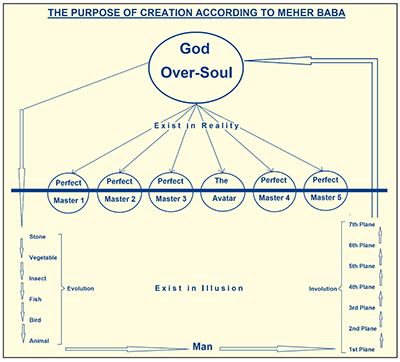
Most interestingly, the old creation vs evolution debate has so conditioned us to believe that one either believes in God i.e. in creation, or in science i.e. in evolution; however Baba incorporates the evolutionary process into his philosophy of creation showing us that the two are not incompatible.
At the beginning of time nothing existed but God or the Over-Soul. He created of Himself and creation went through a process of evolution from stone to vegetable to insect to fish to bird to animal. Ultimately, through the evolutionary process, emerges man. Man goes through a process of involution passing through seven planes. In the fifth and sixth plane man appears God-intoxicated. Baba calls these individuals "masts.” When on the seventh plane man becomes God-realized and merges with God. This cycle of reincarnations now ceases. Baba explains that, since he creates of himself, what he creates must return to him.
At any time in the universe, there are five perfect masters. They are God’s men in charge in the universe and through them He does His work. These five are selected by God from souls on the seventh plane who have already merged with God. Every so many hundreds of years God manifests in human form on earth and He is called the Avatar of that particular age. When the Avatar and the five perfect masters drop their bodies they merge again with God. The five perfect masters take on a subsidiary role when the Avatar manifests.
Only God exists in reality. The Avatar and the five perfect masters exist both in reality and in illusion so that they can do their work in the universe. Man and all else live in a state of illusion.
Meher Baba says, "Do not try to understand me, love me for I am beyond understanding.” Meher Baba in all his discourses says "I know.” We ordinary mortals cannot know, therefore we can only believe or disbelieve. As the saying goes: "For those who believe no proof is necessary, for those who don’t no proof is enough.”
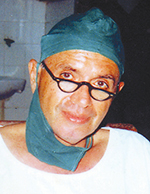 Dr Hirji Adenwalla is head of the department of Plastic Surgery, Burns and the Charles Pinto Centre for Cleft Lip, Palate and Cranio Facial Anomalies at the Jubilee Mission Medical College in Trichur, Kerala.