
Tribute
The humane healer
Pediatric surgeon Dr Hirji Adenwalla transformed faces and lives
I write this memoriam in honor of Dr Hirji Sorabh Adenwalla who lived for 90 glorious years and passed away peacefully on May 27, 2020.
He was a man in a million; he was my best friend. I first met him one afternoon during recess on the playing fields of St Mary’s High School in Bombay. Boys from the higher classes were playing cricket. Hirji Adenwalla, who had newly joined the school,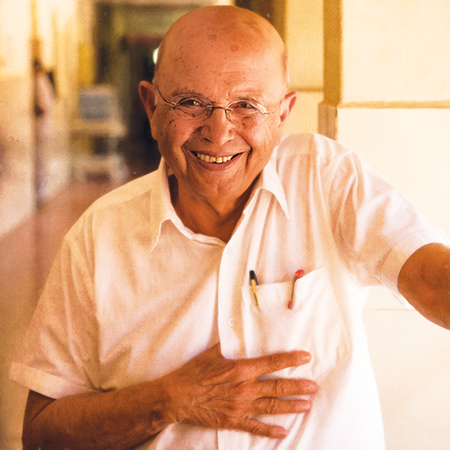 badgered the seniors to allow him to bat. Finally they agreed and decided to ask the fastest and best bowler of the School, four to five years Hirji’s senior, to bowl to him and teach him a lesson. This big, strong boy came thundering down bowling a well-pitched scorcher. Hirji put his left foot forward and smacked the ball with a beautiful off drive for four. This is when we became friends. We have been best friends for more than 80 years. Incredible as it may sound; there has never been even a hiccup or one harsh word.
Hirji passed out from G. S. Medical College, K.E.M. (King Edward Memorial) Hospital and joined the pediatric unit at the adjacent Jerbai Wadia Hospital. He trained for four years as a senior registrar under both Dr Rustom Irani and Dr Charles J. T. Pinto — the former a general pediatric surgeon (Hirji said of him "On his good days there was no one who could beat him”), and the latter a pediatric plastic surgeon. He was extremely fond of both. I was at that time a senior registrar in medicine at KEM.
Undergraduate days, the years spent in hospitals as house physicians and registrars, as also the short, boisterous holidays spent in his hometown Ahmednagar, were some of the happiest times of our lives — fun, mischief, many escapades, yet a devotion and dedication to our work.
He fell in love with a beautiful young girl named Gulnar, whom he used to meet in Ahmednagar during our short holidays, and married her in 1960. He responded to an advertisement for a surgeon at the Jubilee Mission Hospital in Trichur, at that time a forsaken spot in Kerala. He confided in me that he wished to be as far away from Bombay as possible.
He was a man in a million; he was my best friend. I first met him one afternoon during recess on the playing fields of St Mary’s High School in Bombay. Boys from the higher classes were playing cricket. Hirji Adenwalla, who had newly joined the school,
badgered the seniors to allow him to bat. Finally they agreed and decided to ask the fastest and best bowler of the School, four to five years Hirji’s senior, to bowl to him and teach him a lesson. This big, strong boy came thundering down bowling a well-pitched scorcher. Hirji put his left foot forward and smacked the ball with a beautiful off drive for four. This is when we became friends. We have been best friends for more than 80 years. Incredible as it may sound; there has never been even a hiccup or one harsh word.Hirji passed out from G. S. Medical College, K.E.M. (King Edward Memorial) Hospital and joined the pediatric unit at the adjacent Jerbai Wadia Hospital. He trained for four years as a senior registrar under both Dr Rustom Irani and Dr Charles J. T. Pinto — the former a general pediatric surgeon (Hirji said of him "On his good days there was no one who could beat him”), and the latter a pediatric plastic surgeon. He was extremely fond of both. I was at that time a senior registrar in medicine at KEM.
Undergraduate days, the years spent in hospitals as house physicians and registrars, as also the short, boisterous holidays spent in his hometown Ahmednagar, were some of the happiest times of our lives — fun, mischief, many escapades, yet a devotion and dedication to our work.
He fell in love with a beautiful young girl named Gulnar, whom he used to meet in Ahmednagar during our short holidays, and married her in 1960. He responded to an advertisement for a surgeon at the Jubilee Mission Hospital in Trichur, at that time a forsaken spot in Kerala. He confided in me that he wished to be as far away from Bombay as possible.
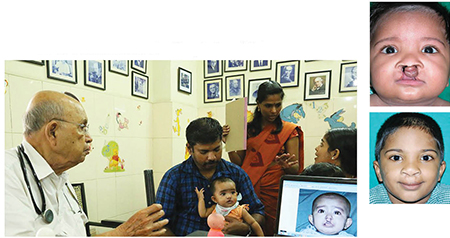
Top: Dr Hirji Adenwalla; above: with patients;
child with cleft lip before and after surgery
It was in Trichur that his life’s work began. He wrote to me that the 15-bed Hospital was a mere shed with a roof, an operation theater with open windows looking out on a dusty road, with the headlamp of a car fixed to the ceiling serving as light for surgery. There was no lab technician, no adequately equipped laboratory, no anesthetist. He trained Gulnar to maintain the anesthesia after he had first induced the patient. He practiced medicine, surgery, pediatrics, orthopedics and even performed Caesarian sections when needed. The Hospital slowly grew; he gathered like-minded men and women around him. I remember in particular Dr Yazdi Mistry, a surgeon and his wife Gool, who became his favorite anesthetist. The "shed,” as he called it, has grown today into a huge institution with flourishing specialties and sub-specialties. It would never have been so had it not been for my friend deciding to work there.
Hirji took a very short sabbatical in Bombay, and passed his MS exam. In the course of time he set up an excellent burns unit with the help of his friend and colleague Dr M. Keshwani. He now concentrated first on pediatric surgery and finally on plastic surgery for correction of harelip, cleft palate and craniofacial anomalies. His mentor was Dr Pinto who would come down from Bombay to Trichur for plastic surgical work on patients Hirji had selected. Hirji set up the C. J. T. Pinto Plastic Surgery Unit in memory of his mentor. Hirji finally decided to solely practice the super specialty of correction of harelips and cleft palates and craniofacial abnormalities and continued to do so all his remaining days.
There are many surgeons who have practiced their art and craft all their working years. My friend was unique. He was a humanist. He recognized, understood and felt the pain and torment in a child whose face was deformed and had a hole in the roof of the mouth, as also the agony of parents whose children suffered this deformity. He did his best to relieve this suffering. He did not speak the local language, so always had an interpreter; but his eyes, his hands, his bearing, his smile, gentleness and genuine empathy were so evident that it did not matter. I believe his inability to speak Malayalam may have worked to his advantage among the poor he tended.
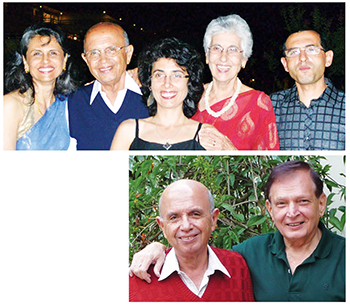
Clockwise, from top l: Homai Kumaravelu, Hirji, Meher Verghese,
Gulnar, Firdaus; Dr Farokh Udwadia with Hirji
When I would visit him in Trichur and see the results of his surgeries I would tell him that his corrected harelips and cleft palates looked perfect. "No, not quite perfect,” he would answer. It was the joy of pursuing perfection that mattered to him. It was like a love affair never quite consummated; a utopian dream he had to pursue.
We both used to get literally "zero” marks in drawing exams all through school, but Hirji turned out a true artist as a surgeon; he cut slowly, delicately, gently, with precision; he cut in order to heal. He and his team performed about 22,800 surgical procedures.
He felt bliss at seeing a child’s or infant’s face restored, to view a smile that was normal, to realize he had changed a life. This was his reward. He shunned fame and publicity, was incapable of a base act. Generous to a fault, he never pandered to the affluent and powerful. He rarely met them socially, and when he did I sensed he was on guard! Gentle but highly principled, he would pick a quarrel unhesitatingly if he saw even a stranger talking rudely to a domestic help or being cruel to a dog. Yes! He loved dogs; he always had one right up to the end.
Eventually the surgical fraternity took note of his achievements. Eminent professors from various disciplines all over the world came to observe, study and marvel at his dedicated work. To his great fortune, "Smile Train” who knew of his work, funded his surgeries. The financial worries were alleviated. The young man who started work as a surgeon in a remote corner of the country received his due recognition both as an outstanding surgeon and a caring human being.
In true Oslerian tradition (Sir William Osler was a great physician, a superb writer and thinker of the 20th century), he believed like me that the practice of medicine and surgery was more than just a profession; it was "a calling in which your heart will be exercised equally with your head.” We both felt that in spite of the great advances in science and technology, the profession had now lost its ethical moorings. It had turned into a business where the pursuit of money was more important than the welfare of the patient.
We shared common loves — history, literature, poetry, medicine. His hero in the field of medicine, remarkably enough like me, was not a surgeon, but Osler, a physician. Lord George Byron was Hirji’s favorite poet — he could recite Child Harold’s Pilgrimage by heart. We shared a common hero in Napoleon Bonaparte, but he also liked Sir Winston Churchill for his determination, doggedness and oratory. We would often exchange quotes and, both being avid readers, we would often pinch books from each other’s libraries.
Cricket was his passion — not the 20-over or the one-day game, but the five-day gentleman’s Test matches where not just skill but the character of a player was on display. He talked about Sir Don Bradman, Harold Larwood, Victor Trumper, Wally Hammond, C. K. Naidu, Ranjitsinghji, Mushtaq Ali and even Sachin Tendulkar as if he knew them personally and had actually witnessed their expertise.
We often discussed over the phone some of his post-operative cases where children had not done as well as expected, or some poem, literary piece or history he had read. Letters would follow, replete with quotes he had come across, or charming poems he had chanced upon.
He had great faith in Meher Baba — he was the Avatar. But to me he (Hirji) was the most outstanding Zoroastrian I knew. His life was a prayer to the Lord, supported by good thoughts, words and deeds.
My wife Vera and I will never forget the enjoyable lunches we shared at each other’s homes in Coonoor; the breakfasts laid out by Gulnar on the outdoor veranda, on a large wooden table facing a peaceful garden with the melodious twitter of birds all around. Beautiful memories to fall back upon in tired times. Gulnar was not only his great love but his great support. He could never do without her. She allowed him to dream but also saw he awakened to reality.
When does one call a man happy? To me, when he loves his wife deeply — as he did Gulnar who in return loved him deeply; when he loves his children and would do all for them; his three children, Homai, Firdaus and Meher, loved and adored him; when he is passionate about his work; when he lives, as he did, with unblemished honor and integrity; when he never looks away from the inequity and sadness of so many poor lives around him but strives to make a difference, bringing joy where there is sorrow; when he enjoys the simple pleasures of life, is content and has given love and happiness to many — his work spoke for him; when he has at least one loyal and trustworthy friend, which indeed he had.
The medical fraternity has lost an excellent, dedicated surgeon. The world has lost a wonderful human being, a man in a million who many will forever remember.
Rest in peace my very dear friend.
"His life was gentle and the elements so mixed in him that nature might stand up and say to all the world, this was a man.”
◆ ◆ ◆
From the archive