
My tryst with clefts
Smile Train has funded countless cleft palate affected patients throughout the world
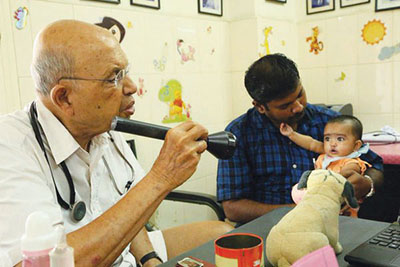
Dr Hirji Adenwalla examining a child
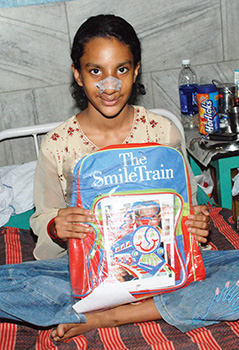
A post operative patient showing off her Smile Train bag
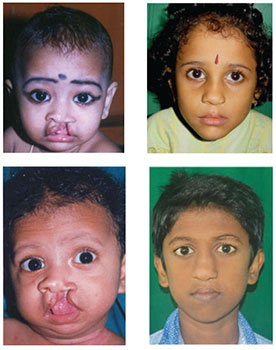
Children to be operated on and operated
I had one look at the newspaper cutting and threw it into the wastebasket. My wife Gulnar picked it up and wrote a long letter to Wang about my work and the volume of cases that I had repaired. She sent this letter to Wang’s hotel address in Delhi, where he was staying. I kept telling her that this was an exercise in futility and that she would not get a reply.
To my surprise I got a call from Delhi one Sunday morning, from a lady by the name of DeLois Greenwood who said that Wang had asked her to check on me. She put me through a grueling interview on clefts.
Cleft lip, palate and other deformities of the face and other congenital anomalies in children were always my prime interest. Cleft lip and palate occur when a baby’s lip or mouth does not form properly during pregnancy. For these conditions I was mainly trained by eminent surgeons like Drs Charles Pinto, Rustom Irani, Rustom Katrak and Arthur de Sa at the Bai Jerbai Wadia Hospital for Children in Bombay. When I first came to the Jubilee Mission Hospital in Trichur from Bombay in the year 1959, I was reasonably well trained in pediatric surgery and in the plastic surgery of those days. Things were very primitive in the Hospital to start with but as the work increased, a single doctor hospital became a multi-specialty centre. As the surgical staff in my department grew, I moved away from general surgery and concentrated more on the treatment of burns and other general plastic surgical problems, including clefts.
Sometime in the late 1990s, I met Prof Patrick Bolten, past president of the Royal College of Surgeons of Edinburgh and he advised me to narrow my field if I wanted to keep abreast with recent advances. It was then that I decided to restrict my work to cleft and craniofacial surgery and started a department called the Charles Pinto Centre for Cleft Lip, Palate and Craniofacial Anomalies. The quantum of work began to increase, the patients were very poor and though the Hospital was very generously subsidized, I was always short of funds. There was a period when I received monetory support from Dutch organizations called Simavi and the Rotary Club of Dokkum. But the funds were never enough. In spite of this, we managed, and never ever was a patient turned away.
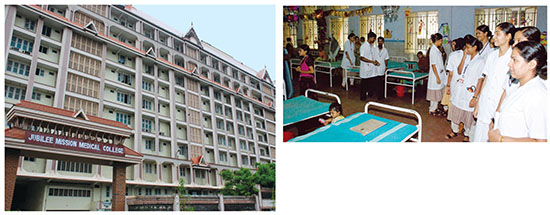
Jubilee Mission Hospital complex; (Right) Children’s ward of the Hospital
A few months after Greenwood’s call, Satish Kalra walked into my consulting room, which was like a village bazaar (it still is) and introduced himself as the regional director of Smile Train. He had come to inspect my department and sign a contract with me, to make my department the first partner of Smile Train in India. I said, "Satish, I am delighted but what does this entail?” He said, "We will fund you a substantial amount per case. We will equip you with whatever you need to upgrade your department, set up an ICU (intensive care unit) for you, for our prime concern is quality and patient safety.” "Satish,” I said, "I am so pleased.” To which he replied, "Doctor, in return I have a request. I have just retired from a senior position in a big Indian company. I know nothing about cleft deformity. I want you to teach me everything about clefts.” That day he sat in my office with a pad and pen till late in the evening, and I told him all about the deformity and how I proposed to go about tackling the cases. When I met Kalra three months later he could tell me a thing or two about clefts which I did not know. Such was the mettle of the man.
Thus the real cleft work started in a big way. Cases just poured in, most of them abject poor mothers in distress hiding their children’s faces. The transformation after surgery was so dramatic that parents left grateful and in smiles. The quantum of work demanded that I take in more surgeons. I appointed three other surgeons to do the soft tissue reconstruction. One more to do only the bony and dental work which is necessary to restore these children to normal. A speech therapist, a speech pathologist and an orthodontist came on to the team in stages. Nearly 20,300 children’s faces have been restored to normal in this department. (In the last 17 years Smile Train has performed over 5,00,000 free cleft surgeries with 300+ partners in India and over 180 partner hospitals.)
I am now 87 years old. With God’s grace I still operate, teach and consult for 15 days in the month. The rest of the time I spend with Gulnar in Coonoor. Without her initiative, support, understanding and inspiration, none of this work would have been possible. We are now recognized as a partner for training in cleft lip and palate deformities by the DAFPRS (Dutch Association of Facial, Plastic and Reconstructive Surgeons) and get Fellows from all over the world.
Visitors to my department who know that I have been a versatile general surgeon inquire whether I am bored, having restricted myself to this small super-specialty in plastic surgery. The answer is: No. Those of us who work with these children and their parents are deeply affected by the pathos of their lives and the distress that their families go through. When all is done and a child looks good and speaks well, the reward is beyond compare. Besides, if perfection is one’s goal then nothing can be more challenging than the repair of a wide cleft lip and palate.
I end with a poignant story. A child born blind, was brought to us with a bilateral cleft lip and palate. The child was also speech and hearing impaired. We explained to the mother that there was no point in putting this child through major surgery as the child would never be able to see and speak. The mother, a bright and smiling lady begged, "Doctor, at least repair the lip, my child will then look normal.” We repaired the lip and the mother was thrilled with the result. The night I drafted this article I made my nightly visit to the ICU. As I was leaving the ICU, I patted the child’s head. He was half asleep but he grabbed my hand and kissed it. The mother explained that this was his way of saying "Thank you.” "How does he know?” I asked. "Oh, doctor,” said the mother, "you would be surprised as to how much he is aware of his surroundings and what is happening to him.” I left the ICU in tears and said to myself: "I was wrong, I must repair this child’s palate too.” There is one thing about this mother, I have never seen her without a smile on her face and this mother has nothing to smile about.
The birth of Smile Train

A group of forward thinking people like US entrepreneur Brian Mullaney, Greenwood, Wang, Hollywood actress Candice Bergen, and US president George Bush, senior and others thought that it would be a better idea to break away from Operation Smile and start a new organization called "Smile Train." This organization would partner surgeons in their own country, train, equip and fund them for the cases that they do. There would be a rigid quality and safety protocol monitored by a local advisory board and a central one in New York. Smile Train was born in mid 1999. Wang was one of the major donors. The work first started in China. In the year 2000 the first department to be partnered in India was The Charles Pinto Centre. Now there are over 180 departments spread all over the country and over five lakh children have been restored to normal appearance and function. Globally the number of surgeries has exceeded a million at 1,100 centers in over 85 countries. All these repairs have been performed totally free under safe conditions and the quality of the results compares favorably with the standards laid down by experts in this field. Smile Train does not accept any funding from any national, government, religious or political organization and has absolutely no hidden agenda. The New York Times calls it "one of the most productive charities — dollar for deed — in the world."
Gift a smile to children born with clefts by donating to Smile Train, India. Donate online on: www.smiletrainindia.org. Payments accepted by debit card, credit card and online banking. For donations by mail write to: Smile Train India, Plot No. 3, LSC, Sector C Pocket 6/7, Vasant Kunji, New Delhi 110070. Cheques should be made in the name of Smile Train India.