
Books
Relevance of a ritual
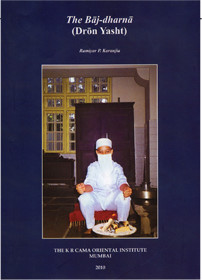
The Bâj-dharnâ (Drôn Yasht). A Zoroastrian Ritual for Consecration and Commemoration. History, Performance, Text and Translation by Ramiyar Parvez Karanjia. Published in 2010 by The K. R. Cama Oriental Institute, 136, Bombay Samachar Marg, Fort, Bombay 400023. Pp: 274. Price: Rs 800.
This is the first complete book in English on the Bâj-dharnâ (Drôn Yasht) with all the previous works being written primarily for the priesthood; no known translation of the accompanying text currently exists in any language. Recognizing the importance of such a project, Ervad (Dr) Ramiyar Karanjia, principal of the Dadar Athornan Institute has explained the ritual. This handsome book with 11 color photos has a preface, an introduction, three main chapters on "Purposes and Functions,” "Requisites and Performance,” and "Text and Translation” as well as a concluding section entitled "Epilogue: Lessons Beyond Words.” It also has sections on abbreviations, a glossary and a bibliography that focuses on the performance of this ritual and also "explores the significance of the varied performances for different purposes, and gives a detailed account of its history, transmission and performance on the basis of Pahlavi and Persian texts. This work also documents the minor differences in text and performance observed in the various priestly traditions.”
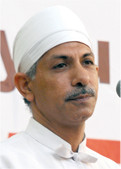
Ervad (Dr) Ramiyar Karanjia: insider knowledge
The Drôn Yasht referred to as the Bâj-dharnâ in India (the colloquial Parsi Gujarati verbs for the performance are injvu- "to consecrate” or dharvu- "to hold”) is a widely performed ritual for consecration. Karanjia’s research on this important area of ritual studies began with a Fellowship at Uppsala University in Sweden in 1999 with an invitation from Prof Anders Hultgård and Dr Michael Stausberg from a grant provided by the prestigious Wenner-Gren Foundation dedicated to the advancement of anthropology throughout the world. The work continued at the University of Heidelberg in 2002-2003 as part of the DFG Project with the continued support of Stausberg.
Before addressing the importance of the topic and the work more generally, it should be stated that Karanjia’s book has several features that make its detailed and thoughtful presentation more user friendly and should become standards in the field. In the bibliography Karanjia translates the titles of the Gujarati works, thus bringing greater attention to the importance of Parsi scholarship in Gujarati. Karanjia also wisely uses the Avestan transcription as established by Karl Hoffmann and the Pahlavi transcription put forth by David Neal MacKenzie, both of which are now standards in the field. Karanjia cites his collaboration with various non-Zoroastrian scholars such as Stausberg, Hultgård, Almut Hintze and Helmut Humbach. He also thanks Dastur (Dr) Firoze Kotwal and Mobed Mehraban Firouzgary from Tehran for providing him with invaluable information about current practices in both Zoroastrian communities. It is to his credit that Karanjia has solicited the expertise of so many experts and the book’s particular focus on practice speaks to his strengths as both a scholar and a priest.
From the perspective of textual scholars of Zoroastrianism, Karanjia’s work is particularly important for understanding one of the most frequently performed rituals by establishing the text of the accompanying ritual. This unfortunately was not included in the Avesta editions of Niels Ludwig Westergaard (1852-1854) and Karl Friedrich Geldner (1896). Westergaard and Geldner did not include the Bâj-dharnâ in their editions since it was considered as an abbreviated part of the Yasna (Ijashne). Karanjia is therefore the first person to seriously examine the differences between the two texts (the Drôn Yaðt is done without performing the Gathas). The ritual requirements like drôn, goshodâg, water and some fruits are common to both though the ritual implements and acts like pressing the hôm in the Yasna (Yaðt î meh "the Great Yašt”) and the Drôn Yaðt (Yaðt î keh "the Little Yašt”) are in fact different.
Bâj-dharnâ is the Gujarati translation of the Pahlavi wâz-griftan "to take the Bâj” which is primarily performed in the urwîs gâh — the 8 x 5 foot rectangular area where inner rituals are performed — generally adjoining a fire temple. As a consequence, fully qualified priests are often referred to as bâjgîr in Parsi priestly parlance. The ritual of the Bâj-dharnâ is now performed by one priest and generally should take 20 minutes to complete, being an essential prerequisite for other inner rituals (those performed in the fire temple as opposed to those that are generally done outside). A variation of the ritual is performed by the laity and women as a form of religious service for meals. The ceremony is an old one and can be traced back to Sasanian times with extant texts like the Cim î Drôn ("Meaning of the Drôn”); portions of the Ardâ Wirâz Nâmag and the Nçrangestân; Chapters 12-13 of the Pahlavi Rivâyat Accompanying the Dâdestân î Dçnîg; and the Pahlavi Rivâyat of Farnbag-Srôð (1008 CE) which is almost exclusively devoted to it.
In his discussion of the usage of this ritual Karanjia points out in his Introduction that it frames acts and prayers like eating, drinking, sleeping, bathing, and answering calls of nature. The bâj is also used for inviting friends and family in honor of the departed. "Taking bâj” also represents a particular mode of speech in a suppressed or subdued tone used to recite Pâzand (late middle Persian/early classical Persian written in the Avestan alphabet) passages between Avestan texts in prayers and rituals. In Persian this practice is referred to as be bâj guftan ("to speak with Bâj”) or bistâ ["spoken with closed (lips)”], often referred to by Muslim authors as zamzame.
In his second chapter Karanjia suggests that the purposes of this ritual for the laity "may be theological, like venerating divine beings, it may be ecclesiastical like initiating a candidate into priesthood, or it may be socioreligious like celebration of certain events and festivals.” He divides these into six categories: Invocation of Divine Beings; Consecration; Commemoration of persons and events; Part of a Set of Bâj; Part of a group of rituals; and Special Purposes. Karanjia’s survey provides examples of special circumstances and Iranian practice, as well as variants in performance and he discusses when certain bâj are no longer performed. His survey includes more than 40 different divine beings and he discusses invocations with multiple divine beings as well as the consecration of items "related to ritualistic or eschatological purposes.”
In his third chapter focusing on requisites and performance Karanjia argues that "a Zoroastrian ritual is often a means to re-create the perfection inherent in the spiritual world after the end of this period of mixture (Pahlavi gumezisn) between good and evil.” He also discusses the symbolism of the ritual and states that "in the Bâj-dharnâ the creations are represented as follows: Humans by the priest, animals by the gôshôdâg, metals by ritual utensils, earth by the demarcated furrowed area, plants by fruits and drôn. Water and fire too are present, completing the heptad of creation.” Perhaps the strongest feature of Karanjia’s book is his insider knowledge of Zoroastrian rituals. This is evident throughout the work but one example is worth mentioning. He makes the observation that unmarked drôn should be called frasast but that older scholars like Martin Haug, Sohrab Bulsara, Dinshah Kapadia and Edward West conflated the two due to their reliance on ancient texts. He points out that the ritual implements are now made of an alloy called German silver and he provides a very useful list with their Pahlavi, Persian and Gujarati names. It would be well worth knowing what materials were used to make the utensils in earlier days. Karanjia also provides a strong historical focus to his study by discussing ritual requisites that are no longer being used in current practice; e.g. wine (used in Navsari till the late 19th century), sprahm (herbs), citron, garlic, salt, rue, and liquor-koumiss and apple juice. Karanjia’s detailed descriptions of priestly garments will prove to be highly useful to scholars interested in the Zoroastrian priesthood and ritual practice.
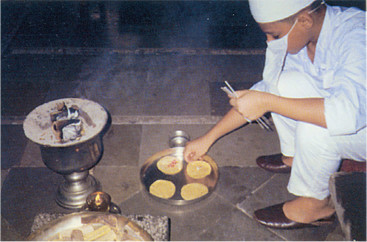
A bâj ceremony in progress
In his fourth and final chapter Karanjia provides us with the text and translation for the ritual. He discusses questions of transmission, the manuscript tradition, printed books published in India and he even provides readers with a very useful summary of the printed texts in table form. Most crucially, he provides a new division of the text giving the ritual "a character and identity of its own” thus providing "a definitive structure and meaning to the text in context of the ritual.” He does note the conservative nature of the Zoroastrian priestly tradition however when he states that: "no noticeable difference has been witnessed in the text of the ritual or the ritual acts as it is used now and as it appears in the manuscripts.”
In his Epilogue Karanjia lays out some of his most explicit statements about what he believes Zoroastrian rituals are about and he contrasts this with the common view that rituals are "mindless repetition of meaningless acts.” He argues that "much of Zoroastrian philosophy and theology is woven into rituals at theoretical as well as practical levels” and he suggests that rituals "were viewed as vehicles to convey ideas that were sublime and beyond words, beyond a cognizable logical structure, beyond tangible metaphors and of an entirely experiential nature.” He goes on to state that rituals "serve the purpose of transferring the consciousness of the person and the participants, to a realm where the presence of divine beings can be perceived when they are invoked and subconscious channels of communication open up with the divine world during their performances.” Karanjia closes this impressive book by arguing that "the climatic progression enunciated in the ritual, of the thought culminating into speech and finally ending into the act of ritual tasting, can be seen as a reflection of the Zoroastrian maxims of humata, hûxta and huuaršta "good thoughts, good words and good deeds.”
This book is a highly successful marriage of a dedicated priest and a talented scholar in the person of Karanjia. The book also represents a milestone in Parsi scholarship on Zoroastrianism and will serve as a resource to scholars and laypeople alike for many years to come. The author and the publisher, The K. R. Cama Oriental Institute should be commended for providing us with such a fine volume and it is hoped that such collaborations between well-respected institutions and energetic priest-scholars continue to produce interesting and valuable works.
DR YUHAN SOHRAB-DINSHAW VEVAINA
◆ ◆ ◆
From the archive