
Life-Style
Pages from the past - II
Engaged in farming, running liquor shops or working as forest rangers the Parsis of old worked hard, ate heartily and often paid for services by barter
In those early days of the last century when electricity was unheard of and a fanas (lantern) was the commonest source of light, the laid-back Parsis still maintained a lifestyle that differentiated them from other communities. These reminiscences, serialized over three instalments, evoke the sights and flavors of that era. The first instalment described the habitation and attire of the Parsis of yore. The second instalment, here, refers to their modes of livelihood and the communication facilities then available. The last instalment will refer to the rites and rituals observed, their values and beliefs.
Communication and transport
The villages were irregularly serviced with the semblance of a postal facility called "Kasad.” A sort of postman wearing a khaki shirt and short pants carrying a staff studded with ghungris (small bells) at the top would cover long distances from village to village, constantly running at slow pace. He would take your post, if any, on his return. The service cost two-three paise in olden times! A telegram meant bad news and was rare to come by. Some Zoroastrian families would get their copy of a newspaper, of course after a delay of four-five days. The most popular was Sayaji Vijay published from Baroda. Jam-e-Jamshed and Kaiser-E-Hind weeklies came later. In some houses one spotted The Illustrated Weekly of India, Reader’s Digest or Life brought by a city dweller visiting the village during a vacation.
Roads being almost non-existent, the main vehicle of transport was a cart or a horse driven carriage. If one had to visit relatives in Surat or Bharuch, the sojourn would start at 4 a.m. and halt by mid day near a water hole to have food and some rest. A roadside kitchen would offer khichri and tomato brinjal shaak with dried bumla (Bombay Duck) — an unforgettable delicacy.
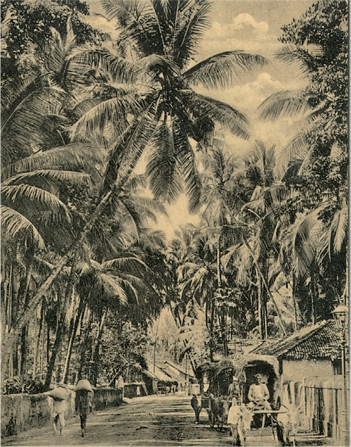
A palm lined village road
High calorie intake
From earliest times we were known to be good eaters in the habit of partaking high calorie food. On some days the breakfast would be the previous night’s left over juvar ni rotli (chappaties made of jowar) and a big cup of tea. At other times bhakhra, puri or chaapat. When the men were away in the fields lunch was sent to them — rice, dal, onion, pickles, etc. Mori dal or khichri would have an extra topping of pure ghee.
During season toddy was enjoyed in plentiful. Some would drink only from a particular Khajuri tree, while others liked the stuff warmed up overnight. Those living close to the railway track would oblige a train driver or guard friend with a bathiyu(pot)ful of fresh toddy.
Goat meat, shikar meat, poultry, fish and a very tempting king size lobster would also form part of their cuisine. One gentleman was so fond of fish that he would go every morning to catch some — a practice he indulged in till an advanced age. During the monsoon, with a decline in the availability of meat and fish, dried salted fish, kolmi (prawns) and bumla were considered delicacies. On certain occasions roasted meat, bhujan, sota nu gosh or patrani machhi would be offered as a feast. Smoked machhi, covered with a thin cotton cloth and secured with a thread, cooked under hot wood ash containing small bits of atash tasted exquisite. Sota nu gosh would be prepared with a large chunk of marinated meat pierced with three-four foot long metal skewers and roasted on red hot atash burning in a pit in the open. This was a dream menu meant for special events.
During mango season, the ladies of the house along with some from the neighboring village would get together to prepare pickes and papads for the whole year, laborious and tiring work. They would prepare pickles like methiyu, paaninu, chavchav nu, gor keri nu, bamboo shoot nu, gharab nu, machhi nu and even green lavang nu achar as well as papads by the hundred.
Economics and finance
The main sources of livelihood were farming and tadi-daru ni dukan (alcohol shops). The crops cultivated were jowar, wheat, rice and pulses. The cash crops were tobacco, til (sesame seeds), chickpeas, cotton and groundnut. The elders had the uncanny skill of forecasting arrival of the monsoon by spotting changes in the color of the leaves of certain trees. They would also forecast with fairly remarkable precision whether there would be vèpariyu varas (intermittent rain) or lilo dukal (very heavy rain).
In the Gaekwadi state, the auction for the tadi-daru ni dukan would be conducted during the monsoons in Navsari in Dhadaka no Bungalow. Some would participate in the bidding only to hike the bidding amount and settle scores with their competitors. The main distillery called FUD was at Navsari and was owned by Fanibunda and Gyara who distributed the products to all the depots in the state. The basic ingredient was mahuva fruits from which Rasi, Bevdo and Masalano varieties of alcohol were produced and sold to different vendors in wooden casks. One year it so happened that the mahuva crop was poor and the distillery was forced to look for an alternative ingredient. On learning that alcohol can also be made from jaggery they decided to try it but lacked the knowhow which was ultimately obtained from the state of the Nizam. The consumers were mainly local tribal menfolk who would come to have some drinks in the evening after a hard day’s work.
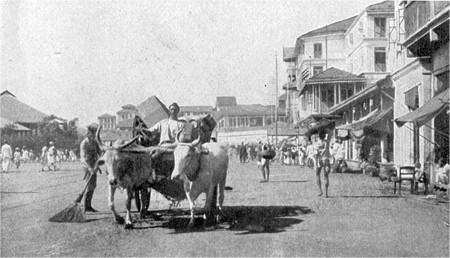
Bullock carts were a common form of transport
The toddy season used to last for around eight months, roughly from October to May end. The toddy tappers had to leave home by 4 a.m. so that the product was available for sale by 8 a.m. Winters being very harsh, in certain families the boys who were on this job had compulsorily to drink a glass of milk with one egg and a peg of alcohol to keep warm. Customers coming from afar would know that toddy was available when they sighted a white flag hoisted atop a very tall taad tree. On festival days like Holi or Diwali the locals of both sexes would dance in gay abandon to the sound of an instrument called Dobra.
Some relatively well off families would venture to bid at forest auctions for cutting and selling huge logs of timber. The forest mainly consisted of teakwood trees and being government property were very well maintained. The Government "Beat Guard,” a local tribesman wearing khaki shorts and top, Yankee hat and shoes, and carrying a danda (stick) would patrol the forest day and night to ensure that no person roaming in the forest was carrying a matchbox. This practice assured that there were no forest fires. These rangers were mainly Parsis and would survey the forest riding a horse. Other forest produce like bamboo used to be illegally cut and transported by waterways and the nakedar, usually a Zoroastrian, was in charge of preventing this activity. They were not learned or qualified but honest and trustworthy. Corruption was absolutely unheard of and those were the days of "Kaida ni ghya (earn as per the rules)” and not like today’s "Kai dya ani ghya (give some bribe and take your due).”
Many families would keep cattle and horses to supplement their income or as a point of barter — a system much in vogue in those days. The services of a washerman, barber, tailor, carpenter, blacksmith were bartered against a yearly quota of grains and occasionally cash. Even the priest manning the agiary was offered grains, ghee, oil, sugar, etc as yearly gifts by members of the community. The ladies would earn some extra income by selling grams, peanuts, dariya (hard grams) or bumla. Sale of eggs, pure ghee and hand made kustis would also bring them some cash.
Some families had license to sell opium as well. It was not a prohibited item and one did not need a permit to consume it. Opium would come in the shape of a black softish ball and had a peculiar smell. It had to be cut with a knife or sudi and kept in a black theli (bag) under lock and key. The weighing unit was very sensitive with a range of one to 10 gms. A register had to be maintained accurately and was subjected to inspection by the excise authorities.
Once in a while some traveling salesmen peddling their wares on a bicycle would come visiting, the main merchandise being fabrics, saris, etc, a prerogative of Chinese vendors. That’s the reason our ancestral homes had some exquisitely embroidered Chinese garas and kor saris and beautiful vases. It is also reported that Mafat Gagal once traded fabrics from village to village on a bicycle and succeeded in building an empire, the House of Mafatlal.
Banks were never heard of, compelling people to hide their meager cash in bamboo holes or bury it under the ground, both risky practices. Insurance was a luxury which few could afford. Inability to continue paying the premium meant a personal loss of finance. Those running short of cash had to sit with folded hands before Kashturchand or Nemichand or Dalichand and beg for finance against land or house. They would oblige after a lot of taunting, and that too at an exorbitant compound interest. The ritual would continue year after year until they could not retrieve their land or house.
To be concluded
Dr Burjor Eruchshaw Patell is a senior practitioner of homeopathy and was former dean of the Homeopathic Medical College, Bombay. Born in village Kanza, Surat district, his education started in Mandvi, and later took him to Baroda, Bombay and Calcutta.
◆ ◆ ◆
From the archive