
Observation
Ritual religious recital
Vocalizing the Gathas in the form of an opera as in the oral tradition of the old days uplifts the spirit
One requires a lot of perseverance to recite the Avestan rituals, going by my personal experience. My education commenced at the Billimoria High School, Panchgani, where the religious aspect was provided by a humbandagi at bedtime. A few months later I was moved to a Methodist high school in Kanpur (Cawnpore), then known as Girls’ High School. While studying as a boarder there for five years, I was exposed to the Bible and Methodist hymns. This did not draw me to Christianity but helped me to understand Zoroastrianism in the light of another religion. Being interested in music, I enjoyed singing the hymns. (Many years later, when I was studying at Aberdeen University, my rendition of the hymns fascinated my Scottish landlady.)
From the Methodist school I moved to the Byramjee Jeejeebhoy Parsee Charitable Institution in Bombay where I studied for five years. During my crucial teenage years, I was exposed to Zoroastrian religious concepts expounded by prominent priests of those days (1946-1950). This aroused in me an interest in the Gathas. Not having a good background in reading Gujarati, I could not get a hang of the correct Avesta pronunciations required for chanting our prayers. I tried to overcome this handicap by listening to our priests pray. I wanted to tape-record the Avesta and Gathas, but in those days there was strong opposition to this, an attitude that has now changed.
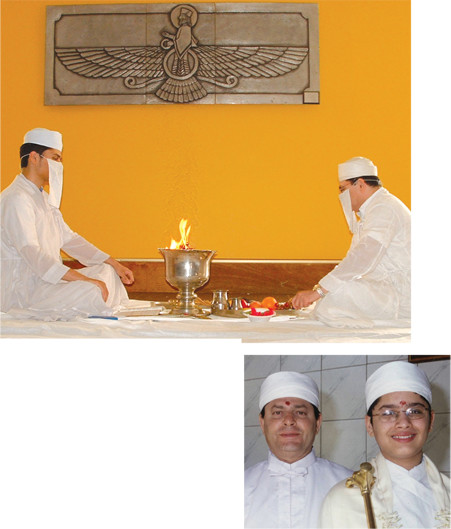
Above (from l): Ervads Jimmy and Rayomand Ravji; (top) the Ravjis performing a prayer ceremony
Every year during the muktad days I enjoyed listening to the priests reciting the Avesta rituals. But this did not help me overcome my problem because what they recited and what I followed from the regular Avesta prayer book was neither cohesive nor coherent. This problem was eased somewhat when I came across a book by Ervads (Dr) Jehan Bagli and Adi Unwalla entitled Understanding and Practice of Jashan Ceremony, written in English. When I met Ervad Jimmy (Jamshed) Ravji after I moved to the USA, I mentioned to him that though I was able to follow his recitation of the rituals, I could not coordinate it with Bagli’s text. He understood my difficulty and showed me the appropriate sequence with page numbers to follow during the different rituals.
I consider Ravji an enlightened priest for a couple of reasons. A few years ago he regularly visited nursing homes and provided ministering services for the elderly, come rain or snow. One Zoroastrian gentleman who had left India in 1935 or so and never returned even for a visit, was under Ravji’s care. At first he paid no heed to the priest’s ministering, but after some time he was so moved by Ravji’s chanting and honesty that he gave him a signed blank check to withdraw as much money he wished to. The man was worth more than a million dollars, but Ravji did not touch a cent. He still has the blank check — which he keeps as a souvenir! A few months before the man died he requested Ravji to obtain his mother’s photo from his brother in Bangalore, and sure enough, the priest managed to do so. It is to Ravji’s credit that the man’s nephew donated a sum of $ 10,000 to the Zoroastrian Association of Chicago (ZAC) after his uncle died in 2001.
Ravji also visited a lady who had arrived in the USA in the ’60s. Being an orthodox and religious lady, she assigned $ 29,700 to be invested for her after-death rituals account at ZAC. She was so greatly comforted by Ravji’s ministering that she instructed her executor that Ravji be assigned the duty of performing the rituals for her, which is being done now.
Having observed Ravji’s honesty and enlightenment at close quarters, I began to admire his devotion to the Zoroastrian religion. His prayers come from the heart when he recites them. He has imparted the same religious perspective and zest to his son Rayomand, an undergraduate at the University of Illinois who is following in his father’s footsteps. Since Rayomand is an ordained ervad he takes part in many rituals. Recently, when no other priest was available (and ZAC has about 15 of them), Rayomand stood at his father’s side assisting him in performing the paidust (geh sarna) for a lady who had died.
Both eastern and western scholars have provided their interpretation of the Avesta and the Gathas in later languages for lay individuals like us to understand what we pray. However, I and many others like me enjoy the Gathas by vocalizing them in a form of an opera as was done in the olden days when parents taught the hymns to their children as their oral heritage. Many individuals have emphasized that chanting the Gathas in this way uplifts their spirits to the point of ecstasy and enlightens them — and I agree. This is spiritual enlightenment.
◆ ◆ ◆
From the archive