
Scholarship
Zarathushtra’s western image
The western concept of Zarathushtra is at odds with the Zoroastrian tradition, argues Prof (Dr) Prod Oktor Skjaervo
Prof (Dr) Prod Oktor Skjaervo, Aga Khan professor of Iranian at Harvard University has trained his philological laser on the concepts of the Gathas as eulogized by western scholars. He argues that the Avestan grammar does not permit some of the interpretations they offer. He prefers to interpret the Gathas through the Pahlavi texts of Sasanian and post Sasanain Iran on which are based the ritualistic practices of the Zoroastrians of India and Iran.
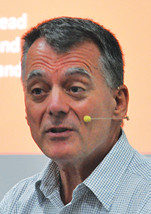
Lecturing on "The Western appropriation of Zarathushtra” at Bombay’s K. R. Cama Oriental Institute, on August 5, 2011 he noted the confusion of students of Zoroastrianism as different handbooks described it in different ways with non-specialists choosing "what appealed to them aesthetically and politically.” According to him, "Zarathushtra has been made into a creature consonant with the Western scholars’ own ideas and prejudices.”
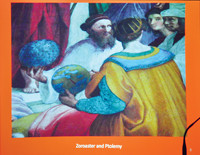
Taking a quick historical look at Zarathushtra’s (or Zoroaster, as more familiarly known in the West) presence in Western literature and art, the professor places the earliest references to about 500 BC, adding that the Prophet was "not mentioned in the oldest Greek histories.” Picking up the thread from circa 100 AC, he says that the Prophet has been depicted in the West as a Bactrian king. In the medieval era the Western mind associated him with Chaldean astronomers and magicians and simultaneously considered him a philosopher and lawgiver who lived in the time of Abraham. Around 1500 AC the renowned Renaissance artist Raphael has painted Zarathushtra and geographer Ptolemy together on a fresco in the Vatican.
The connection to Christianity came to the fore in the 16th and 17th centuries. It was believed that "the magi came to Bethlehem because Zarathushtra knew of the trinity of angels, heaven and hell,” said Skjaervo. "The discovery of Iranian Zoroastrians, then locally known as the Gabr, by European travelers in Persia,” led to drawings depicting Zoroastrian priests in Thomas Hyde’s History of the Persian Religion, published in Oxford in 1700. "According to (Hyde) Zarathushtra was a reformer, teacher and philosopher, not unfamiliar with the Old Testament of the Bible,” said the scholar, adding, "This description did not change for 300 years in the West.”
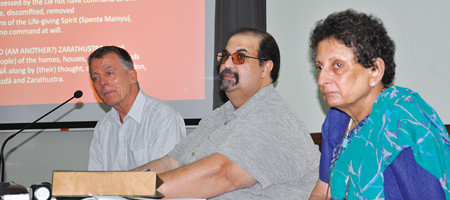
Prof (Dr) Prod Skjaervo Muncherji Cama and Nawaz Mody
After French scholar Anquetil Duperron spent time in Surat (1755-61), translating Avestan and Pahlavi texts, mainly consisting of the Vendidad and Yasna, and deposited 180 manuscripts in the Bibliotheque Nationale de Paris, "British scholars were upset at the French upstaging them, while Voltaire and the other Encyclopaedists were very disappointed and dismissed the effort as hodgepodge.” The thought in the European scholarly community was that "either Zarathushtra didn’t write these books or he was not so wise.” The concept of dualism which became apparent was ranked by the Catholic Church as "heresy.” Generally dismissed as superstition, there were "doubts about it being written by Zarathushtra as perceived in the West,” said Skjaervo.
In 1819 Danish language scholar Rasmus Rask traveled to India and returned with several manuscripts, noted the scholar. There were doubts that the Parsi dasturs really understood the Avestan texts. It was believed that traditional Parsi understanding of the religion was based on poorly understood Pahlavi texts. Reverend John Wilson had refuted the Zoroastrian religion on the basis of the Vendidad.
a view of the audience
When the Sanskrit translation of the Avesta by Neriosang Dhaval came to the notice of Western scholars, they analysed the grammar and compared it to other languages. E. W. West traveled to India via Iran and published a complete edition of Avestan texts. In 1833 Eugene Burnouf showed that Duperron’s translations were unreliable. Thereafter Niels Ludwig Westergaard published his version of the complete texts. In 1862 Martin Haug defended and rehabilitated Zoroastrianism, concluding that the Gathas, as the oldest text, must be attributed to Zarathushtra, Skjaervo traced the scholarly understanding of Zoroastrianism in the West.
Himself a Lutheran Christian, Haug distinguished between the monotheism of the Gathas and the dualism of the later texts. Emphasizing that Zarathushtra was as important as Moses, Haug "disassociated him from the ritualism of the later texts, leading to a highly Christianized image of Zarathushtra,” noted Skjaervo, adding, "Haug believed that Zarathushtra reformed the old religion into a monotheism and that later it degenerated again… ‘Gathas only’ is a notion prescribed by Western scholars.” This line of thinking continued with Haug’s successors, James Moulton and Robert Zaehner.
Ones to disagree with the main premise of Haug and others were James Darmesteter whose translation of the Pahlavi texts is part of the Sacred Books of the East and Walter B. Henning.
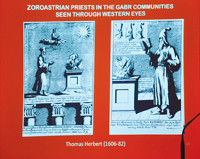
Illustrations from Hyde’s book
"In the Gathas, Zarathushtra speaks of himself as a man commanded by God to perform a great task… (But) there is no historical record of the Prophet... We don’t know when Zarathushtra lived or where he lived. We do know that he lived. Now scholars have turned to Pahlavi literature, using the ‘sifting method’ to produce a historical Zarathushtra… When there are words we don’t have anywhere else, there is nothing to compare. Pahlavi translators had more or less the same problem we have… Scholars from Christian Bartholomae to Mary Boyce have admitted that the tradition contains much that was difficult to explain in historical terms,” says Skjaervo.
According to the philologist the Gathas’ language is similar to the Rigveda, composed in the late second millennium BC, a period unknown in scholarly records. "Since the 1960s there has been considerable disagreement about the meaning of the Gathas.” Briefly tracing the lineup of scholars in recent times, Skjaervo says Haug’s monotheism was refuted by Henning who mounted the dualist protest. Helmut Humbach has read the imminent beginning of the end of the world into the scriptures. Boyce saw traditional beliefs at the noble and subtle level. Stanley Insler has rejected mindless rituals while Gherardo Gnoli says the dualist faith is based on a philosophical elaboration of the problem of evil, with anti-ritual emphasis. "All of them have argued that the later texts reflected little of Zarathushtra’s reform, that his teachings have been distorted. Marijan Mole argued in the late 1950s that the geography of the Gathas is reflected in the Pahlavi texts and that Zarathushtra was the model for every righteous Zoroastrian — a ritual model accepted by all Zoroastrian priests. "His theory was dismissed by the scholarly community. He also died young.”
Surprisingly, Skjaervo made no direct reference to German philosopher Friedrich Nietzsche and his theory of the superman (Thus Spake Zarathustra) so happily embraced by Hitler and his ilk, except for a passing reference to Aryanism in response to a question from the audience.
Prof Skjaervo with Ervad Parvez Bajan and Dr Yuhan Vevaina
Providing his own view of the Prophet, Skjaervo says, "There is nothing to show that Zarathushtra existed according to modern standards of historiography.” There is nothing to prove that he lived before the Achemenians, but then even the events of Moses’ life are not reflected in the historical texts of the Israelites or of Egypt, he noted, emphasizing the legendary nature of both. "Tradition is mainly oral. It is bound to change in the retelling of stories.”
Zarathushtra’s "work was to fight evil and support good. As the first priest of Ahura Mazda, he (supplied) the blueprint for how human society should behave. He calls himself a soldier fighting the evil spirit (Y 9.14) and his weapons are the Ahunavar and Ashem Vohu… Western scholars have constructed Zarathushtra according to their own individual ideas of what he said. It is time for the real Zarathushtra to step forward, but will it be the glorified Zarathushtra of the West or of the Zoroastrian tradition?”
◆ ◆ ◆
From the archive