
Scholarship
A state in transition
Dr Touraj Daryaee speaks about historic trends pertaining to Iran and the Zoroastrians
"Zoroastrians are doing far better than any other religious groups” in Iran, says Dr Touraj Daryaee, Howard C. Baskerville Professor of History of Iran and the Persianate World and associate director Dr Samuel M. Jordan Center of Persian Studies and Culture at the University of California at Irvine. Daryaee was in Bombay to deliver the Government Research Fellowship Lectures 2010-2011 of the K. R. Cama Oriental Institute held at the Alexandra Girls’ English Institution’s C. M. C. Hall on August 25-27, 2010. His topic for the three lectures concerned the Sasanian dynasty. He spoke to Parsiana on August 28.
An Iranian by birth and early education, the 43-year-old academician visits Iran often and notes the Zoroastrians there are viewed as "true Iranians” and enjoy "a special prestige and status.” Most Iranians consider Zoroastrianism as "original and true.” This does not mean they do not face religious discrimination but the Baha’is, Jews and Armenians suffer more. He notes many Armenians have migrated as have members of other religious minorities but adds, "More Muslims have left than any other religious groups.” He estimates the number to be around three to five million with most migrating to Europe and the USA.
Many Zoroastrians are leaving the outlying villages and moving to Yazd, Kerman, Shiraz and of course Tehran. "But this is a general trend in Iran,” he notes and not peculiar to Zoroastrians.
"Many people in Iran are secularized though not necessarily westernized,” he observes. Daryaee sees the "people in charge” trying to balance modernization "under an Islamic vision of things” with tradition. The scholar is "very hopeful” that despite an "unsettling transition,” in 20 to 30 years democracy will take root. He envisions Iran as "a pluralistic society” in which "men and women would be equal regardless of religion.”
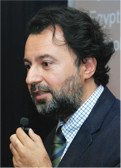
Dr Touraj Daryaee: "the humanities are lagging behind”
Were the Achemenian kings Cyrus, Darius and others Zoroastrians? we asked. "It depends on your definition of Zoroastrianism,” the professor replied. "Zoroastrianism meant different things at different times… The religion has changed over the past 3,000 or so years.” But "all the evidence shows a strong affinity with Zoroastrianism.” One finds the term Mazda during the Achemenian period but no mention of Zoroaster. But not all religions refer to the prophets. God is sufficient. For example followers of Islam are called Muslims ("one who surrenders”) though some refer to them incorrectly as Mohammedans.
While the Islamic religious tracts refer to both the name of Allah and Muhammad, "it does not necessarily mean everybody else does it,” notes Daryaee. "The Iranian people believe they (the Achemenians) are Zoroastrian. Groups of scholars also think so.”
The coins of the Achemenian period portray the kings with bows and spears while the coins of the Sasanian period often show fire altars and carry the word Mazda. During the Sasasian period "the kingdom and the religion went hand in hand. They are the two pillars” of the state.
As regards proselytization during the Sasanian period, Daryaee says, "I have seen no evidence of it.” But he adds "the sticky issue is Armenia.” Here it is believed Zoroastrians converted to Christianity and were then forced to reconvert to Zoroastrianism. "In medieval times it was a curse to leave Zoroastrianism,” he notes.
Even though Daryaee states that "Mazdayasni and Zoroastrianism go hand in hand, there is no evidence” to show that Mazdayasnism existed before Zoroaster as our high priests and others keep repeating ad nauseam. "It’s very difficult to make such a claim.”
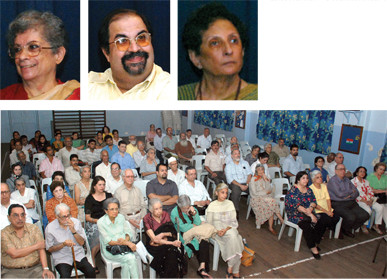
Above (from left): Prof (Dr) Shereen Rutnagar, Muncherji Cama and Dr Nawaz Mody Bottom: A section of the audience
He believes "conversion is a more modern issue... Iranians are amenable to Zoroastrianism,” he observes. "In Europe, the USA, Latin America we are seeing people convert” to the ancient Iranian religion. In Iran converting from Islam to another religion is "a no-no.” But many Iranians are giving their children pre-Islamic names, he notes.
Daryaee places the birth of the prophet between 1300 to 600 BC. Did Zoroaster exist or was he the creation of somebody’s imagination? "You can’t prove or disprove,” the theories, says the professor, "just like the date.” But he personally believes Zoroaster existed and was probably born in Bactria, once part of greater Iran and now belonging to the Balkh region of northern Afghanistan.
The Sasasian dynasty fell to the invading Arabs because of the internal rivalries among the rulers and infighting in the military. A long, depleting war with the Byzantines also weakened the Iranian resolve to resist.
Visiting the city after 38 years Daryaee says he "is happy to be in Bombay. The Parsis have become very dear to me.” He bemoans the fact that Irvine is the only center for Persian studies in the US. The nomenclature Iranian and Persian are used intermittently, the latter name coined by the Greeks in deference to the powerful district of Fars. Also in today’s context where Iran often has a negative connotation, Persia is a more acceptable appellation. Persian/Iranian studies at universities in the West are largely funded by private donations. "Money has to come from the community” if more universities are to take up these studies, says the professor. "Jewish studies are thriving because of the Jewish community” lending financial support.
In Iran technical subjects receive substantial attention but "the humanities are lagging behind.” Perhaps once secular, democratic ideals take deeper root, the imbalance will be set right.
◆ ◆ ◆
From the archive