
A Zoroastrian kaleidoscope
Three specialists give their perspectives on different aspects of the religion at the 10WZC
He commenced with defining Zoroastrians as people with a social and religious identity. The academic also included para-Zoroastrians who are not born in the ethnic community but identify with it. He desired to talk on the religion that individuals may make "informed decisions as there is a lot of misinformation on what we can and cannot do.” He referred to the "doom-and-gloom demographics” quoted at the 10WZC. Scholarly discourses seemed to be wanting in the declared sessions, he felt. And this can only worsen with a dearth of scholarship. He also stayed clear from political leanings as he rhetorically asked "How do you side in religious politics?” jocularly stating, "I stay away from dentists who don’t go to dentistry school.”
The specialist went straight to the challenges that research in Zoroastrian studies faces today, specifically in India. One of them was lack of access to the latest, up-to-date western scholarship. He lauded Dr Ramiyar Karanjia, the last candidate from India to earn a PhD in Avesta and Pahlavi.
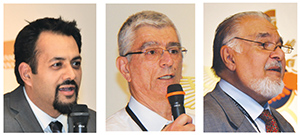
In fact, there is a huge drop in students internationally in pursuit of this subject as the existing ones cannot get jobs on completion of their studies he declared. "Hyper specialization is worse every year.” Collaboration is lagging as each sees the other as competition. When academic positions fall vacant, they are neither filled nor replaced. Worse still, the discipline is merged with historic, literary or modernistic pursuits. Budget cuts are global. After quoting losses of chairs in Europe, he stated that he and Jamsheed Choksy, professor of Iranian studies and former director of the Middle Eastern Studies Program at Indiana University were the only two Zoroastrians who still teach a 3,500-year-old tradition. Iran was isolated from the outside and so "Stale debates continue, from no matter which side.” At international seminars, if an academic drops out, there is little likelihood of a replacement. So how can all this result in any scholarly magazine or journal being published on the subject?
More and more students pursue information technology, biotechnology and other more "lucrative” subjects. Even funds from alumni in Iranian studies are drying up and a desire to pursue Zoroastrian research is declining, especially over the past 10 years. The academic’s other concern was that as scholars become entrenched in reading and writing this may lead to further loss of age tested methods of dialog, argumentation and discourse. He also lamented the vast bodies of writing merely to extend one’s academic tenure which almost becomes a must merely to get that tenure. However, the average knowledge consumer does not want to read long diatribes, he felt.
One of the first questions Vevaina had to face was authenticity on the web. Is Wikipedia a good source? His take was "something is good and something is horrendous. It’s personal. Wikipedia is used extensively by students as scholars are ‘snobby’ and do not put out their findings on the web. Lot of 19th century stuff is around and so better (up-to-date) information should get in.”
He tried a hard sell on establishing a lifetime chair for Zoroastrian study and pegged the amount to USD five million (Rs 31,50,00,000) at an Ivy League college. He noted that a few wealthy Iranians were endowing chairs in the US and Europe for Iranian studies. He urged India and Iran to follow suit. "The chair must be endowed for a specific subject — either Parsi or Zoroastrian studies,” or on any aspect related to Iran.
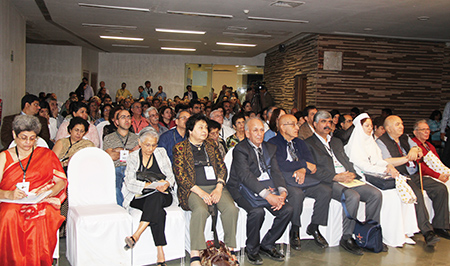
A small but captivated audience
Zoroastrian scholarship
"Everything that is created was first a thought… So let your thoughts be good… Let your good thoughts be known through good words,” quoted Fariborz Rahnamoon from Yasna Ha 28.11. A Zoroastrian Gathic scholar from Vancouver, Rahnamoon also publishes a magazine Iran Zamin and is the webmaster of www.ancientiran.com, apart from being the chairman of the Arbab Guiv Trust and is on the Mehraban Zartoshty Education Fund in Vancouver, Canada. He addressed the 10WZC on December 28, 2013. His co-speaker was unable to attend and he used the full hour of that session — a boon as his address was almost aborted under the claim that he was a convert and a non-Zoroastrian (see "At a low ebb” Parsiana, December 21, 2013.) He spoke on "Gathas, the Beacon in the 21st Century.”
The scholar explained that "the Gathas were not only for the dead but their wisdom is for all.” He proceeded to illustrate the science behind the 241 preserved Gatha verses. The Gathas say "that giving good guidance and awakening the person to realize the truth will help that person progress and achieve righteousness. This will also benefit those who are close to such a person.
"The Gathas urge its followers to be wise, to become learned, to explore, to discover, to invent, to progress and not be bogged in traditions. The goal in the Gathas is to harmonize the human spirit with the universe:
"This I seek with reverence / With uplifted hands / The perfect-ness of the mind, Wisdom (Mazda) / The first good rule to Asha (The law of nature, the law of the Universe. The Truth) is /All should aspire to make /Good use of the wisdom in the mind / To create harmony between the universe / And the inner-self.”
Zarathushtra – Gathas – Yasna 28.1
"The Gathas reveal the Truth, analyze it, and show the way to progress towards a better life, the best life, Be-hest a heavenly life. Persuasion and not persecution is the mode of passing on the message and showing the path of progress,” Rahnamoon reiterated.
He went on to say that the Gathas make it clear that God is not to be blamed for floods, hurricanes, earthquakes and the like. Natural calamities are not the work of Spenta Mainyu but of Angra Mainyu.
"The history of the Persians that has come down to us over the last two millenniums is that which is written by our adversaries.”
In summation he cautioned those who believe that there is no conversion "that they are wrong, and that Zarathushtra wants everyone to reap the benefit and does not limit the fruits of wisdom for a chosen or limited group… True Zoroastrianism is not about rituals (as mentioned in Ha 28.5) but it is about perfection, Asha. He imparted that we "convert by giving knowledge, not by the sword…”
He further cited Yasna 30.02: "Listen with your ears to the best / Consider with open mind / Among the paths before deciding / Person by person for his own self / Before greatness of this message / Is truly spread understand each one.”
He reminded all that the Gathas do not want knowledgeable people to give up in their effort to guide those that are misled, for it says good knowledge will achieve righteousness.
Linking through Zoroastrian shrines
Parviz Varjavand also in the small room to keep other scholars company, touched upon "A Window into Zoroastrian Religious Shrines of Yazd and Kerman,” on the same day. An architect from the University of Berkeley, USA he has written "Persian Paradigm — Zoroastrianism, Sacred Lands and Sites.” He touches base regularly with his roots in Iran as he believes that money is not what makes him rich but his moorings.
Varjavand referred to geographical identity (based on one’s place of birth) and other identities like familial, social, national, ethnic or religious. A Yazdi from Yazd may further be qualified by from where in Yazd s/he comes. There are several Yazdis who have actually never been to Yazd but have a connect nevertheless. It gives a grounding, a sense of belonging. "Children today are spread all over, they need to know where they come from, who they are, what their ancestry is…” Of course contrarily, if one "holds on to identity too strongly, rigor mortis sets in,” the architect acknowledged.
Ancient Iranian kings Faredoon and Threton simplistically divided the world into Iraj or Iran (land of the Aryans) which was white and central; Sam or black and dark (Africa) and Tuth or Toor, yellow with slanted eyes (Far East). For religions, however, there is need to be linked to heritage — a place you can visit and go to, so one wends one’s way to holy places like Jerusalem, Mecca or Benares. It is for this that the shrines of Yazd and Kerman are so critical to the Zoroastrian faith, he asserted.
Showing images of shrines in Yazd and Kerman to the audience, the architect stressed on how imagery can lead to historic dating and determine geographic spread. So wherever barsom (a plant indigenous to Iran and widely used in Zoroastrian liturgical practices and rituals) was located in imagery, it showed a clear Persian influence. Projecting a Takht-e-Bostan bas relief, he claimed Zoroaster is shown with the barsom on a lotus representing earth, water, air, following the sun (fire) — all elements fundamental to the faith. Zoroaster standing on a lotus indicates the soul. Following other slides, he then showed Mt Damavand as it is said to be the birth place of Zoroaster. It is our "heritage” our answer to who we are and where we come from. Concluding that "Mt Damavand is the mountain for us,”
Projecting a picture of the Magi in red cap and leggings, he identified the Persian influence through the red cap and the fashion of the leggings. He decoded that the leggings symbolize freedom, as clothing which enables you to ride, slotted you into the wealthy echelons, and wealthy folk were free persons. He ended with "Each man must know how to pay tribute to religion.” He recommended individuation — a personal, individual interpretation of religion.